


The central bank yesterday kept its policy rates unchanged, saying the economy has recovered mild growth since last quarter and the pace is expected to accelerate next quarter and beyond.
The move followed four interest rate cuts of 12.5 basis points in the past 12 months, when the nation’s export-focused economy took a hit from a slowdown with major trading partners, including China.
“The nation’s interest rates are low enough and loose monetary policy is increasingly reaching its limit,” central bank Governor Perng Fai-nan (彭淮南) told a news conference after the bank’s quarterly board meeting.
This means the rediscount rate will hold steady at 1.375 percent, the collateralized loan rate at 1.75 percent and the unsecured loan rate at 3.625 percent.
The economy is forecast to grow 1.99 percent this quarter and 2.38 percent next quarter, after managing a 0.7 percent pick up in the second quarter following three quarters of contraction, the Directorate-General of Budget, Accounting and Statistics said.
“Having left interest rates on hold today, we think [the central bank] might now leave rates on hold in the short-term,” Gareth Leather, senior Asia economist at Capital Economics in London wrote in a note.
“But given the poor growth outlook for 2017, there is still a good chance the [central bank] will resume its rate cutting cycle next year,” Leather added.
One of the longest-serving central bank governors in the region, Perng said that this term would be his last.
He is scheduled to hand over the reins in February 2018, after 20 years at the helm.
Recent data suggested a gradual recovery in Taiwan’s economy, with export orders last month increasing 8.3 percent from a year earlier for the first expansion in 17 months and industrial production expanding 7.74 percent annually in the month.
Perng said the landscape looks brighter next year compared with this year, rendering further rate cuts unnecessary.
However, he said the pace of growth is likely to remain slow amid a continued retreat in global trade and sharpening of competition.
Still, there are many policy tools for the government to spur growth if it can guide the nation’s excessive savings to public construction works, Perng said.
For example, Taiwan Taoyuan International Airport needs to be upgraded and expanded to better serve travelers, Perng said, adding that the airport tends to face problems following heavy rains and typhoons.
The government can also encourage urban renewal projects through regulatory easing to improve safety, adding that 45 percent of existing homes are 30 years and older, the governor said.
“Urban renewal projects spell huge business opportunities that can enhance private investment and living standards of residents in older buildings,” Perng said.
However, the central bank keeps credit controls on luxury homes nationwide, with the loan-to-value ratio capped at 60 percent, as their prices remain volatile, Perng said.
“The ceiling is quite loose,” he said.
Above all, the government must help solve labor disputes as frequent protests and policy instability will jeopardize efforts to boost private investment, Perng said.
Major trade groups have refused to join government-sponsored negotiations with labor unions over working hours, basic wages and other issues after the government voiced sympathy for the labor camp.
Additional reporting by Bloomberg
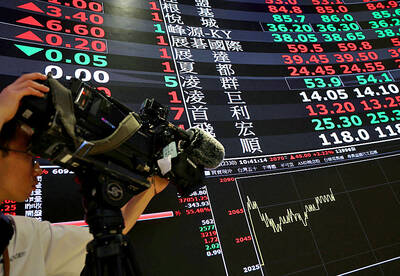
After several years flying high as Asia’s best Nvidia Corp proxy, Taiwan Semiconductor Manufacturing Co (TSMC, 台積電) is increasingly vying with other artificial intelligence (AI) stocks for investor attention. Stock traders are chasing a wider array of beneficiaries as mainstream usage of AI creates demand for hardware beyond the most-advanced chips TSMC makes for Nvidia. Subthemes from the deepening memory crunch to advances in robotics are also luring bids. At the same time, investment caps on single stocks are pushing funds to diversify, while retail investors long familiar with TSMC through its US depositary receipts are being offered a broader set of
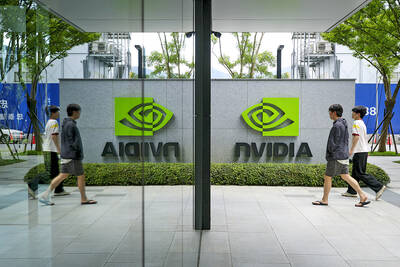
UNDER MICROSCOPE: Taiwan detained three people who allegedly conspired to buy servers in Taiwan and export them using fraudulent documentation, prosecutors said Nvidia Corp chief executive officer Jensen Huang (黃仁勳) on Saturday urged Super Micro Computer Inc to tighten up on compliance after Taiwan detained three people this week for allegedly making fraudulent declarations about artificial intelligence (AI) servers made by its US partner. The development marked the nation’s first crackdown on semiconductor smuggling, which grew after the US slapped restrictions on exports of high-end chips such as Nvidia AI accelerators to China. Nvidia is “rigorous” in explaining regulations to all of its partners, Huang told reporters after arriving in Taipei. “Ultimately Super Micro has to run their own company,” he said in response to
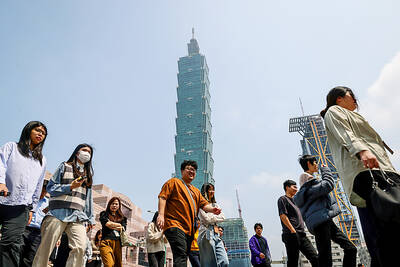
TECH RELIANCE: Growth is increasingly reflecting an unequal K-shaped distribution, where technology sectors outperform and other industries struggle, an expert said Standard Chartered Bank has significantly raised its forecast for Taiwan’s economic growth to 9.5 percent this year, up from 7.6 percent previously, citing surging artificial intelligence (AI) demand driving exports, semiconductor production and investment. The upgrade reflects a sustained AI supercycle that continues to fuel demand for advanced chips and technology infrastructure, which form the backbone of Taiwan’s exports, the bank said in a report this week. “We raise our 2026 growth forecast to reflect a much stronger-than-expected first-quarter GDP figure,” Standard Chartered senior economist for greater China and Asia Tommy Wu (胡東安) said in the report. Driven largely by a 35.3 percent
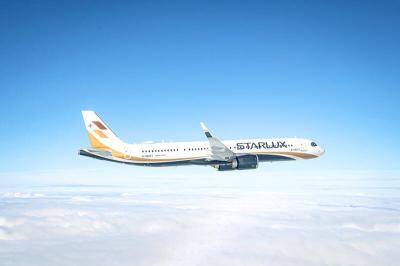
Two of Taiwan’s international carriers, Starlux Airlines Co (星宇航空) and EVA Airways Corp (長榮航空), have retained the five-star airline rating awarded by international airline review organization Skytrax. Starlux was awarded the distinction for a second consecutive year, while EVA Air received it for the 11th straight year, Skytrax said in statements released yesterday and on Thursday last week, respectively. The five-star rating is considered one of the airline industry's highest honors and is awarded following professional audits of airline product and frontline service standards, Skytrax said. The ratings are based on in-depth assessments using unified global quality standards rather than customer review scores


 RSS
RSS