


The unemployment rate stood at 4.08 percent last month, up 0.06 percentage points from the previous month and up 0.18 percentage points from the year-earlier level, the Directorate-General of Budget, Accounting and Statistics (DGBAS) said yesterday.
After seasonal adjustments, the unemployment rate was 3.95 percent, it said.
The number of unemployed reached 480,000 last month, up 8,000 from a month earlier and an increase of 24,000 from a year earlier, it said.
The spike in the unemployment rate was the result of an increase in first-time jobseekers due to the graduation season and a rise in part-time jobseekers, Census Department Deputy Director Pan Ning-hsin (潘寧馨) said.
The DGBAS numbers showed that the first-time jobseekers rose by 5,000 from July, and the number of those who lost their jobs due to business downsizing or closures rose by 1,000.
The number of those who were unhappy with their jobs and quit rose by 1,000, as did the number of people who lost their jobs because their temporary contracts expired.
National Development Council Minister Chen Tain-jy (陳添枝) said the rising jobless rate was not unusual during graduation season.
As the unemployment rate is a lagging economic indicator, it takes time for the job market to show signs of improvement, he added.
The latest data showed that the jobless rate last month among the 20 to 24 age group hit 13.43 percent, up 0.38 percentage points from July, but fell 0.21 percentage points from a year earlier, while the unemployment rate among the 25-29 age bracket reached 6.98 percent, up 0.13 percentage points month-on-month and also up 0.27 percentage points year-on-year, the DGBAS said.
The jobless rate among those with a university degree or higher stood at 5.11 percent, up 0.11 percentage points from a month earlier and also up 0.04 percentage points from a year earlier, the agency said.
In the first eight months of this year, the jobless rate averaged at 3.93 percent, up 0.2 percentage points from a year earlier.
The average nominal regular monthly wage in the first seven months of the year rose 1.36 percent from a year earlier to NT$39,118, the highest level compared with the same periods in the past, the DGBAS said.
However, the average monthly nominal wage, which comprise regular salaries and non-regular salaries such as bonuses and overtime pay, fell 0.06 percent year-on-year to NT$51,429 in the first seven months, the DGBAS said, citing smaller bonus payouts by employers at a time when the economy was slowing down.
After inflationary adjustments, the average monthly real wage fell 1.53 percent to NT$49,200 over the period, while the average monthly real regular wage during the same period also fell 0.13 percent year-on-year to NT$37,423.

Taiwan Semiconductor Manufacturing Co (TSMC, 台積電) last week recorded an increase in the number of shareholders to the highest in almost eight months, despite its share price falling 3.38 percent from the previous week, Taiwan Stock Exchange data released on Saturday showed. As of Friday, TSMC had 1.88 million shareholders, the most since the week of April 25 and an increase of 31,870 from the previous week, the data showed. The number of shareholders jumped despite a drop of NT$50 (US$1.59), or 3.38 percent, in TSMC’s share price from a week earlier to NT$1,430, as investors took profits from their earlier gains

In a high-security Shenzhen laboratory, Chinese scientists have built what Washington has spent years trying to prevent: a prototype of a machine capable of producing the cutting-edge semiconductor chips that power artificial intelligence (AI), smartphones and weapons central to Western military dominance, Reuters has learned. Completed early this year and undergoing testing, the prototype fills nearly an entire factory floor. It was built by a team of former engineers from Dutch semiconductor giant ASML who reverse-engineered the company’s extreme ultraviolet lithography (EUV) machines, according to two people with knowledge of the project. EUV machines sit at the heart of a technological Cold

TAIWAN VALUE CHAIN: Foxtron is to fully own Luxgen following the transaction and it plans to launch a new electric model, the Foxtron Bria, in Taiwan next year Yulon Motor Co (裕隆汽車) yesterday said that its board of directors approved the disposal of its electric vehicle (EV) unit, Luxgen Motor Co (納智捷汽車), to Foxtron Vehicle Technologies Co (鴻華先進) for NT$787.6 million (US$24.98 million). Foxtron, a half-half joint venture between Yulon affiliate Hua-Chuang Automobile Information Technical Center Co (華創車電) and Hon Hai Precision Industry Co (鴻海精密), expects to wrap up the deal in the first quarter of next year. Foxtron would fully own Luxgen following the transaction, including five car distributing companies, outlets and all employees. The deal is subject to the approval of the Fair Trade Commission, Foxtron said. “Foxtron will be
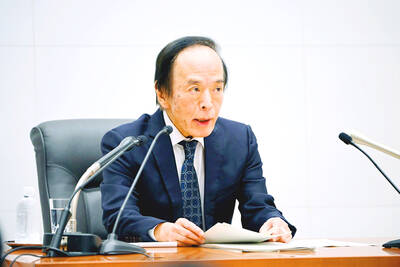
INFLATION CONSIDERATION: The BOJ governor said that it would ‘keep making appropriate decisions’ and would adjust depending on the economy and prices The Bank of Japan (BOJ) yesterday raised its benchmark interest rate to the highest in 30 years and said more increases are in the pipeline if conditions allow, in a sign of growing conviction that it can attain the stable inflation target it has pursued for more than a decade. Bank of Japan Governor Kazuo Ueda’s policy board increased the rate by 0.2 percentage points to 0.75 percent, in a unanimous decision, the bank said in a statement. The central bank cited the rising likelihood of its economic outlook being realized. The rate change was expected by all 50 economists surveyed by Bloomberg. The


 RSS
RSS