


CSBC Corp, Taiwan (台灣國際造船) said delivery of a US$150 million cargo ship would be delayed by about three months due to damage caused by Typhoon Meranti.
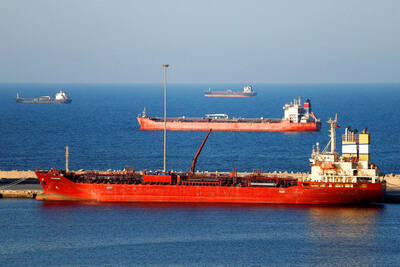
The nation’s only publicly traded shipbuilder said that the 14,000 twenty-foot-equivalent unit (TEU) cargo ship commissioned by Canada’s Seaspan Corp would be delivered in December instead of this month, as the vessel sustained damage when the typhoon tore through the company’s shipyard in Kaohsiung on Wednesday last week, it said in a filing with the Taiwan Stock Exchange on Friday.
All 38 10cm-thick cables that secured the ship to its moorings snapped under the strain of gusts, sending the ship adrift, the company said.
The ship could not be reined in, despite three hours of efforts by six tugboats, and crashed into four overhead cranes at a dock operated by Yang Ming Marine Transport Corp (陽明海運), with its bridge getting stuck under one of the cranes, the company added.
No one was injured in the incident, it said.
CSBC said that its own cranes and equipment also sustained collision damage during the typhoon.
“We are in negotiations with our builder’s risk insurer, and expect to complete repairs and resume operations shortly,” the company said.
CSBC added that it does not expect to pay a high deductible.
In 2013, Seaspan commissioned CSBC to build five 14,000 TEU cargo ships, of which three have been delivered. The vessel damaged by last week’s typhoon was the fourth.
CSBC reported that aggregate sales in the first eight months declined 18.04 percent annually to NT$11.9 billion (US$375.5 million) amid a global downturn in global trade and the container shipping sector.
In related news, CSBC and other shipbuilders and suppliers showcased their capabilities at the Kaohsiung International Maritime and Defense Industry Expo — which took place from Friday last week to yesterday — in response to the government’s plan to build an indigenous submarine fleet.
CSBC unveiled a model of its submarine design, while several other suppliers exhibited control systems, high-tensile steel for hull construction and low-noise mechanical propulsion systems.
The exhibition drew more than 50,000 visitors, organizers said.
HORMUZ ISSUE: The US president said he expected crude prices to drop at the end of the war, which he called a ‘minor excursion’ that could continue ‘for a little while’ The United Arab Emirates (UAE) and Kuwait started reducing oil production, as the near-closure of the crucial Strait of Hormuz ripples through energy markets and affects global supply. Abu Dhabi National Oil Co (ADNOC) is “managing offshore production levels to address storage requirements,” the company said in a statement, without giving details. Kuwait Petroleum Corp said it was lowering production at its oil fields and refineries after “Iranian threats against safe passage of ships through the Strait of Hormuz.” The war in the Middle East has all but closed Hormuz, the narrow waterway linking the Persian Gulf to the open seas,

Apple Inc increased iPhone production in India by about 53 percent last year and now makes a quarter of its marquee devices there, reflecting the US company’s efforts to avoid tariffs on China. The company assembled about 55 million iPhones in India last year, up from 36 million a year earlier, people familiar with the matter said, asking not to be named because the numbers aren’t public. Apple makes about 220 million to 230 million iPhones a year globally, with India’s share of the total increasing rapidly. Apple has accelerated its expansion in the world’s most populous country in recent years, bolstered

HEADWINDS: The company said it expects its computer business, as well as consumer electronics and communications segments to see revenue declines due to seasonality Pegatron Corp (和碩) yesterday said it aims to grow its artificial intelligence (AI) server revenue more than 10-fold this year from last year, driven by orders from neocloud solutions clients and large cloud service providers. The electronics manufacturing service provider said AI server revenue growth would be driven primarily by the Nvidia Corp GB300 server platform. Server shipments are expected to increase each quarter this year, with the second half likely to outperform the first half, it said. The AI server market is expected to broaden this year as more inference applications emerge, which would drive demand for system-on-chip, application-specific integrated circuits
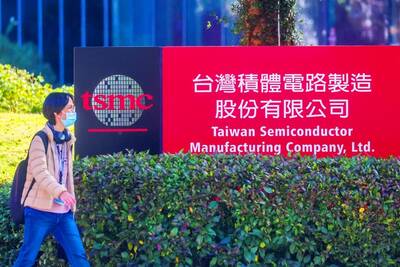
PROJECTION: TSMC said it expects strong growth this year, with revenue in US dollars projected to grow by about 30 percent, outperforming the industry Taiwan Semiconductor Manufacturing Co (TSMC, 台積電) yesterday reported consolidated sales last month reached NT$317.66 billion (US$9.98 billion), the highest ever for the month of February, driven by robust demand for chips built using the company’s advanced 3-nanometer (3nm) process. Last month’s figure was up 22.2 percent from a year earlier, but fell 20.8 percent from January, the world’s largest contract chipmaker said in a statement. For the first two months of the year, TSMC posted cumulative sales of NT$718.91 billion, up 29.9 percent from a year earlier. Analysts attributed the growth to sustained global demand for artificial intelligence (AI) products


 RSS
RSS