


Siliconware Precision Industries Co (SPIL, 矽品精密) chairman Bough Lin (林文伯) does not plan to retire from the semiconductor industry, despite losing his grip on the company cofounded by his father more than three decades ago.
In the summer of 1984, SPIL started out as a small factory in a three-story building in a Taichung suburb, financed mainly by Lin Chung-li (林鐘隸), Bough Lin’s father.
SPIL was Taiwan’s first chip tester and packager, at the time competing with Texas Instruments Inc and General Electric Co.
Despite its status as the world’s No. 3 chip tester and packager, with an annual revenue of NT$82.84 billion (US$2.61 billion) and a net profit of NT$8.76 billion last year, SPIL was faced with a takeover bid by its bigger rival, Advanced Semiconductor Engineering Inc (ASE, 日月光半導體), in August last year.
After months of resisting the bid, SPIL in May agreed to merge with ASE into a holding company.
Bough Lin agreed to sell his 2.07 percent stake in SPIL to ASE and is to sit on the board of the new holding company — ASE Industrial Holding Co Ltd (日月光投資控股) — after ASE obtains the approval of global competition watchdogs to complete the NT$128.7 billion deal next year.
In an interview during a business trip to Japan last month, 65-year-old Bough Lin said that Japan is evolving and plays a critical role in the supply of semiconductor components and materials.
“Without Japan, not a single iPhone can be assembled and shipped,” he said.
According to statistics provided by SPIL, half of the components in Apple Inc’s iPhone are sourced from Japan, including memory chips and displays.
Japan supplies 50 percent of the components used by the global semiconductor industry, and the figure rises to 70 percent when it comes to supplying components to chip testers and packagers, SPIL said.
Japan contributed only 1 to 2 percent of SPIL’s total revenue last year, but Bough Lin said he remains optimistic about the market’s long-term prospects.
Chang Jan-jue (張仁治), president of United Microelectronics Corp’s (聯電) Japanese unit, voiced similar views.
While Japanese firms stopped investing in chip manufacturing technologies at the 65-nanometer process, they are potential growth drivers for Taiwan’s semiconductor industry, Chang said.
Last year, Japanese semiconductor companies placed outsourcing orders to Taiwanese firms totaling US$2.5 billion, compared with US$1 billion in 2014.
“We believe this trend will continue,” Chang said.
Niigata, Japan-based Namics Corp has invested more than US$10 million in a factory in Miaoli County’s Tongluo Township (銅鑼), and plans to raise the contribution of advanced semiconductor materials from the plant to 50 percent of overall shipments by the end of this year, Namics Taiwan Co general manager Eric Teng (鄧志華) said.
However, Bough Lin said he is concerned about the prospects of Taiwan’s semiconductor industry amid the rise of China’s semiconductor companies.
He asked what the next growth drivers will be for Taiwanese semiconductor firms, after PC, memory, mobile and TV chips.
“We are losing direction,” Bough Lin said in the interview.
“South Korea is making progress” in drawing up development plans, “and so is China,” he said.
Debates over whether to relax restrictions on Chinese investment in Taiwanese chip companies continue, with a focus on whether Taiwan’s national champions might be absorbed into China’s supply chain.
Bough Lin said that Taiwanese companies need to cope with the rise of China, which is soon to surpass Taiwan to become the world’s No. 2 chip designer.
“China will become the [center of the global] semiconductor market over the next 10 years,” he said, adding that Chinese electronics vendors are using domestically developed chips in their products and have a large domestic market to expand their businesses.
President Tsai Ing-wen’s (蔡英文) administration is forging new policies to reorient Taiwan’s economy toward a more balanced model, but the transition might prove to be challenging.
The government’s “new southbound policy” might not apply to the semiconductor industry, as there are no major chip manufacturing plants or big electronics assemblers in Southeast Asia, Bough Lin said.
“The lack of a cluster effect is the main concern,” he said.
However, he said Taiwan has its own advantages, and can be the world’s chip manufacturing hub.
Taiwan has a high-quality, stable workforce, compared with China’s high labor turnover rate of 8 percent, which translates into more than 10,000 workers being replaced each year, he said.
Wages in China have also climbed steadily in recent years, he added.

HORMUZ ISSUE: The US president said he expected crude prices to drop at the end of the war, which he called a ‘minor excursion’ that could continue ‘for a little while’ The United Arab Emirates (UAE) and Kuwait started reducing oil production, as the near-closure of the crucial Strait of Hormuz ripples through energy markets and affects global supply. Abu Dhabi National Oil Co (ADNOC) is “managing offshore production levels to address storage requirements,” the company said in a statement, without giving details. Kuwait Petroleum Corp said it was lowering production at its oil fields and refineries after “Iranian threats against safe passage of ships through the Strait of Hormuz.” The war in the Middle East has all but closed Hormuz, the narrow waterway linking the Persian Gulf to the open seas,

Apple Inc increased iPhone production in India by about 53 percent last year and now makes a quarter of its marquee devices there, reflecting the US company’s efforts to avoid tariffs on China. The company assembled about 55 million iPhones in India last year, up from 36 million a year earlier, people familiar with the matter said, asking not to be named because the numbers aren’t public. Apple makes about 220 million to 230 million iPhones a year globally, with India’s share of the total increasing rapidly. Apple has accelerated its expansion in the world’s most populous country in recent years, bolstered

HEADWINDS: The company said it expects its computer business, as well as consumer electronics and communications segments to see revenue declines due to seasonality Pegatron Corp (和碩) yesterday said it aims to grow its artificial intelligence (AI) server revenue more than 10-fold this year from last year, driven by orders from neocloud solutions clients and large cloud service providers. The electronics manufacturing service provider said AI server revenue growth would be driven primarily by the Nvidia Corp GB300 server platform. Server shipments are expected to increase each quarter this year, with the second half likely to outperform the first half, it said. The AI server market is expected to broaden this year as more inference applications emerge, which would drive demand for system-on-chip, application-specific integrated circuits
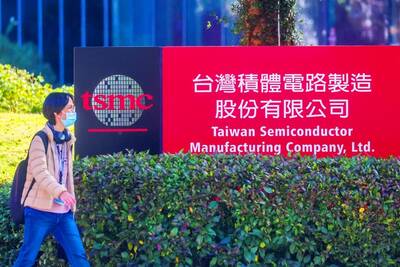
PROJECTION: TSMC said it expects strong growth this year, with revenue in US dollars projected to grow by about 30 percent, outperforming the industry Taiwan Semiconductor Manufacturing Co (TSMC, 台積電) yesterday reported consolidated sales last month reached NT$317.66 billion (US$9.98 billion), the highest ever for the month of February, driven by robust demand for chips built using the company’s advanced 3-nanometer (3nm) process. Last month’s figure was up 22.2 percent from a year earlier, but fell 20.8 percent from January, the world’s largest contract chipmaker said in a statement. For the first two months of the year, TSMC posted cumulative sales of NT$718.91 billion, up 29.9 percent from a year earlier. Analysts attributed the growth to sustained global demand for artificial intelligence (AI) products


 RSS
RSS