


The end of Yahoo Inc as an independent company might be near, and Verizon Communications Inc — long considered the leading contender to buy the aging Web pioneer — is the most likely buyer.
The two companies are in advanced talks over a takeover of Yahoo that could be worth close to US$5 billion, a person briefed on the matter said on Friday.
Any transaction would be for Yahoo’s core Internet business, although it is unclear whether a deal would also include other assets, such as real estate or patents.
Both companies are hoping to announce a deal as early as next week, the person said.
Verizon is scheduled to report earnings on Tuesday.
A sale of Yahoo’s core business — a sprawling collection of properties including its sports and news sites, search engine, e-mail and the social network Tumblr — has attracted a handful of bidders, which included AT&T Inc; private equity firms like TPG Capital LLP; and Quicken Loans Inc cofounder Dan Gilbert, who has received the backing of Warren Buffett’s Berkshire Hathaway Inc.
However, people involved in the process long believed that Verizon, with its enormous cash pile and its ability to wring out efficiencies by merging Yahoo with AOL Inc, was the most likely winner.
Brian Wieser, an analyst with Pivotal Research, said that combining AOL with Yahoo would create a stronger No. 3 digital platform for online advertising, after Google and Facebook Inc.
“This is a one plus one equals two-and-a-half,” he said.
No final deal has been reached and the talks could still falter, the person said.
One of the other finalists in the Yahoo auction process could also re-emerge with a higher bid.
Verizon, which last year had US$132 billion in revenue, has been trying to build up its digital content portfolio, particularly in mobile and video, to serve customers of its wireless telephone, cable TV and Internet businesses.
Last year, it bought AOL for US$4.4 billion, acquiring not just its content sites, including the Huffington Post and TechCrunch, but also the advertising technology used to target online ads to Internet users.
Yahoo would bring in a huge amount of additional news, sports and finance content — and the 1 billion people per month who visit Yahoo services — and would offer Verizon another set of sophisticated advertising technologies.
Yahoo’s BrightRoll division is a leader in delivering automated, real-time advertising, and it could be merged with AOL’s ad technology to deliver more appealing options to marketers, particularly in video.
“They’re not going to be anybody’s first port of call, but they will have a deeper set of data than anyone except Facebook and Google,” Wieser said.
However, any purchase of Yahoo carries some real risks. In addition to US Federal Communications Commission rules that would make the data sharing less valuable, integrating ad platforms is a complex challenge, usually plagued with delays.
The firms also have a different incentive structure for their advertising sales forces and unifying them could be disruptive, Wiser said..
AOL and Yahoo are long-time competitors, dating to the early days of the Web.
AOL CEO Tim Armstrong has also been a rival of Yahoo CEO Marissa Mayer since the days when they both worked at Google.
Mayer rejected the idea of merging with AOL a couple of years ago, but with Yahoo’s business now in deep decline and the board of directors eager to find a way out, she might not have a choice.
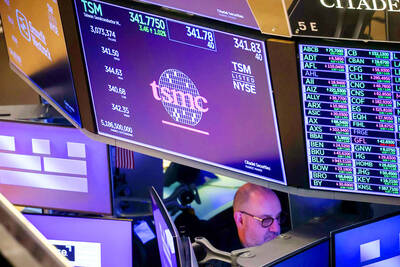
STRONG INTEREST: Analysts have pointed to optimism in TSMC’s growth prospects in the artificial intelligence era as the cause of the rising number of shareholders The number of people holding shares of chipmaker Taiwan Semiconductor Manufacturing Co (TSMC, 台積電) hit a new high last week despite a decline in its stock price, the Taiwan Depository and Clearing Corp (TDCC, 台灣集保) said. The number of TSMC shareholders rose to 2.46 million as of Friday, up 75,536 from a week earlier, TDCC data showed. The stock price fell 1.34 percent during the same week to close at NT$1,840 (US$57.55). The decline in TSMC’s share price resulted from volatility in global tech stocks, driven by rising international crude oil prices as the war against Iran continues. Dealers said
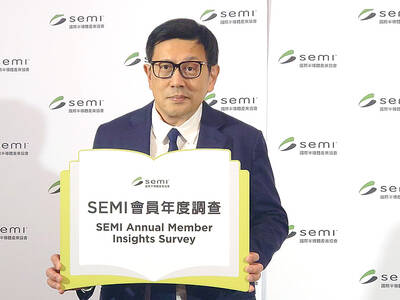
PRICE HIKES: The war in the Middle East would not significantly disrupt supply in the short term, but semiconductor companies are facing price surges for materials Taiwan’s semiconductor companies are not facing imminent supply disruptions of essential chemicals or raw materials due to the war in the Middle East, but surges in material costs loom large, industry association SEMI Taiwan said yesterday. The association’s comments came amid growing concerns that supplies of helium and other key raw materials used in semiconductor production could become a choke point after Qatar shut down its liquefied natural gas (LNG) production and helium output earlier this month due to the conflict. Qatar is the second-largest LNG supplier in the world and accounts for about 33 percent of global helium output. Helium is
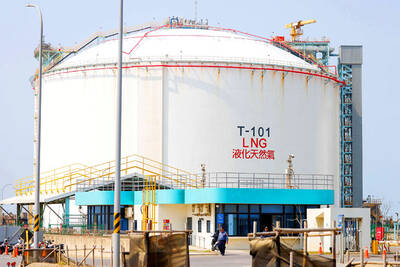
Taiwan’s natural gas supply remains stable through the end of May, despite rising concerns about potential disruptions to Qatari liquefied natural gas (LNG) supplies due to escalating conflicts in the Middle East, the Ministry of Economic Affairs said yesterday. The ministry in a statement said that Taiwan has completed preparations for natural gas supply and shipping schedules through the end of May. It has also made plans to increase natural gas imports from regions outside the Middle East in June to ensure a stable supply, it added. Taiwan sources natural gas from 14 countries and is not solely dependent on the Middle East,

China is clamping down on fertilizer exports to protect its domestic market, industry sources said, putting an additional strain on global markets that were already grappling with shortages caused by the US-Israeli war on Iran. China is among the largest fertilizer exporters — shipping more than US$13 billion of it last year — and it has a history of controlling exports to keep prices low for farmers. Shipments through the war-blocked Strait of Hormuz account for about one-third of the sea-borne supply. This month, Beijing banned exports of nitrogen-potassium fertilizer blends and certain phosphate varieties, sources said. The ban, which has not


 RSS
RSS