


Taiwanese companies with high European sales contributions or earnings that are linked to the movement of the yen are expected to be most affected by the fallout from Britain’s vote to leave the EU, Yuanta Securities Investment Consulting Co (元大投顧) said.
“Brexit” has unleashed a new wave of uncertainty for global markets, leading to expectations of heightened foreign-exchange volatility as global funds take shelter in defensive options such as the yen and the US dollar, the brokerage said in a report on Friday.
A stronger yen is expected to bring increased cost constraints for Taiwanese dealers of, and suppliers to, Japanese brands, and local companies including Nissan Motor Co (裕隆日產) and Toyota and Lexus distributor Hotai Motor Co (和泰車) might be compelled to increase prices, which could hamper their sales, the report said.
However, local companies that compete against Japanese rivals are set to benefit from a pricing advantage, including makers of industrial machinery, printed circuit boards, and passive electronic components, as well as mobile phone camera supplier Largan Precision Co (大立光) and contact lens manufacturer St Shine Optical Co Ltd (精華光學).
As economic growth prospects turn gloomy, consumers in the EU might become cautious about spending, which could weaken the sales of Taiwanese companies heavily reliant on the European markets, the report said.
Britain’s economy is set to grow by 0.5 percent annually this year, decelerating from last year’s 2.2 percent expansion, Hong Kong-based JPMorgan Asset Management forecast.
Hota Industrial Manufacturing Co (和大工業), which makes gears and shafts for automakers, has a significant 65 percent sales contribution from the EU, Yuanta data showed.
Bicycle maker Merida Industry Co (美利達) has a 40 percent sales dependency on the EU, compared to its peer Giant Manufacturing Co Ltd’s (巨大機械) 27 percent.
haLocal PC makers Asustek Computer Inc (華碩) and Acer Inc (宏碁) generate 35 percent and 37 percent of their sales from the continent respectively, the data showed.
While a risk averse investment environment does not bode well for emerging markets or perceived higher risk assets such as Asian equities, the majority of Asian holdings have a domestic focus — with most companies earning about 60 percent of revenue and profits from their local regions — Fidelity International Asia Pacific ex Japan investment chief Tim Orchard said.

DAMAGE REPORT: Global central banks are assessing war-driven inflation risks as the law of unintended consequences careens around the world, spiking oil prices Central banks from Washington to London and from Jakarta to Taipei are about to make their first assessments of economic damage after more than two weeks of conflict between the US and Iran. Decisions this week encompassing every member of the G7 and eight of the world’s 10 most-traded currency jurisdictions are likely to confirm to investors that the specter of a new inflation shock is already worrying enough to prompt heightened caution. The US Federal Reserve is widely expected to do exactly what everyone anticipated weeks ahead of its March 17-18 policy gathering: hold rates steady. The narrative surrounding that

Taiwan Semiconductor Manufacturing Co’s (TSMC, 台積電) share of the global foundry market rose to almost 70 percent last year amid booming demand for artificial intelligence (AI), market information advisory firm TrendForce Corp (集邦科技) said on Thursday. The contract chipmaker posted US$122.54 billion in revenue, up 36.1 percent from a year earlier, accounting for 69.9 percent of the global market, TrendForce said. Its share was up from 64.4 percent in 2024, it said. TSMC’s closest rival, Samsung Electronics, was a distant second, posting US$12.63 billion in sales, down 3.9 percent from a year earlier, for a 7.2 percent share of the global market. In the
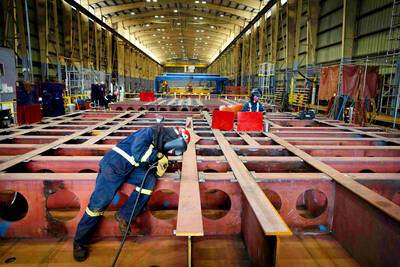
At a massive shipyard in North Vancouver, Canadian workers grind metal beams for a powerful new icebreaker crucial to cementing the country’s presence in the increasingly contested arctic. Icebreakers are specialized, expensive vessels able to navigate in the frozen far north. And “this is the crown jewel,” said Eddie Schehr, vice president of production at the Seaspan shipyard. For Canadian Prime Minister Mark Carney, who heads to Norway next Friday to observe arctic defense drills involving troops from 14 NATO states, Canada’s extreme north has emerged as a strategic priority. “Canada is and forever will be an Arctic nation,” he said ahead of

Chinese entrepreneur Frank Gao used to spend long hours running his social media accounts but now outsources the chore to artificial intelligence (AI) agent tool OpenClaw, which is taking China by storm despite official warnings over cybersecurity. OpenClaw, created in November by an Austrian coder, differs from bots such as ChatGPT because it can execute real-life tasks such as sending e-mails, organizing files or even booking flight tickets. “Since January, I’ve spent hours on the lobster every day,” Gao said in an interview, referring to OpenClaw’s red crustacean mascot. “We’re family.” After downloading OpenClaw, users connect it to artificial intelligence models of their


 RSS
RSS