


The government is to maintain a ban on Chinese investment in local IC design companies, Minister of Economic Affairs Lee Chih-kung (李世光) said yesterday, after reports of pressure from technology firms to remove the restrictions.
The Liberty Times (the Taipei Times’ sister newspaper) yesterday reported that MediaTek Inc (聯發科) allegedly pressured the Ministry of Economic Affairs to ease restrictions on Chinese companies investing in local chip designers to facilitate an acquisition bid from China.
However, Lee said MediaTek did not manage to pressure ministry officials.
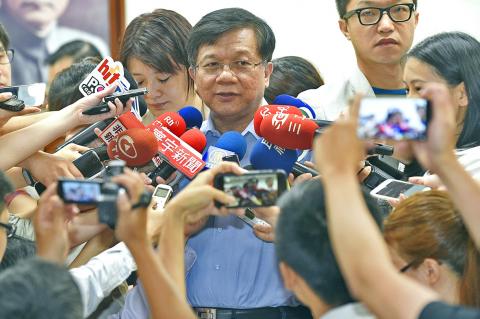
Photo: Chen Chih-chu, Taipei Times
“We will consider transferring the officials to other positions if they cannot handle the stress,” Lee said during a legislative hearing.
Industrial Development Bureau Director-General Wu Ming-ji (吳明機) said any policy change would have to go through due process and would not be easily influenced by any particular company.
Commenting on the pros and cons of easing regulations on Chinese investment in IC design houses, Lee said there should be a middle ground.
“If I keep the regulations unchanged, they might leave Taiwan. If I lift all the bans and open the market, there is still a possibility that they would leave,” Lee said.
MediaTek yesterday refuted the Liberty Times’ report, saying it was untrue.
According to the report, the Investment Commission said MediaTek needed to file a share acquisition application before it could accept any acquisition bids.
MediaTek, which generates more than half of its revenues from Chinese customers, denied the allegation.
As Chinese investors are barred from investing in local chip designers, MediaTek is not obliged by the regulation to submit any share acquisition proposal from a Chinese firm, according to a company statement submitted to the Taiwan Stock Exchange yesterday.
Chinese semiconductor company Tsinghua Unigroup Inc (清華紫光) earlier this year expressed a strong interest in buying MediaTek shares.
In addition, MediaTek said the deal to sell its Chinese subsidiary AutoChips Inc (傑發) to China’s digital map provider Navinfo Co Ltd (四維圖新) for US$497 million would not require approval in advance as related rules stipulate, the statement said.
The deal was announced last month.
The company is only required to notify the Investment Commission of the deal two months after the transaction, it said.
If the company has further investment, or collaboration plans with the Chinese firm, it will follow local rules to proceed with the cases, it said.
MediaTek also plans to spend US$100 million on a new joint venture with Navinfo, or to invest in an existing company, the company said, without disclosing details.
MediaTek said that the deal would help it accelerate its expansion into fast-growing telematics and advanced driver assistance systems markets.
In a separate statement issued yesterday, MediaTek said revenues rose 7 percent to NT$24.64 billion (US$760.45 million) last month from April’s NT$23.02 billion. That represented an annual growth of 60.87 percent.
In the first five months, revenues expanded 32.83 percent to NT$103.56 billion from NT$77.96 billion in the same period last year.
Former minister of economic affairs John Deng (鄧振中) in November last year requested the Industrial Development Bureau review the feasibility of allowing Chinese investment in Taiwan’s IC design industry.
The review was halted due to the transition of power.

In Italy’s storied gold-making hubs, jewelers are reworking their designs to trim gold content as they race to blunt the effect of record prices and appeal to shoppers watching their budgets. Gold prices hit a record high on Thursday, surging near US$5,600 an ounce, more than double a year ago as geopolitical concerns and jitters over trade pushed investors toward the safe-haven asset. The rally is putting undue pressure on small artisans as they face mounting demands from customers, including international brands, to produce cheaper items, from signature pieces to wedding rings, according to interviews with four independent jewelers in Italy’s main

Japanese Prime Minister Sanae Takaichi has talked up the benefits of a weaker yen in a campaign speech, adopting a tone at odds with her finance ministry, which has refused to rule out any options to counter excessive foreign exchange volatility. Takaichi later softened her stance, saying she did not have a preference for the yen’s direction. “People say the weak yen is bad right now, but for export industries, it’s a major opportunity,” Takaichi said on Saturday at a rally for Liberal Democratic Party candidate Daishiro Yamagiwa in Kanagawa Prefecture ahead of a snap election on Sunday. “Whether it’s selling food or

CONCERNS: Tech companies investing in AI businesses that purchase their products have raised questions among investors that they are artificially propping up demand Nvidia Corp chief executive officer Jensen Huang (黃仁勳) on Saturday said that the company would be participating in OpenAI’s latest funding round, describing it as potentially “the largest investment we’ve ever made.” “We will invest a great deal of money,” Huang told reporters while visiting Taipei. “I believe in OpenAI. The work that they do is incredible. They’re one of the most consequential companies of our time.” Huang did not say exactly how much Nvidia might contribute, but described the investment as “huge.” “Let Sam announce how much he’s going to raise — it’s for him to decide,” Huang said, referring to OpenAI
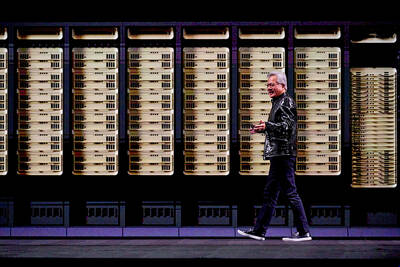
The global server market is expected to grow 12.8 percent annually this year, with artificial intelligence (AI) servers projected to account for 16.5 percent, driven by continued investment in AI infrastructure by major cloud service providers (CSPs), market researcher TrendForce Corp (集邦科技) said yesterday. Global AI server shipments this year are expected to increase 28 percent year-on-year to more than 2.7 million units, driven by sustained demand from CSPs and government sovereign cloud projects, TrendForce analyst Frank Kung (龔明德) told the Taipei Times. Demand for GPU-based AI servers, including Nvidia Corp’s GB and Vera Rubin rack systems, is expected to remain high,


 RSS
RSS