


Greece will return to credit markets next year if the country’s international creditors offer debt relief measures at a crucial May 24 meeting of eurozone finance ministers, Greek Prime Minister Alexis Tsipras told a newspaper on Saturday.
The cash-strapped country, which has been cut off from global debt markets since 2014 and agreed a third multibillion-euro bailout in July last year, started talks with lenders earlier this week on how to make its debts more manageable.
Tsipras’ government aims to conclude a review of its progress on bailout-linked reforms at the May 24 meeting, a step that would unlock the next tranche of funds in time to meet repayments to the EU and the IMF as well as state suppliers.

Photo: AP
The leftist leader, re-elected in September last year on promises to mitigate the impact of austerity on crisis-weary Greeks, also hopes for progress on easing its debt burden, which is set to reach 182.8 percent of GDP this year, according to European Commission forecasts.
“If we achieve what we seek for the debt on May 24, we will return to the markets next year,” he told Realnews newspaper.
“We might exit the bailout once and for all a lot before the program expires in August 2018,” Tsipras added.
Greek Finance Minister Euclid Tsakalotos said last year a long-term commitment to debt relief from eurozone countries was key to restoring investor confidence, and that Athens could return to bond markets by the end of this year.
Greece’s 10-year bond yields fell below 8 percent for the first time in more than six months on Tuesday after eurozone finance ministers offered debt relief to the country from next year. They soared to almost 19 percent at the height of the country’s debt crisis in the middle of last year.
Treasury bills are Greece’s main source of short-term funding.
European Commission Vice President Valdis Dombrovskis told the Kathimerini that Greece and its lenders were very close to concluding the review on May 24, but no deadline has been set.
Greece last week voted pension and tax reforms, part of a package agreed under its bailout.
Dombrovskis said Athens needed to legislate the remaining measures and contingency reforms, which the country would not have to implement unless it falls short of its fiscal targets.
Tsipras’ government is expected to submit a bill on the pending reforms and secure a parliamentary approval before the Eurogroup meets to wrap up the review.
The package would probably include a set of indirect tax hikes, setting up a new privatization fund, regulations on Greek banks’ “bad loans” and the contingency reforms.
Dombrovskis said eurozone finance ministers aimed to specify a “road map” on the debt relief measures at the May 24 meeting to secure the IMF’s participation in the Greek bailout rather than finalize a full three-stage debt relief program.

Netherlands-based semiconductor equipment supplier ASML Holding NV yesterday said that it is planning to hire an additional 1,000 people in Taiwan this year in response to growing demand from clients. ASML had previously planned to recruit 600 people this year, but that the plan has been adjusted upward, ASML vice president and ASML Taiwan general manager Grace Wang (汪佳慧) told reporters. ASML has a workforce of more than 4,500 in Taiwan, accounting for about 10 percent of its global total, Wang said. This year’s recruitment campaign would focus on adding people in the customer support, manufacturing and supply chain domains to assist ASML

UNDER MICROSCOPE: Taiwan detained three people who allegedly conspired to buy servers in Taiwan and export them using fraudulent documentation, prosecutors said Nvidia Corp chief executive officer Jensen Huang (黃仁勳) on Saturday urged Super Micro Computer Inc to tighten up on compliance after Taiwan detained three people this week for allegedly making fraudulent declarations about artificial intelligence (AI) servers made by its US partner. The development marked the nation’s first crackdown on semiconductor smuggling, which grew after the US slapped restrictions on exports of high-end chips such as Nvidia AI accelerators to China. Nvidia is “rigorous” in explaining regulations to all of its partners, Huang told reporters after arriving in Taipei. “Ultimately Super Micro has to run their own company,” he said in response to
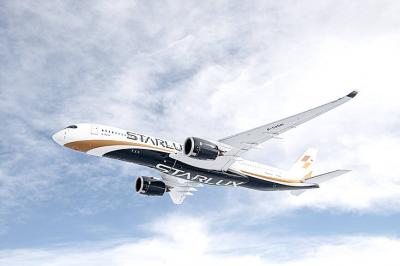
Starlux Airlines Co (星宇航空) today unveiled a long-haul network expansion plan at a shareholders’ meeting in Taipei, including direct flights to Barcelona, Spain, and Zurich, Switzerland, as well as a service connecting Taipei, Sydney and New Zealand. Starlux is to become the first Taiwanese carrier to offer non-stop services to the two European cities, while the inaugural oceanic route is expected to expand transit opportunities within the Australia-New Zealand market, Starlux said. Flight services to Chicago, Dallas, Washington and New York are under evaluation, the airline added. Prior to the shareholders’ meeting, the airline earlier this year announced that it would be

Nvidia Corp yesterday announced that CEO Jensen Huang (黃仁勳) would attend an employee meeting in Taipei tomorrow to celebrate the launch of the company’s Taiwan headquarters project. Huang would attend a gathering at the site of Nvidia’s planned headquarters in Beitou Shilin Technology Park (北投士林科技園區), the company said in a statement. After arriving in Taiwan on Saturday last week, Huang told reporters that he plans to meet with Quanta Computer Inc (廣達) chairman Barry Lam (林百里) and Taiwan Semiconductor Manufacturing Co (TSMC, 台積電) chairman C.C. Wei (魏哲家), and would attend the groundbreaking ceremony for Nvidia’s Taiwan headquarters tomorrow. Nvidia has not yet applied


 RSS
RSS