


Panama on Wednesday said it would form an independent commission to review the country’s financial practices following the leak of information from a local law firm that has embarrassed a clutch of world leaders.
“The Panamanian government, via our foreign ministry, will create an independent commission of domestic and international experts ... to evaluate our current practices and propose the adoption of measures that we will share with other countries of the world to strengthen the transparency of the financial and legal systems,” Panamanian President Juan Carlos Varela said in a televised address.
Governments across the world have begun investigating possible financial wrongdoing by the rich and powerful after the leak of more than 11.5 million documents, dubbed the “Panama Papers,” from the Panamanian law firm Mossack Fonseca.
In his brief statement, Varela reiterated Panama would work with other countries over the leak, which was published in an investigation by the US-based International Consortium of Investigative Journalists and various news organizations.
The papers have revealed financial arrangements of prominent figures, including friends of Russian President Vladimir Putin, relatives of the prime ministers of Britain and Pakistan, and Chinese President Xi Jinping (習近平), as well as the Ukrainian president.
Panama is still considering who is to be in the commission, and senior government adviser Gian Castillero said in an interview he expected it to report within six months.
Castillero conceded that the leak had hurt the reputation of Panama, which has an economy that is 83 percent services-based, he said.
The French government responded to the revelations on Tuesday by saying it would put Panama back on its list of “uncooperative countries,” though Castillero was dismissive of the move.
“The declarations from France are emotional and political declarations which shouldn’t be repeated,” he said in response to a question about whether other countries would follow France.
Castillero said that no proof had been found to show Mossack Fonseca had acted improperly, and he was adamant that the fact that founding partner Ramon Fonseca was a friend of Varela would not affect the government’s judgement of the firm.
“I don’t think it’s really that difficult,” he said.
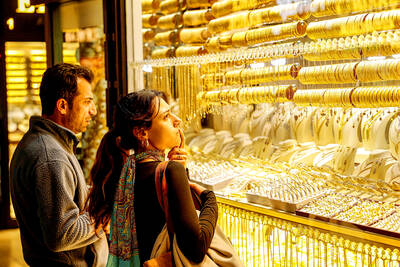
In Italy’s storied gold-making hubs, jewelers are reworking their designs to trim gold content as they race to blunt the effect of record prices and appeal to shoppers watching their budgets. Gold prices hit a record high on Thursday, surging near US$5,600 an ounce, more than double a year ago as geopolitical concerns and jitters over trade pushed investors toward the safe-haven asset. The rally is putting undue pressure on small artisans as they face mounting demands from customers, including international brands, to produce cheaper items, from signature pieces to wedding rings, according to interviews with four independent jewelers in Italy’s main

Macronix International Co (旺宏), the world’s biggest NOR flash memory supplier, yesterday said it would spend NT$22 billion (US$699.1 million) on capacity expansion this year to increase its production of mid-to-low-density memory chips as the world’s major memorychip suppliers are phasing out the market. The company said its planned capital expenditures are about 11 times higher than the NT$1.8 billion it spent on new facilities and equipment last year. A majority of this year’s outlay would be allocated to step up capacity of multi-level cell (MLC) NAND flash memory chips, which are used in embedded multimedia cards (eMMC), a managed
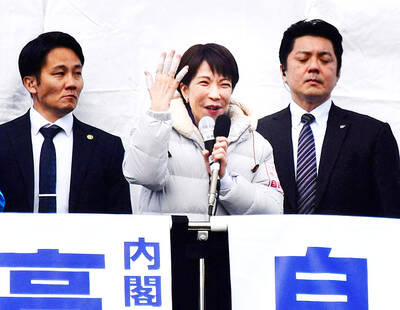
Japanese Prime Minister Sanae Takaichi has talked up the benefits of a weaker yen in a campaign speech, adopting a tone at odds with her finance ministry, which has refused to rule out any options to counter excessive foreign exchange volatility. Takaichi later softened her stance, saying she did not have a preference for the yen’s direction. “People say the weak yen is bad right now, but for export industries, it’s a major opportunity,” Takaichi said on Saturday at a rally for Liberal Democratic Party candidate Daishiro Yamagiwa in Kanagawa Prefecture ahead of a snap election on Sunday. “Whether it’s selling food or

In the wake of strong global demand for AI applications, Taiwan’s export-oriented economy accelerated with the composite index of economic indicators flashing the first “red” light in December for one year, indicating the economy is in booming mode, the National Development Council (NDC) said yesterday. Moreover, the index of leading indicators, which gauges the potential state of the economy over the next six months, also moved higher in December amid growing optimism over the outlook, the NDC said. In December, the index of economic indicators rose one point from a month earlier to 38, at the lower end of the “red” light.


 RSS
RSS