


When doctors told Australian Greg Jefferys he had hepatitis C and the disease was destroying his liver, the devastating diagnosis was compounded by the cost of a cure.
Unable to afford Sovaldi, hailed as a miracle drug, the 61-year-old flew to India, one of a growing army of patients seeking out low-cost, life-saving medicines on the subcontinent.
Their illnesses vary — hepatitis C, cancer and HIV are among the most common — but they are almost always desperate, seeing in India their only hope to save their life or that of a loved one.
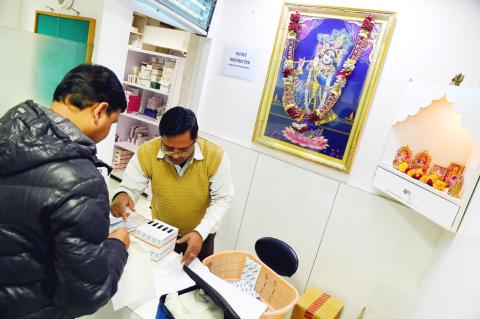
Photo: AFP
They contact underground “buyers clubs,” make the trip to India to buy from a legitimate distributor or seek out shady online pharmacies promising mail-order cures.
“The doctors told me ‘you’ve got Hepatitis C, you’ve probably got liver cancer,’” said Jefferys, a PhD student.
“The chatter was around the new generic versions of Sovaldi being released in India. I hopped on a plane to Chennai and in about two days I had an appointment with a specialist,” he said.
India earned a nickname as “the pharmacy to the developing world” for its tough stance on patents.
Successive governments have taken a view that patents should be granted only for major innovations, not updates to existing compounds — allowing domestic manufacturers to make generic versions of drugs at vastly lower cost.
Sovaldi, chemically known as sofosbuvir, is made by US pharmaceutical giant Gilead and costs US$84,000 for a 12-week cycle of treatment in the US.
Rejected for a patent in India, generic drug makers, some licensed by Gilead, produce versions such as Mylan’s MyHep, that cost less than US$900 a cycle.
“This is something I observe more and more,” said Leena Menghaney, who runs Medecins Sans Frontieres’ Access Campaign in India, which works to broaden access to drugs.
“All kinds of people and patients across the world are starting to access medicines from India. They travel themselves, or they contact a friend,” she said.
More than 130 million people live with chronic hepatitis C worldwide, according to the WHO, and 500,000 die each year from related liver diseases.
Since writing a blog, Jefferys receives 150 e-mails a day from people in the US, Britain and elsewhere asking for help.
When Loon Gangte, a Delhi-based HIV activist, was diagnosed with the virus in 1997, the price of treatment was far beyond his reach.
However, the advent of generic Indian anti-retrovirals saved his life — and made the country a global center for cheap, lifesaving HIV drugs.
Gangte is open about carrying medicines overseas for others and says in a decade he has been stopped just once, at Thai customs, and fined.
Most countries allow patients to import small amounts of medicines only for personal use.
Campaigning by activists like Gangte for better access to HIV treatments helped give rise to so-called buyers clubs, made famous by the 2013 Hollywood film.
“When I saw Dallas Buyers Club, I laughed,” said a woman who asked to be called Meera,who helps one Delhi club by ferrying drugs illegally in her suitcase whenever she travels. “I hate the term ‘drug tourism.’ This is about saving lives.”
Dinesh (not his real name), a long-time HIV campaigner, began working full-time for the same buyers club in August last year, helping people obtain medicines for a nominal fee.
He is not sure how people find him — he has no online presence — but gets requests from as far afield as Austria and Indonesia.
“My family were a bit reluctant, there is always a grey area in this, but I fear only the one above. I feel completely that this is right,” he said.
Pharmaceutical firms say India’s disregard for patents will stifle innovation or make drugs commercially unfeasible — Gilead paid US$11 billion to buy the developer of Sovaldi in 2012.
However, after losing several high-profile patent battles, it appears drugmakers can do little to combat the Indian government’s will or that of overseas patients determined to import drugs.
Gilead spokesman Nick Francis said the company was “aware such activity may occur.”
Perhaps the riskiest route is online pharmacies — a search on e-marketplace IndiaMart turns up dozens claiming to sell generics — with no guarantee against counterfeits.
However, legal channels are springing up, including Delhi-based Ikris Pharma Network, set up in August 2014, which does not sell drugs, but connects patients to genuine distributors.
Founder Praveen Sikri receives 70 calls a day from people struggling to access drugs, including generic Veenat, for cancer.
“Either the drug is not available or it is very expensive,” Sikri said. “We help the patient to get the product in a legalized manner.”
One recent e-mail is from a young man in San Francisco whose grandad desperately needs medicine for a stomach tumor.
In India, one way or another, he will probably be able to find it.
“There are many, many people doing this,” Sikri said.

Cairo’s new monorail slices across the city skyline, running above the familiar chaos of blaring horns and aging buses’ exhaust fumes that mark rush hour below. The US$4.5 billion monorail, opened this month, is among Egypt’s most prominent new transport projects, part of a debt-funded infrastructure drive criticized for sapping state finances while bringing limited benefits to most of the country’s 109 million people. “It feels like you’re in a different country,” said Ramy Sayed, a restaurant manager, aboard a driverless Innovia 300 train. “No noise, no traffic, we’re not used to this.” The eastern line runs 56km from the bustling middle-class
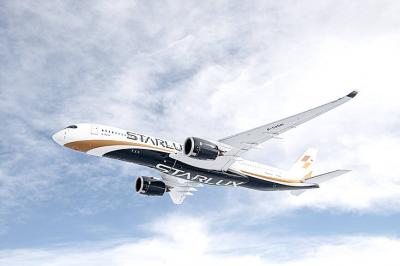
Starlux Airlines Co (星宇航空) today unveiled a long-haul network expansion plan at a shareholders’ meeting in Taipei, including direct flights to Barcelona, Spain, and Zurich, Switzerland, as well as a service connecting Taipei, Sydney and New Zealand. Starlux is to become the first Taiwanese carrier to offer non-stop services to the two European cities, while the inaugural oceanic route is expected to expand transit opportunities within the Australia-New Zealand market, Starlux said. Flight services to Chicago, Dallas, Washington and New York are under evaluation, the airline added. Prior to the shareholders’ meeting, the airline earlier this year announced that it would be

Taiwanese prosecutors suspect that three people successfully smuggled at least one shipment of Nvidia Corp artificial intelligence (AI) chips to China after first exporting them to Japan, people familiar with the matter said. The trio was detained last week by the Keelung District Prosecutors’ Office for allegedly falsifying documents related to exports of Super Micro Computer Inc servers containing advanced Nvidia chips, which the US has barred from sale to China without a license from Washington. The move marked Taiwan’s first public crackdown on AI chip diversion after years of pressure from the US to take a more active role in curtailing
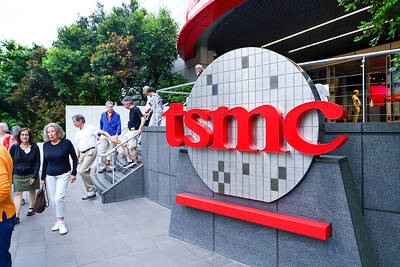
Taiwan Semiconductor Manufacturing Co (TSMC, 台積電) employee bonuses are likely to grow more than 30 percent this year, in line with the past few years as the company’s profits continue to set new records, an anonymous source cited TSMC chairman C.C. Wei (魏哲家) as saying yesterday. TSMC, the world’s largest contract chipmaker, is committed to taking care of its workers, the source said, citing Wei’s meeting with employees yesterday morning. Wei also expressed gratitude to employees for their contribution to the company’s improving bottom line, the source added. Since 2023, TSMC’s employee bonuses have grown at an annual rate of


 RSS
RSS