


The Fair Trade Commission is to make a ruling on Advanced Semiconductor Engineering’s (ASE, 日月光半導體) takeover bid of rival Siliconware Precision Industries Co (SPIL, 矽品精密) on Wednesday next week at the earliest, the commission said in a statement yesterday.
SPIL has been resisting ASE’s takeover bid, saying that the merger would do more harm than good to Taiwan’s semiconductor supply chain.
“The merger would undermine the competitiveness of Taiwan’s chip testers and packagers,” SPIL said.
“Order losses due to the merger are to reach between NT$30 billion and NT$45 billion [US$895.9 million and US$1.34 billion]” because customers tend to have a second source, it said.
The merger would also trigger an exodus of local semiconductor raw material suppliers because fewer orders would come from Taiwan, SPIL said.
SPIL’s local partners and clients, such as United Microelectronics Corp (聯電) and Novatek Microelectronics Corp (聯詠), oppose the deal because they are worried about losing bargaining power, SPIL said.
They said that they would seek a second testing and packaging service provider if the deal was given the go-ahead, SPIL said.
SPIL made the remarks during a forum held by the Fair Trade Commission to weigh the pros and cons of ASE’s proposal to acquire SPIL.
SPIL and ASE held a more than 60 percent share of Taiwan’s chip testing and packaging market in 2014 by revenue, SPIL said, citing figures from local researcher Industrial Technology Research Institute (ITRI, 工研院).
During yesterday’s forum, participants took into account a total of 7,077 opinions submitted by the public, the commission said.
“Nearly all of the necessary procedures determining the deal’s approval have been completed,” Fair Trade Commission Vice Chairman and spokesperson Chiu Yung-ho (邱永和) said.
The commission has 30 days to review the deal since the proposal was submitted on Feb. 4.
The review can be extended to 60 days at the maximum, if needed, the commission said.
Due to the longer-than-expected review by the commission, ASE has extended the deadline of its acquisition bid by one month to March 17.
ASE, the world’s largest chip packager and tester, in December last year launched a second tender offer to purchase an additional 24.71 percent in SPIL in the first leg of ASE’s two-stage plan to fully own SPIL.
The latest stake purchase would bring ASE’s holding of SPIL to 49.71 percent, from 24.99 percent.

ENERGY ISSUES: The TSIA urged the government to increase natural gas and helium reserves to reduce the impact of the Middle East war on semiconductor supply stability Chip testing and packaging service provider ASE Technology Holding Co (日月光投控) yesterday said it planned to invest more than NT$100 billion (US$3.15 billion) in building a new advanced chip testing facility in Kaohsiung to keep up with customer demand driven by the artificial intelligence (AI) boom. That would be included in the company’s capital expenditure budget next year, ASE said. There is also room to raise this year’s capital spending budget from a record-high US$7 billion estimated three months ago, it added. ASE would have six factories under construction this year, another record-breaking number, ASE chief operating officer Tien Wu

The EU and US are nearing an agreement to coordinate on producing and securing critical minerals, part of a push to break reliance on Chinese supplies. The potential deal would create incentives, such as minimum prices, that could advantage non-Chinese suppliers, according to a draft of an “action plan” seen by Bloomberg. The EU and US would also cooperate on standards, investments and joint projects, as well as coordinate on any supply disruptions by countries like China. The two sides are additionally seeking other “like-minded partners” to join a multicountry accord to help create these new critical mineral supply chains, which feed into

For weeks now, the global tech industry has been waiting for a major artificial intelligence (AI) launch from DeepSeek (深度求索), seen as a benchmark for China’s progress in the fast-moving field. More than a year has passed since the start-up put Chinese AI on the map in early last year with a low-cost chatbot that performed at a similar level to US rivals. However, despite reports and rumors about its imminent release, DeepSeek’s next-generation “V4” model is nowhere in sight. Speculation is also swirling over the geopolitical implications of which computer chips were chosen to train and power the new
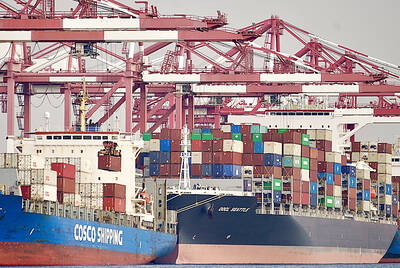
TECH WINNERS: Taiwan and South Korea reported robust trade, which suggests that they have critical advantages in the rapidly expanding AI supply chain, an official said Exports last month surged to a new high, as booming demand tied to artificial intelligence (AI) infrastructure fueled shipments of advanced technology components, underscoring the nation’s pivotal role in the global semiconductor supply chain. Outbound shipments climbed to US$80.18 billion, the highest ever for a single month, rising 61.8 percent from a year earlier and marking the 29th consecutive month of growth, the Ministry of Finance said yesterday. “The surge was driven primarily by global investment in AI infrastructure,” Department of Statistics Director-General Beatrice Tsai (蔡美娜) said. The mass production of next-generation AI computing systems has accelerated procurement across the semiconductor supply


 RSS
RSS