


After spending more than US$16 billion on Asian acquisitions in the past decade, China’s banks still have a long way to go before their regional forays start to have a meaningful impact on earnings.
Only 9.1 percent of Asian companies outside China currently have working relationships with the nation’s top banks for cash management, according to a survey of 848 corporations by research firm East & Partners.
The survey showed 14.4 percent work with the Chinese lenders for trade finance.
Given that it was a first-time study, the firm had no comparable historical data.
“Definitely, it’s disappointing,” Singapore-based East & Partners senior analyst Jonathan Chng said. “They have spent so much money trying to penetrate the overseas market and to expand into non-Chinese corporate customers, but the result is still not very favorable to them.”
While China is already the biggest trading partner for Asian countries from India to Japan, Chinese banks have struggled to compete with the wider range of products long-established rivals in the region such as HSBC Holdings PLC and Standard Chartered PLC offer to customers.
The state-owned lenders’ overseas plans — initially intended to support the global use of the yuan and the financing of Chinese infrastructure projects offshore — have taken on greater significance as a weaker economy and rising soured debt hobbles profit growthat home.
Growing use of the yuan in international business seems to have some bearing on how Asian companies engage with Chinese banks; 28.7 percent of the firms in the East & Partners survey had a working relationship with the lenders for foreign exchange, the biggest connection to mainland banks.
Just over 17 percent had banking relationships for investment services, rounding out the four business areas covered by the survey.
The more than US$16 billion of Asian acquisitions by Chinese lenders in the past 10 years includes Industrial & Commercial Bank of China Ltd’s (ICBC, 中國工商銀行) purchase of Bank Halim Indonesia, which was completed in 2007, data compiled by Bloomberg show.
More recently, China Construction Bank Corp (CCB, 中國建設銀行) took a controlling stake in Indonesia’s PT Bank Windu Kentjana International late last year, while China Minsheng Banking Corp (中國民生銀行) won approval earlier this month to buy Quam Ltd, a Hong Kong-based brokerage and financial-services provider.
ICBC does not provide a breakdown of its Asian profits. Its interim report showed that its overseas business accounted for 6.6 percent of operating income in the first half of last year, up from 2.3 percent in 2006, before its Bank Halim acquisition.
CCB, China’s second-largest bank by assets, is seeking to expand its network to about 40 countries from 24 and increase the overseas contribution of pretax profit to 5 percent by 2020, chairman Wang Hongzhang (王洪章) said.
The overseas business only accounted for 1.79 percent of the firm’s pretax profit in the first half of last year, up from 0.83 percent in 2006, exchange filings show.
“We are accelerating the pace to internationalize and to provide global financial services,” Wang said in Hong Kong in October last year. “We are taking the opportunity of companies expanding overseas and the renminbi internationalization to strengthen our global competitive position.”
Operations outside mainland China contributed 3.2 percent of Agricultural Bank of China Ltd’s (中國農業銀行) total operating income in the first half of last year, and 23 percent of Bank of China Ltd’s (中國銀行) pretax income. Bank of China’s Hong Kong unit is the territory’s top mortgage lender.
Concerns over deteriorating asset quality as the country’s economy slows had dragged shares of the four banks down by an average 15 percent in Hong Kong this year to Thursday.
“In China, although the market is very big, there are a lot more opportunities overseas,” Chng said.
Chinese banks “still have a lot of work to do in order to be on the same level as international banks,” he said.
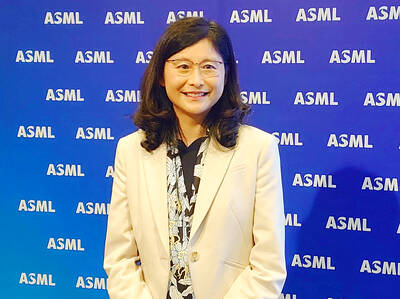
Netherlands-based semiconductor equipment supplier ASML Holding NV yesterday said that it is planning to hire an additional 1,000 people in Taiwan this year in response to growing demand from clients. ASML had previously planned to recruit 600 people this year, but that the plan has been adjusted upward, ASML vice president and ASML Taiwan general manager Grace Wang (汪佳慧) told reporters. ASML has a workforce of more than 4,500 in Taiwan, accounting for about 10 percent of its global total, Wang said. This year’s recruitment campaign would focus on adding people in the customer support, manufacturing and supply chain domains to assist ASML
UNDER MICROSCOPE: Taiwan detained three people who allegedly conspired to buy servers in Taiwan and export them using fraudulent documentation, prosecutors said Nvidia Corp chief executive officer Jensen Huang (黃仁勳) on Saturday urged Super Micro Computer Inc to tighten up on compliance after Taiwan detained three people this week for allegedly making fraudulent declarations about artificial intelligence (AI) servers made by its US partner. The development marked the nation’s first crackdown on semiconductor smuggling, which grew after the US slapped restrictions on exports of high-end chips such as Nvidia AI accelerators to China. Nvidia is “rigorous” in explaining regulations to all of its partners, Huang told reporters after arriving in Taipei. “Ultimately Super Micro has to run their own company,” he said in response to

Nvidia Corp yesterday announced that CEO Jensen Huang (黃仁勳) would attend an employee meeting in Taipei tomorrow to celebrate the launch of the company’s Taiwan headquarters project. Huang would attend a gathering at the site of Nvidia’s planned headquarters in Beitou Shilin Technology Park (北投士林科技園區), the company said in a statement. After arriving in Taiwan on Saturday last week, Huang told reporters that he plans to meet with Quanta Computer Inc (廣達) chairman Barry Lam (林百里) and Taiwan Semiconductor Manufacturing Co (TSMC, 台積電) chairman C.C. Wei (魏哲家), and would attend the groundbreaking ceremony for Nvidia’s Taiwan headquarters tomorrow. Nvidia has not yet applied
Huawei Technologies Co (華為) said it has come up with a new pathway to shorten its gap with industry leader Taiwan Semiconductor Manufacturing Co (TSMC, 台積電), potentially achieving a breakthrough in making advanced semiconductors without cutting-edge equipment. Right now there is about a five-year gap between what TSMC is capable of and what Huawei, together with its manufacturing partner Semiconductor Manufacturing International Corp (中芯), can produce. Huawei is to start making 1.4-nanometer chips by 2031 with its own “LogicFolding” technology, Huawei semiconductor chief He Tingbo (何庭波) said in a rare public appearance during a chip conference yesterday, while TSMC has


 RSS
RSS