


Brazil’s government on Thursday said it would offer US$20 billion worth of special loans to stimulate the recession-stricken economy.
It will extend credit lines of up to 83 billion reais (US$20.4 billion) for farming, housing and infrastructure, and for small and medium-sized companies, Brazilian Minister of Finance Nelson Barbosa said.
The credit will be offered via public banks and other bodies “using existing resources in the best way possible” so as not to weigh on the public finances, he told a news conference.
“These credit lines don’t jeopardize the fight against inflation because they come from resources that are already in the financial system,” Barbosa said in Brasilia. “We have to restart economic growth, and this involves stabilizing credit.”
The minister also proposed setting a legal limit on government spending and creating ranges for future fiscal targets to allow for some fluctuations in tax revenue.
Brazil, the world’s seventh-largest economy, had a gloomy start to the year as it prepares to host the summer Olympic Games in August.
Official figures showed that 1.5 million jobs were destroyed last year.
The IMF said Brazil’s economy contracted 3.8 percent last year and is expected to shrink 3.5 percent this year.
A finance scandal that sparked impeachment proceedings against leftist Brazilian President Dilma Rousseff has aggravated the crisis.
Ratings agencies Fitch and Standard & Poor’s have downgraded Brazil’s credit score, saying Rousseff’s government has failed to clean up its public finances.
Rousseff said at an economic forum on Thursday that balancing the books was the challenge for this year.
“In 2015, we made a fiscal tightening unprecedented in our history,” she said.
“We know that there is still much to do,” she added, promising further cuts to public spending.
Rousseff said she also wanted to revive a controversial tax on financial transactions that was scrapped in 2007.


Taiwan’s foreign exchange reserves fell below the US$600 billion mark at the end of last month, with the central bank reporting a total of US$596.89 billion — a decline of US$8.6 billion from February — ending a three-month streak of increases. The central bank attributed the drop to a combination of factors such as outflows by foreign institutional investors, currency fluctuations and its own market interventions. “The large-scale outflows disrupted the balance of supply and demand in the foreign exchange market, prompting the central bank to intervene repeatedly by selling US dollars to stabilize the local currency,” Department of Foreign

Intel Corp is joining Elon Musk’s long-shot effort to develop semiconductors for Tesla Inc, Space Exploration Technologies Corp and xAI, marking a surprising twist in the chipmaker’s comeback bid. Intel would help the Terafab project “refactor” the technology in a chip factory, the company said on Tuesday in a post on X, Musk’s social media platform. That is a stage in the development process that typically helps make chips more powerful or reliable. The chipmaker’s shares jumped 4.2 percent to US$52.91 in New York trading on Tuesday. The Terafab project is a grand plan by Musk to eventually manufacture his own chips for
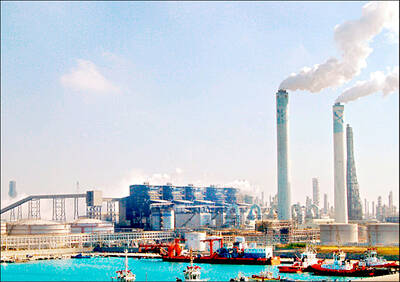
Taiwan Power Co (Taipower, 台電) yesterday said it plans to resume operations at two coal-fired power generators for three months to boost security of electricity supply as liquefied natural gas (LNG) supply risks are running high due to the Middle East conflict. The two coal-fired power generators are at Mailiao Power Plant in Yunlin County’s Mailiao Township (麥寮). The plant, operated by Formosa Plastics Group (台塑集團), supplied electricity to Taipower’s power grid until the end of last year. Taipower’s decision came about one month after Minister of Economic Affairs Kung Ming-hsin (龔明鑫) on March 10 said that the nation had no imminent

Some robotaxi passengers were left stranded in the middle of fast-moving traffic in a major Chinese city after their driverless vehicles stopped running, according to police and media reports on Wednesday. A preliminary investigation indicates more than 100 robotaxis came to a halt because of a “system malfunction,” police in the city of Wuhan said in a statement, without elaborating. No injuries were reported. One passenger told Chinese media that their robotaxi stopped after turning a corner. An instruction on a screen read: “Driving system malfunction. Staff are expected to arrive in 5 minutes.” After no one showed up, the passenger pushed


 RSS
RSS