


The Ministry of Economic Affairs yesterday said that 136 Taiwanese products included in the WTO’s expanded tariff-reduction program for information technology products would benefit after the program takes effect on July 1 next year.
“Joining the expanded ITA would help Taiwanese manufacturers save a lot on tariff costs,” Vice Minister of Economic Affairs Bill Cho (卓士昭) told a press conference, referring to the Information Technology Agreement.
The ministry’s remarks came after the WTO’s ministerial meeting on Wednesday in Nairobi, Kenya, concluded negotiations on the expanded ITA. Members agreed to remove duties on 201 information technology products — valued at US$1.3 trillion — within seven years after the accord takes effect.
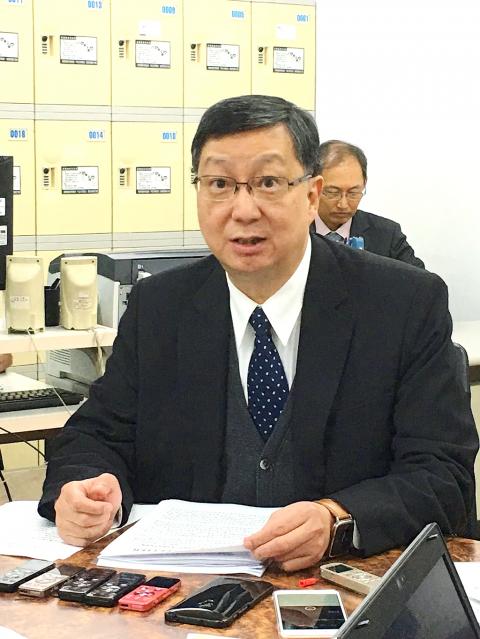
Photo: Taipei Times
The ministry said the 136 products — or 68 percent of the 201 products — would have a direct impact on the interests of Taiwanese manufacturers, helping them save an estimated US$820 million in annual tariff expenses.
Taiwanese exports of LED backlight modules could save US$233.9 million in costs per year once the duties are removed, Industrial Development Bureau Deputy Director-General Leu Jang-hwa (呂正華) said
Semiconductor manufacturers are estimated to enjoy US$132.6 million in tariff savings, while producers of digital cameras, television cameras and video cameras could see US$108.5 million shaved off their expenses per year, he said.
Leu said that as 90 percent of Taiwan’s set-top boxes are exported to the US, local makers could see immediate cost savings of US$72.8 million a year after the US eliminates the 5 percent duty.
Cho said the expanded tariff-elimination scheme would also help boost Taiwanese exports to emerging markets, such as Malaysia, Thailand and the Philippines.
Manila currently imposes a tariff of 20 percent on quartz or fused silica insulated fittings for the manufacture of semiconductor wafers, but it is scheduled to remove such duties by 2017, Cho said.
However, Taiwan still failed to have flat panels and machine tools for making flat panels included in the ITA.
Cho said the government would continue to negotiate on behalf of Taiwanese panelmakers in cross-strait trade in goods agreement talks.
Some members of the ITA were not happy with China’s proposal to remove tariffs on some of its products in seven years, Cho said.
In a bid to pressure China to shorten its tariff-elimination period, Cho said that several members, including Taiwan, the EU, the US and Japan, had increased the number of goods whose duties should be removed immediately after the agreement takes effect on July 1 next year.
Cho said that, for example, the ministry had persuaded Taiwanese manufacturers of 35 items whose tariffs were supposed to be removed in three years to opt for immediate removal.
As a result, China agreed to add five more items for immediate tariff elimination, he said.

KEEPING UP: The acquisition of a cleanroom in Taiwan would enable Micron to increase production in a market where demand continues to outpace supply, a Micron official said Micron Technology Inc has signed a letter of intent to buy a fabrication site in Taiwan from Powerchip Semiconductor Manufacturing Corp (力積電) for US$1.8 billion to expand its production of memory chips. Micron would take control of the P5 site in Miaoli County’s Tongluo Township (銅鑼) and plans to ramp up DRAM production in phases after the transaction closes in the second quarter, the company said in a statement on Saturday. The acquisition includes an existing 12 inch fab cleanroom of 27,871m2 and would further position Micron to address growing global demand for memory solutions, the company said. Micron expects the transaction to
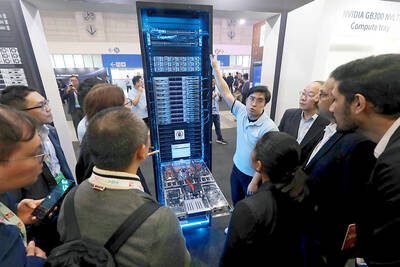
Nvidia Corp’s GB300 platform is expected to account for 70 to 80 percent of global artificial intelligence (AI) server rack shipments this year, while adoption of its next-generation Vera Rubin 200 platform is to gradually gain momentum after the third quarter of the year, TrendForce Corp (集邦科技) said. Servers based on Nvidia’s GB300 chips entered mass production last quarter and they are expected to become the mainstay models for Taiwanese server manufacturers this year, Trendforce analyst Frank Kung (龔明德) said in an interview. This year is expected to be a breakout year for AI servers based on a variety of chips, as
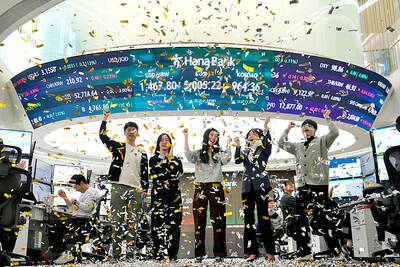
Global semiconductor stocks advanced yesterday, as comments by Nvidia Corp chief executive officer Jensen Huang (黃仁勳) at Davos, Switzerland, helped reinforce investor enthusiasm for artificial intelligence (AI). Samsung Electronics Co gained as much as 5 percent to an all-time high, helping drive South Korea’s benchmark KOSPI above 5,000 for the first time. That came after the Philadelphia Semiconductor Index rose more than 3 percent to a fresh record on Wednesday, with a boost from Nvidia. The gains came amid broad risk-on trade after US President Donald Trump withdrew his threat of tariffs on some European nations over backing for Greenland. Huang further
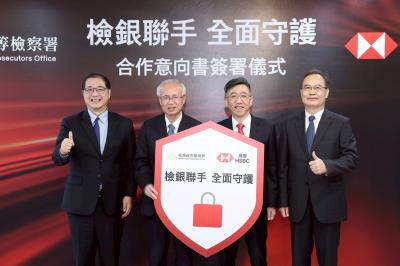
HSBC Bank Taiwan Ltd (匯豐台灣商銀) and the Taiwan High Prosecutors Office recently signed a memorandum of understanding (MOU) to enhance cooperation on the suspicious transaction analysis mechanism. This landmark agreement makes HSBC the first foreign bank in Taiwan to establish such a partnership with the High Prosecutors Office, underscoring its commitment to active anti-fraud initiatives, financial inclusion, and the “Treating Customers Fairly” principle. Through this deep public-private collaboration, both parties aim to co-create a secure financial ecosystem via early warning detection and precise fraud prevention technologies. At the signing ceremony, HSBC Taiwan CEO and head of banking Adam Chen (陳志堅)


 RSS
RSS