


The manufacturing purchasing managers’ index (PMI) contracted to 45.1 last month, down from 46 the previous month, indicating a further deterioration in operating conditions for local manufacturers, the Chung-Hua Institution for Economic Research (CIER, 中華經濟研究院) said yesterday.
It was the fifth straight month of contraction for the economic barometer, a critical gauge of the manufacturing industry’s health, as external demand failed to show an improvement, despite the high-sales season for technology components and devices.
“The latest PMI data suggest the economic state remains both weak and slow” after slipping into a downturn last quarter, CIER president Wu Chung-shu (吳中書) said at a media briefing.
The nation’s export-focused economy entered a recession in the past two quarters, according to Directorate-General of Budget, Accounting and Statistics data, but the government is standing by the year-on-year comparison, under which the second-quarter reading managed a 0.57 percent increase.
Wu attributed the soft purchasing activity to conservative market sentiment and continued inventory adjustments.
PMI scores above 50 signify business expansion and values below the threshold indicate contraction.
The sub-indices on new orders and production have weakened for five consecutive months, falling to 44.9 and 45.3 respectively last month, as domestic and international clients cut their inventories to avoid a supply glut amid the global economic slowdown, the CIER said.
With the exception of food manufacturers, firms in all sectors tightened their belts and adopted a negative view about the business outlook in the next six months, the survey showed.
The nation’s main trading rivals such as South Korea, Singapore and Hong Kong fared similarly badly, affirming a slack worldwide trade to which Taiwan is not immune, Wu said, adding that the chance of a recovery appears dim in the current quarter in light of the data released so far.
The sub-index on employment dropped to 45.7 last month from 47.8 in October, heaping pressure on the job market and the prospects for private consumption.
The government has introduced travel subsidies in the hope that domestic demand might keep GDP growth in positive terrirtory this year.
That goal is under threat after the non-manufacturing index registered 48.7 last month, down from 50.8 in October, meaning operating conditions turned from expansion to contraction last month, the Taipei-based think tank said in a separate survey.
While non-manufacturing businesses continued to add employees last month, many expect the landscape to darken, the second survey said, as domestic demand is heavily reliant on exports.

HSBC Holdings PLC is deepening its commitment to Taiwan as the economy emerges as one of the bank’s fastest-growing markets globally, driven by an artificial intelligence (AI) investment boom, expanding cross-border trade, and rising wealth creation. “The advantage that Taiwan has is a growth story linked to the semiconductor and broader AI industries, strong underlying corporate performance, and wealth creation,” said Surendra Rosha, HSBC’s co-chief executive for Asia and the Middle East, in an exclusive interview with the Taipei Times on June 2, during this year’s HSBC Taiwan Conference. That combination has helped HSBC cement its position as the most profitable international
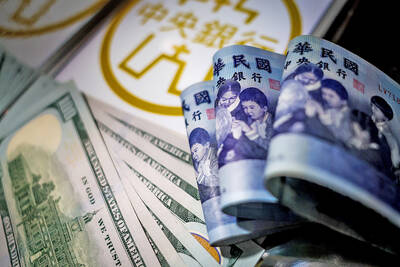
The New Taiwan dollar yesterday fell sharply against the US dollar to close at its lowest level since May 22 amid a massive outflow of funds from the country because of investors panicking over global equity markets. The NT dollar ended at NT$31.580 against the US dollar, slightly lower than its close of NT$31.568 on May 22, after moving between NT$31.5 and NT$31.648 on combined turnover of US$3.062 billion on the Taipei Foreign Exchange and the Cosmos Foreign Exchange. The NT dollar received a significant hit in the morning session, slumping as much as NT$0.173 at a time when other Asian currencies
Taiwan Semiconductor Manufacturing Co (TSMC, 台積電) is now ranked ninth among the world’s 100 most valuable companies after its market capitalization more than doubled over the past year, PricewaterhouseCoopers (PwC) Taiwan said in a report last month. TSMC’s market capitalization surged 101 percent year-on-year to US$1.427 trillion as of March 31, the accounting and consulting firm’s 2026 Global Top 100 Companies by Market Capitalization report said. The gain catapulted the world’s largest contract chipmaker from 12th place to ninth in the rankings, and it was the fastest-growing among the global top 10, it said. TSMC was the only Taiwanese company among the top
Taiwan Semiconductor Manufacturing Co (TSMC, 台積電) yesterday reported record revenue of NT$416.975 billion (US$13.17 billion) for last month, putting the world’s largest contract chipmaker on track to set a record for quarterly revenue. Last month’s figure surpassed March’s record NT$415.19 billion and represented increases of 1.5 percent from April and 30.1 percent from a year earlier. For the first five months of the year, TSMC generated NT$1.96 trillion in revenue, up 30 percent year-on-year, it said in a statement. TSMC has forecast second-quarter revenue of between US$39 billion and US$40.2 billion, representing sequential growth of about 10 percent and year-on-year growth of about


 RSS
RSS