

The nation’s economic outlook remained bleak after the government’s business monitoring system flashed “blue” for the fourth consecutive month last month, the National Development Council said yesterday.
The overall score remained unchanged on 14 points.
The nine business gauges making up the business monitoring system saw across-the-board declines last month, dragged by weak industrial output and commercial sales, the council said.
The exception was M1B money supply, which improved from “yellow-blue” to “green,” indicating a slight uptick for the financial sector, the council said.
The M1B reading, which includes cash and cash equivalents, last month increased 6.6 percent on a year-on-year basis, compared with 5.9 percent in August.
Looking ahead, the council expects the year-end shopping season to help boost the nation’s languishing exports.
Citing US-based research institute Global Insights, the council said many uncertainties remain a drag on the nation’s exports.
Concerns include the glut of consumer electronics inventories and diminished consumption by the public amid a bleak economic outlook, the council said.
Against that backdrop, consumer confidence dipped again this month, marking the sixth consecutive month of decline, amid rising concerns over consumer prices and dismal employment prospects, a survey by National Central University showed.
The Consumer Confidence Index, a monthly survey by National Central University, logged 84.6 this month, falling 0.72 points from 85.32 last month, dragged down by an across-the-board tumble in all of its six sub-indices.
The sub-index gauging sentiment over consumer prices in the next six months saw the steepest decline this month, dropping 1.9 points to 57.3. However, the figure was 12.1 points higher than a year earlier.
Typhoons have driven up food prices, particularly vegetables, and the sharp decline in the sub-index reflects consumers’ sensitivity to higher costs of grocery and household goods, said Dachrahn Wu (吳大任), director of the university’s Research Center for Taiwan Economic Development, which conducted the survey.
The sub-index measuring investment sentiment saw the second-sharpest decline, falling 0.7 points to 72.5, the survey showed.
Investment has stabilized after the National Financial Stabilization Fund was activated in August, Wu said.
The sub-index on purchasing durable goods, which is widely regarded as an indicator for the housing market, this month registered 102.05, ending four consecutive months of decline.
However, as the figure has held above 100 for the 25th consecutive month, the outcome suggests that the public has not yet turned pessimistic on the housing market, the survey showed.
A spike in the number of workers on unpaid leave sent the sub-index on jobseeker confidence down 0.55 points to 112.65, the survey showed.
Scores above 100 indicate optimism, while values below that suggest pessimism.
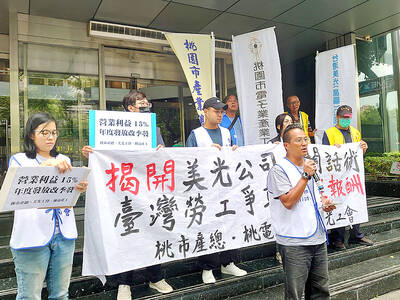
UNION DETERMINATION: Rejecting an offer for a one-time payout as an attempt to influence opinion, the union said a strike at the memory chip manufacturer is possible The Micron Taiwan workers’ union yesterday rejected a one-time payout unveiled by US-based Micron Technology Inc last week, saying it wants a long-term mechanism under which employees would share 15 percent of the company’s operating profits. While the union and the company are still in talks over the dispute, the reward package was proposed unilaterally by the employer without reaching an agreement with the union, union head Jerry Lin (林哲瑞) told reporters. Lin said he suspected the company was seeking to influence public opinion with the move. On Friday last week, Micron announced a reward package under which employees in Taiwan would receive
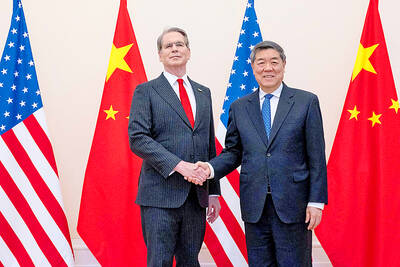
MINIMAL EXPECTATIONS: Analysts think that the two sides are likely to aim for ‘status quo’-level agreements, maintaining civility, without major trade breakthroughs US Secretary of the Treasury Scott Bessent and Chinese Vice Premier He Lifeng (何立峰) were set to meet yesterday to try to set up potential agreements on artificial intelligence (AI), tariffs and critical minerals for a summit in Washington this week between US President Donald Trump and Chinese President Xi Jinping (習近平). The meetings at JPMorgan Chase & Co’s headquarters in Manhattan, which included US Trade Representative Jamieson Greer, were due to start at about 10:30am on Sunday morning and were expected to run all day. Key topics would be the status of a US-China trade truce that is set to expire

BUILDER’s RITES: The topping out ceremony is held when a project being built has its highest point laid out, a sure sign that TSMC’s European project is making solid progress A “topping out” ceremony was held on Monday at a plant under construction in Germany by Taiwan Semiconductor Manufacturing Co (TSMC, 台積電), indicating that the fab is progressing as planned and within budget, the head of a joint-venture company in charge of the project said. A topping out ceremony is the construction milestone of laying the final beam or structural piece at the highest point of a building, and it honors the construction crew, architects and engineers. European Semiconductor Manufacturing Co (ESMC) president Christian Koitzsch said that about 2,000 workers from 106 countries are working around the clock at the site in

APPEAL: Any agreement to produce advanced memory such as HBM or DRAM could run into opposition from Seoul as those technologies are sensitive, sources said South Korea’s SK Hynix Inc is in talks with Intel Corp about a deal that would see it manufacture memory chips on US soil for the first time, three people familiar with the discussions said. Under one potential scenario, SK Hynix would lease part of Intel’s long-planned chipmaking facility in Ohio, they said. Under another scenario, it could form a venture with Intel and major cloud firms that are keen to lock in memory supplies, two of the people said. A deal would relieve pressure on Intel, which has been struggling, and mark a big win for US President Donald


 RSS
RSS