


Yahoo Taiwan Holding Ltd (雅虎) yesterday launched a Taiwan-Hong Kong e-commerce shopping platform, inviting about 1,000 online stores from Taiwan to explore business opportunities of cross-border online shopping.
“The cross-border platform can be successful as Hong Kong has tariff exemption for imports and the consumers there are very interested in Taiwan’s food and cosmetics,” Yahoo Taiwan’s e-commerce group vice president Jacky Wang (王志仁) told a news conference at the eCommerce Expo Asia in the Taipei World Trade Center’s Nangang Exhibition Hall.
Citing international research results, Wang said that the global business-to-consumer cross-border e-commerce market is expected to jump from last year’s US$230 billion to US$1 trillion by 2020.

Photo: Lee Ching-hui, Taipei Times
“The next five years are going to be very important for Yahoo Taiwan to seize the opportunities in cross-border e-commerce,” he said.
Hong Kong is the most suitable market for Taiwan’s online stores moving into the cross-border e-commerce industry, because the territory shares similar cultural and linguistic backgrounds with Taiwan, Wang said.
Taiwan is ranked one of the top five overseas markets for Hong Kong consumers making purchases through online shopping platforms, Wang said, citing company data.
The average monthly salary of a Hong Kong online shopper is NT$110,000 (US$3,340), 2.6 times higher than the Taiwanese average of NT$42,000, which means they have relatively high purchasing power, Wang said.
Yahoo Taiwan is working with Yahoo Hong Kong to offer advertising exposure to Taiwanese online stores during the upcoming 11.11 shopping festival, Wang said.
Singles’ Day (光棍節) on Nov. 11 was reportedly begun by male Chinese university students, who called it Bachelors’ Day, but as its popularity spread it was embraced by both men and women and the name was changed.
Taiwanese shops could station themselves in Hong Kong’s Yahoo Flagship free-of-charge, Wang said, adding that the platform also offers stores complete logistics solutions.
“Yahoo’s services would lower the entry threshold of cross-border e-commerce for the online shops, helping Taiwanese companies enter the international market,” he said.
Taiwan’s e-commerce penetration rate is among the top three in the world, which shows the nation has been successful in developing the business model for retail transactions, the Taiwan Internet and E-Commerce Association (TiEA, 台灣網路暨電子商務產業發展協會) said.
At the expo’s opening ceremony, TiEA chairman Jan Hung-tze (詹宏志) said that e-commerce now accounts for more than 11 percent of Taiwan’s total retail revenue, trailing behind South Korea and the UK, but ahead of the US and China.
While Taiwan lacks large-sized e-commerce operators — defined as those that have market capitalization surpassing US$1 billion — the nation’s nearest small and medium-sized corporate participants have helped the sector grow rapidly, said Jan, who is chairman of PChome Online Inc (網路家庭), a leading Taiwanese e-commerce operator.
The Institute for Information Industry (資策會) has forecast that the local retail e-commerce would earn US$33.4 billion in revenue this year.
Additional reporting by CNA
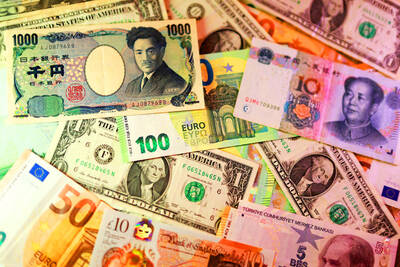
Taiwan’s foreign exchange reserves fell below the US$600 billion mark at the end of last month, with the central bank reporting a total of US$596.89 billion — a decline of US$8.6 billion from February — ending a three-month streak of increases. The central bank attributed the drop to a combination of factors such as outflows by foreign institutional investors, currency fluctuations and its own market interventions. “The large-scale outflows disrupted the balance of supply and demand in the foreign exchange market, prompting the central bank to intervene repeatedly by selling US dollars to stabilize the local currency,” Department of Foreign

ENERGY ISSUES: The TSIA urged the government to increase natural gas and helium reserves to reduce the impact of the Middle East war on semiconductor supply stability Chip testing and packaging service provider ASE Technology Holding Co (日月光投控) yesterday said it planned to invest more than NT$100 billion (US$3.15 billion) in building a new advanced chip testing facility in Kaohsiung to keep up with customer demand driven by the artificial intelligence (AI) boom. That would be included in the company’s capital expenditure budget next year, ASE said. There is also room to raise this year’s capital spending budget from a record-high US$7 billion estimated three months ago, it added. ASE would have six factories under construction this year, another record-breaking number, ASE chief operating officer Tien Wu

The EU and US are nearing an agreement to coordinate on producing and securing critical minerals, part of a push to break reliance on Chinese supplies. The potential deal would create incentives, such as minimum prices, that could advantage non-Chinese suppliers, according to a draft of an “action plan” seen by Bloomberg. The EU and US would also cooperate on standards, investments and joint projects, as well as coordinate on any supply disruptions by countries like China. The two sides are additionally seeking other “like-minded partners” to join a multicountry accord to help create these new critical mineral supply chains, which feed into

For weeks now, the global tech industry has been waiting for a major artificial intelligence (AI) launch from DeepSeek (深度求索), seen as a benchmark for China’s progress in the fast-moving field. More than a year has passed since the start-up put Chinese AI on the map in early last year with a low-cost chatbot that performed at a similar level to US rivals. However, despite reports and rumors about its imminent release, DeepSeek’s next-generation “V4” model is nowhere in sight. Speculation is also swirling over the geopolitical implications of which computer chips were chosen to train and power the new


 RSS
RSS