


Major market players, securities brokers and their major clients said that heavy tax burdens, difficulty turning profits and plans to reallocate funds to markets are the top three reasons for decisions to take flight from the local bourse, a survey released yesterday by the Financial Supervisory Commission (FSC) showed.
As for retail investors, volatility in international markets, increasing misgivings caused by the TAIEX’s continued rise and excessive tax burdens on trading were the main factors holding them back from the market, the survey showed.
It showed that 76 percent of active traders, 94 percent of brokers and their major clients, and 59 percent of retail traders had reduced their positions in the local stock market compared with three years earlier.
The survey showed that active players are opposed to the transaction tax, the levying of a 2 percent supplementary National Health Insurance premium on stock dividends, the halving of the tax deductible amount for stock dividend income and the introduction of a 45 percent bracket for consolidated personal income tax.
However, the 0.3 percent securities transaction tax, instead of the much-maligned capital gains tax, was cited as the main reason behind major players leaving the local market, the survey showed.
On Wednesday, a local brokerage association called on the government to scrap the capital gains tax on stock investments and cut the securities transaction tax from 0.3 percent to 0.15 percent to revitalize the capital market.
The commission sent out 1,122 questionnaires to active players, 300 to security brokers and their major clients, and 200 to retail investors. About 83 percent of active players responded to the survey, while the figure stood at 100 percent for the two other groups.
“The survey is aimed at uncovering the facts surrounding investors’ motivations,” FSC Chairman William Tseng (曾銘宗) said.
Investors voiced several suggestions to the commission, including improving cross-border collaborations with international securities exchanges, delaying the implementation of expanded trading hours, approving a more complete array of day-trading activities and increasing the number of listed exchange traded funds based on Chinese stocks, Tseng said.
“There is no clear and immediate correlation between taxation systems and market performance,” Tseng said, adding that there is no quick fix for the market woes and the tax issue is one of many factors.
“The FSC’s task is to aid in the establishment of an appropriate and just tax system that can stand up to long-term challenges,” he said, adding that he is not pushing for taxes to be as low as possible.
The TAIEX dropped 127 points yesterday, while most neighboring markets closed higher.
Tseng attributed the decline in the local bourse to disappointing earnings by Apple Inc, among other factors.
“One should not assess market performance by merely observing one or two days of trading,” he said.
He estimated that daily turnover in the stock market might not exceed the NT$120 billion to NT$130 billion (US$3.82 billion to US$4.13 billion) range this year.
Turnover was NT$101.12 billion on the Taiwan Stock Exchange yesterday.
Nonetheless, the commission and the Ministry of Finance hold differing views over the tax issue and that is perpetuating uncertainty in the market.
Minister of Finance Chang Sheng-ford (張盛和) stood by taxes on securities transactions and capital gains, saying that the economic slowdown is responsible for the TAIEX’s slump and tax cut talks serve only to blur the issue.
“The poor TAIEX showing has more to do with the economic slowdown and failure to address the fundamental issue does the market no good at all,” Chang told reporters after the Cabinet’s weekly meeting.
It is unfair to blame either tax, since no listed firm has paid any capital gains tax yet and the stock transaction tax has been in place for 23 years, during which time the local bourse has witnessed heavier corrections, he said.
The Cabinet is working to improve the economy and the stock market is likely to get a boost once its measures are in place, he said.
Additional reporting by Crystal Hsu

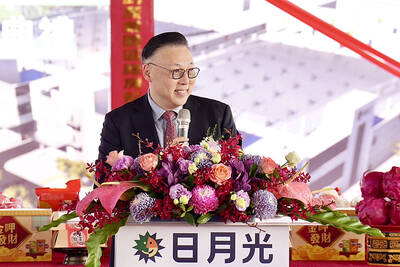
ENERGY ISSUES: The TSIA urged the government to increase natural gas and helium reserves to reduce the impact of the Middle East war on semiconductor supply stability Chip testing and packaging service provider ASE Technology Holding Co (日月光投控) yesterday said it planned to invest more than NT$100 billion (US$3.15 billion) in building a new advanced chip testing facility in Kaohsiung to keep up with customer demand driven by the artificial intelligence (AI) boom. That would be included in the company’s capital expenditure budget next year, ASE said. There is also room to raise this year’s capital spending budget from a record-high US$7 billion estimated three months ago, it added. ASE would have six factories under construction this year, another record-breaking number, ASE chief operating officer Tien Wu

The EU and US are nearing an agreement to coordinate on producing and securing critical minerals, part of a push to break reliance on Chinese supplies. The potential deal would create incentives, such as minimum prices, that could advantage non-Chinese suppliers, according to a draft of an “action plan” seen by Bloomberg. The EU and US would also cooperate on standards, investments and joint projects, as well as coordinate on any supply disruptions by countries like China. The two sides are additionally seeking other “like-minded partners” to join a multicountry accord to help create these new critical mineral supply chains, which feed into

For weeks now, the global tech industry has been waiting for a major artificial intelligence (AI) launch from DeepSeek (深度求索), seen as a benchmark for China’s progress in the fast-moving field. More than a year has passed since the start-up put Chinese AI on the map in early last year with a low-cost chatbot that performed at a similar level to US rivals. However, despite reports and rumors about its imminent release, DeepSeek’s next-generation “V4” model is nowhere in sight. Speculation is also swirling over the geopolitical implications of which computer chips were chosen to train and power the new

Intel Corp is joining Elon Musk’s long-shot effort to develop semiconductors for Tesla Inc, Space Exploration Technologies Corp and xAI, marking a surprising twist in the chipmaker’s comeback bid. Intel would help the Terafab project “refactor” the technology in a chip factory, the company said on Tuesday in a post on X, Musk’s social media platform. That is a stage in the development process that typically helps make chips more powerful or reliable. The chipmaker’s shares jumped 4.2 percent to US$52.91 in New York trading on Tuesday. The Terafab project is a grand plan by Musk to eventually manufacture his own chips for


 RSS
RSS