


Ceva Inc’s bid to rebuild its battered chip design business by catering to Chinese customers is starting to pay off.
Not that the revenue has really started to pour in — it is yet to regain its 2011 peak — but the company’s share price is soaring as investors bet that sales are on the rise. The stock has climbed 52 percent since a low in October to US$19.20 in New York, close to the highest since July 2013.
For Ceva chief executive officer Gideon Wertheizer, that rebound, which comes after a 63 percent sell-off since 2011, serves as something of a vote of confidence in his plan to carve out a niche taking on Qualcomm Inc in China. While Qualcomm is the world’s largest mobile phone-chip maker, China’s market is bigger than any other in the world, giving Wertheizer an opportunity to sell to companies focused on low-end phones that he expects will take a growing slice of the business.
“We are in a trend to increase our market share, because we are expanding our share against incumbents like Qualcomm,” Wertheizer said by phone from Herzliya, Israel. “We still have a lot to grow in the handset market, while they are mature.”
Wertheizer was the head of Ceva when it was the licensing unit of DSP Group in Israel and became CEO of the independent company, based in Mountain View, California, in 2005. Its rally since Oct. 7 compares with a 1.3 percent advance on the Bloomberg Israel-US Equity index.
Ceva, whose market value has been cut in half to US$388 million from its 2011 peak, is rebuilding its share of the mobile-phone chip market after its fortunes collapsed alongside larger players like Finnish handset maker Nokia Oyj, and the exit of customers like Broadcom Corp and ST-Ericsson. The company designs digital signal processors that power mobile phones, and licenses those designs to chip designers for an upfront fee. It also collects royalties on the sale of phones later built off its plans.
Chinese chip designers like Spreadtrum Communications Inc (展訊通信) and MediaTek Inc (聯發科) that use Ceva’s technology are poised to take market share from Qualcomm, which was slapped with a US$975 million fine this month by Chinese antitrust regulators, according to Barclays PLC and Wunderlich Securities Inc.
San Diego-based Qualcomm spokeswoman Emily Kilpatrick declined to comment.
“China is trying to develop an indigenous semiconductor capability and that’s good for Ceva because they’re licensing technology to a lot of those companies,” Matt Robison, a San Francisco-based analyst with Wunderlich, said by phone on Friday.
Ceva’s revenue rose 4 percent to US$50.8 million last year, the first increase since 2011, and net income is forecast to rise 8 percent this year. Five out of eight analysts recommend buying the shares, with an average return forecast of 20 percent over the next 12 months.
Wertheizer is also feeling optimistic because he is diversifying beyond the mobile phone market. Ceva’s wireless communications technology is being designed into chips for automated driver assistance systems, hearing aids and game consoles. Thirty-two of 36 license agreements last year were for applications outside of mobile phones, the company said on a Feb. 3 earnings call.

HORMUZ ISSUE: The US president said he expected crude prices to drop at the end of the war, which he called a ‘minor excursion’ that could continue ‘for a little while’ The United Arab Emirates (UAE) and Kuwait started reducing oil production, as the near-closure of the crucial Strait of Hormuz ripples through energy markets and affects global supply. Abu Dhabi National Oil Co (ADNOC) is “managing offshore production levels to address storage requirements,” the company said in a statement, without giving details. Kuwait Petroleum Corp said it was lowering production at its oil fields and refineries after “Iranian threats against safe passage of ships through the Strait of Hormuz.” The war in the Middle East has all but closed Hormuz, the narrow waterway linking the Persian Gulf to the open seas,

Apple Inc increased iPhone production in India by about 53 percent last year and now makes a quarter of its marquee devices there, reflecting the US company’s efforts to avoid tariffs on China. The company assembled about 55 million iPhones in India last year, up from 36 million a year earlier, people familiar with the matter said, asking not to be named because the numbers aren’t public. Apple makes about 220 million to 230 million iPhones a year globally, with India’s share of the total increasing rapidly. Apple has accelerated its expansion in the world’s most populous country in recent years, bolstered

HEADWINDS: The company said it expects its computer business, as well as consumer electronics and communications segments to see revenue declines due to seasonality Pegatron Corp (和碩) yesterday said it aims to grow its artificial intelligence (AI) server revenue more than 10-fold this year from last year, driven by orders from neocloud solutions clients and large cloud service providers. The electronics manufacturing service provider said AI server revenue growth would be driven primarily by the Nvidia Corp GB300 server platform. Server shipments are expected to increase each quarter this year, with the second half likely to outperform the first half, it said. The AI server market is expected to broaden this year as more inference applications emerge, which would drive demand for system-on-chip, application-specific integrated circuits
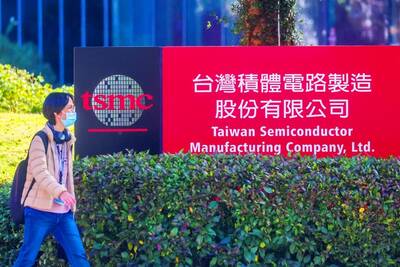
PROJECTION: TSMC said it expects strong growth this year, with revenue in US dollars projected to grow by about 30 percent, outperforming the industry Taiwan Semiconductor Manufacturing Co (TSMC, 台積電) yesterday reported consolidated sales last month reached NT$317.66 billion (US$9.98 billion), the highest ever for the month of February, driven by robust demand for chips built using the company’s advanced 3-nanometer (3nm) process. Last month’s figure was up 22.2 percent from a year earlier, but fell 20.8 percent from January, the world’s largest contract chipmaker said in a statement. For the first two months of the year, TSMC posted cumulative sales of NT$718.91 billion, up 29.9 percent from a year earlier. Analysts attributed the growth to sustained global demand for artificial intelligence (AI) products


 RSS
RSS