


Alibaba Group Holding Ltd (阿里巴巴), which faced scrutiny for allegedly selling counterfeit goods on its Web sites, said it removed 90 million listings that might have breached intellectual property laws.
The product listings were taken down across Alibaba’s e-commerce platforms until September, chief risk officer Polo Shao (邵曉峰) said yesterday at a press conference in Hangzhou, China.
Alibaba, which raised a record US$25 billion in an initial public offering (IPO) in September, said it spent US$160.7 million from the beginning of last year through last month to block counterfeit products and boost consumer protection.
The strategy is part of Alibaba’s plan to build its reputation, now that the company is larger in market value than General Electric Co and Procter & Gamble Co.
Controlling the sales of fake and pirated goods will be crucial in maintaining credibility with investors and limiting risks of lawsuits, analysts said.
“Selling counterfeits has been one of the key criticisms that Alibaba has faced,” Beijing-based Forrester Research Inc analyst Vanessa Zheng said. “Even though the company’s shares have done well, it does not mean that Alibaba is not aware of the risks down the road.”
China’s largest e-commerce company has gained 60 percent since its market debut, compared with a 0.9 percent decline in the NYSE Composite Index.
The company’s efforts to fight copyright infringement are part of a larger legal issue in China.
China is host to a number of markets known for “prominent and extensive availability of counterfeit merchandise,” the Office of the US Trade Representative (USTR) said in a February report. It cited Beijing’s Silk Market and Guangdong’s Zengcheng International Jeans Market, where vendors set up stalls, as examples.
“The fact that Alibaba has a system set up to raise complaints about counterfeit products is an improvement compared with the other on-the-ground shops,” Zheng said.
Alibaba’s most popular platforms are Taobao and Tmall.com, which connect consumers to retail brands. The platforms do not sell merchandise themselves and make most of their sales from commissions and advertising.
To safeguard against infringements, vendors are required to make deposits with Alibaba to ensure that their products are genuine, allowing buyers and sellers to rate each other and helping consumers get refunds.
The company had penalized 131,000 sellers as of Sept. 30, and its cooperation with Chinese law enforcement agencies in more than 1,000 counterfeiting cases this year led to the arrests of 400 suspects, the company said.
Alibaba was removed from the US government’s Notorious Markets list in 2012.
Taiwan Semiconductor Manufacturing Co (TSMC, 台積電) last week recorded an increase in the number of shareholders to the highest in almost eight months, despite its share price falling 3.38 percent from the previous week, Taiwan Stock Exchange data released on Saturday showed. As of Friday, TSMC had 1.88 million shareholders, the most since the week of April 25 and an increase of 31,870 from the previous week, the data showed. The number of shareholders jumped despite a drop of NT$50 (US$1.59), or 3.38 percent, in TSMC’s share price from a week earlier to NT$1,430, as investors took profits from their earlier gains
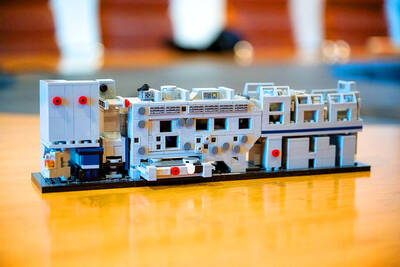
In a high-security Shenzhen laboratory, Chinese scientists have built what Washington has spent years trying to prevent: a prototype of a machine capable of producing the cutting-edge semiconductor chips that power artificial intelligence (AI), smartphones and weapons central to Western military dominance, Reuters has learned. Completed early this year and undergoing testing, the prototype fills nearly an entire factory floor. It was built by a team of former engineers from Dutch semiconductor giant ASML who reverse-engineered the company’s extreme ultraviolet lithography (EUV) machines, according to two people with knowledge of the project. EUV machines sit at the heart of a technological Cold
AI TALENT: No financial details were released about the deal, in which top Groq executives, including its CEO, would join Nvidia to help advance the technology Nvidia Corp has agreed to a licensing deal with artificial intelligence (AI) start-up Groq, furthering its investments in companies connected to the AI boom and gaining the right to add a new type of technology to its products. The world’s largest publicly traded company has paid for the right to use Groq’s technology and is to integrate its chip design into future products. Some of the start-up’s executives are leaving to join Nvidia to help with that effort, the companies said. Groq would continue as an independent company with a new chief executive, it said on Wednesday in a post on its Web

CHINA RIVAL: The chips are positioned to compete with Nvidia’s Hopper and Blackwell products and would enable clusters connecting more than 100,000 chips Moore Threads Technology Co (摩爾線程) introduced a new generation of chips aimed at reducing artificial intelligence (AI) developers’ dependence on Nvidia Corp’s hardware, just weeks after pulling off one of the most successful Chinese initial public offerings (IPOs) in years. “These products will significantly enhance world-class computing speed and capabilities that all developers aspire to,” Moore Threads CEO Zhang Jianzhong (張建中), a former Nvidia executive, said on Saturday at a company event in Beijing. “We hope they can meet the needs of more developers in China so that you no longer need to wait for advanced foreign products.” Chinese chipmakers are in


 RSS
RSS