


In a gritty Rome neighborhood, a soup kitchen is serving up lip-smacking gourmet food donated from a famous delicatessen as part of a new initiative to combat food waste and feed a growing need in recession-hit Italy.
“Of course it’s good. This is a VIP soup kitchen. We get a first course, second course and dessert. It’s like a trattoria,” Alessandro, a homeless Moldovan builder, told reporters as he ate a sorbet in the San Benedetto Parish canteen.
Organizers of the project, called “Pasto Buono” (Good Meal), contact gourmet grocers and restaurants that throw out scraps and day-old food and puts them in touch with organizations that run soup kitchens like Catholic charity Caritas.
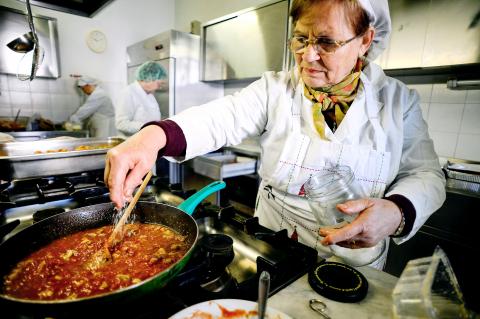
Photo: AFP
Regular runs are arranged. One goes daily from the luxury eatery Volpetti — a destination for fine diners — to the nearby Caritas canteen at San Benedetto in Ostiense, a dilapidated former industrial quarter south of Rome’s city center.
Pizza, pasta, meat and fish all criss-cross the Italian capital, where great wealth lives side by side with increasing desperation caused by a sharp rise in unemployment and homelessness.
In the first few months of this year, Italians have had to cut their spending on food by 3 percent. At the same time, 6 million tonnes of perfectly good food are thrown out in the country every year.
Pasto Buono so far includes about 30 restaurants, bars, patisseries and delicatessens, including famous tiramisu maker Pompi.
“This initiative is very important. It channels the generosity of shopkeepers and the needs of the poorest,” said Father Fabio Bartoli, parish priest at San Benedetto, which feeds about 35 people a day.
Everyone contributes in whatever way they can.
Strabbioni, a trendy restaurant in the city center, makes six meals three times a week for the homeless who sleep near Termini Railway Station.
Tiro a Volo, the restaurant of an exclusive sports club, gives away leftovers from its lavish Sunday buffets every Monday to a soup kitchen at San Bellarmino.
“Sometimes it’s not enough, so I have asked them to prepare two special plates of biscuits,” club director Michele Anastasio Pugliese said.
At Volpetti, employees set aside leftovers in white cardboard boxes every night for pick-up in the morning by a van from Caritas.
Volunteers say former middle-class Italians who have been hit hard by the government’s austerity measures are among the “new poor” coming to soup kitchens, while immigrants who used to attend have left the country.
At the San Benedetto soup kitchen, 58-year-old Donato — one of the “new poor” — is grateful.
“I used to be a jeweler, but I was badly in debt. Now I’ve lost everything,” he said. “For the past two years, I’ve been sleeping in my car. I come and eat here for lunch and in the evenings, I go to the supermarket and steal bread.”
Charities complain that initiatives like Pasto Buono are limited because of the red tape that potential donors have to deal with.
“There is a bureaucracy,” Pasto Buono director Gregorio Fogliano said in an interview, calling for new laws to simplify the process.
“The eateries that have joined are top quality. These are people who apart from wanting to do some good, also want to get rid of unsold food,” he said.
His aim is to provide 110,000 meals a year in Rome.
The initiative began in Genoa in 2007 and is now up and running in Florence as well. It plans to extend to Palermo, Sicily, in the future.

Taiwanese firms have increased investment in the Philippines in recent years as Manila’s ties with Washington deepen and global supply chains continue to shift away from China, an expert at the Chung-Hua Institution for Economic Research (CIER, 中華經濟研究院) said yesterday. The Philippines had not been among Taiwanese investors’ top choices in Southeast Asia, CIER Taiwan ASEAN Studies Center director Kristy Hsu (徐遵慈) said at a seminar in Taipei. However, Taiwan’s investment in the country has grown significantly since the COVID-19 pandemic, reaching US $257 million last year, a high in recent years, she said. Although Taiwan’s total investment in the Philippines still lags

Intel Corp regards Taiwan Semiconductor Manufacturing Co (TSMC, 台積電) as a longstanding partner, as the US chipmaker would continue outsourcing production of advanced chips to TSMC, Intel chief executive officer Lip-Bu Tan (陳立武) said yesterday. “I don’t look at people as competitors. I look at the collaboration... Nvidia is also, you know, a good friend,” Tan told a news conference following his keynote speech at the Computex trade show in Taipei. “It’s a very trusted partnership for us... We are a big, top customer for them, and we’re going to continue doing that,” he said, referring to TSMC, the world’s largest foundry

Artificial intelligence (AI) agents would supplant smartphones as the center of people’s digital lives, fundamentally reshaping personal devices and driving a major computing upgrade cycle, Qualcomm Inc CEO Cristiano Amon said yesterday. In his keynote speech for this year’s Computex trade show in Taipei, Amon said that the rise of "agentic AI" — AI systems capable of reasoning, planning and carrying out tasks autonomously — would transform how people interact with technology across phones, PCs, vehicles and wearable devices. Describing the technology as the next major evolution in computing, Amon said that "2026 is the year of agents.” For decades, smartphones have sat
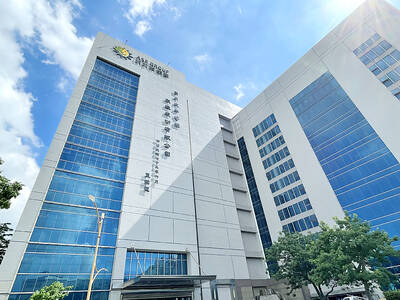
The average pay to employees by ASE Technology Holding Co (日月光投控) was the highest among the companies listed on the local main board last year, while contract chipmaker Taiwan Semiconductor Manufacturing Co (TSMC, 台積電) ranked seventh, the Taiwan Stock Exchange (TWSE) said on Monday. Data compiled by the exchange showed ASE Technology, the world’s largest chip packaging and testing services provider, paid its employees an average of NT$6.28 million (US$199,746) last year, up 40 percent from a year earlier. TSMC, the world’s largest contract chipmaker and the most profitable company in Taiwan, paid its employees NT$4.09 million on average, up


 RSS
RSS