


Asian currencies dropped by the most since January this week on speculation regional central banks would allow their exchange rates to depreciate to keep exports competitive with Japan, where the yen fell to a four-year low.
The New Taiwan dollar and the South Korean won are more sensitive to the yen’s weakness as they compete for global market share. Those exchange rates, along with the Malaysian ringgit, led this week’s drop.
Asian currencies also fell amid rising demand for the US dollar, after US retail sales beat economists’ forecasts.
US RECOVERY
“Policymakers in countries competing with Japan remain sensitive about the yen’s move and there are some intervention concerns in these markets,” said Koji Fukaya, CEO and foreign-exchange strategist at FPG Securities Co in Tokyo. “There’s also general [US] dollar strength on the back of optimism over the US economic recovery.”
The Bloomberg-JPMorgan Asia Dollar Index, which tracks the 10 most-active currencies excluding the yen, declined 0.5 percent from a week ago to 117.42 on Friday. That was the biggest drop since the period ending Jan. 25.
The won dropped 1 percent to 1,117.10, the ringgit weakened 1 percent to 3.0220 and the NT dollar fell 0.9 percent to NT$30.06. South Korea’s markets were shut yesterday for a holiday.
The won touched a three-week low of 1,118.96 per US dollar on Thursday after the Financial Services Commission said in an e-mailed statement that it would monitor market risks, including the weak yen, and take preemptive measures if needed. South Korean Finance Minister Hyun Oh-seok said companies should strengthen their competitiveness because the yen was likely to stay low for “quite some time,” according to a Yonhap News report this week.
Japan’s currency reached ¥103.31 per US dollar on Friday in Tokyo, the weakest level since October 2008. It has lost 16 percent this year, the most in Asia.
“The yen will probably weaken” further this year, said Tarsicio Tong (湯健揚), a currency trader at Union Bank of Taiwan (聯邦銀行) in Taipei. “Currencies like the Taiwan dollar and the won will follow the trend.”
The Dollar Index, which tracks the greenback against the currencies of six major trading partners, rose 1.3 percent this week, the most since February.
The ringgit snapped an eight-week winning streak after economic growth slowed to the least since 2009. Malaysian Prime Minister Najib Razak was re-elected in a May 5 poll, spurring a rally in the nation’s assets.
First-quarter GDP rose 4.1 percent from a year earlier, less than a 6.5 percent increase in the preceding period and the 5.5 percent forecast in a Bloomberg survey, official data showed on Wednesday.
Elsewhere in Asia this week, Indonesia’s rupiah dropped 0.2 percent to 9,757 per US dollar yesterday, the Philippine peso lost 0.2 percent to 41.193 and Vietnam’s dong declined 0.2 percent to 20,985. India’s rupee slipped 0.2 percent to 54.885, China’s yuan was little changed at 6.1419 and the Thai baht fell 0.3 percent to 29.86.
BEATING THE EURO
The US dollar also gained the most in almost two months against the euro amid bets the US Federal Reserve would slow its asset purchases amid signs the world’s biggest economy is accelerating.
The greenback rose versus all of its 16 most-traded peers this week as US retail sales unexpectedly increased, a consumer-confidence gauge climbed and leading indicators beat forecasts. The euro fell to a six-week low versus the US dollar as the currency bloc’s economy shrank for a sixth straight quarter. The yen slid for a third week.
The US currency strengthened 1.2 percent to US$1.2839 per euro this week in New York. It touched US$1.2797 on Friday, the strongest since April 4. The dollar appreciated 1.6 percent to ¥103.21 and touched ¥103.31, the strongest level since October 2008. Japan’s currency fell 0.4 percent to ¥132.51 per euro.
The pound fell 1.2 percent in the week to US$1.5170 at 5:15pm London time on Friday after dropping to US$1.5158, the lowest level since April 4. Sterling was at £0.8449 per euro, from £0.8457 on May 10.

HSBC Holdings PLC is deepening its commitment to Taiwan as the economy emerges as one of the bank’s fastest-growing markets globally, driven by an artificial intelligence (AI) investment boom, expanding cross-border trade, and rising wealth creation. “The advantage that Taiwan has is a growth story linked to the semiconductor and broader AI industries, strong underlying corporate performance, and wealth creation,” said Surendra Rosha, HSBC’s co-chief executive for Asia and the Middle East, in an exclusive interview with the Taipei Times on June 2, during this year’s HSBC Taiwan Conference. That combination has helped HSBC cement its position as the most profitable international
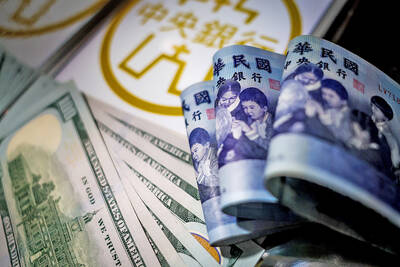
The New Taiwan dollar yesterday fell sharply against the US dollar to close at its lowest level since May 22 amid a massive outflow of funds from the country because of investors panicking over global equity markets. The NT dollar ended at NT$31.580 against the US dollar, slightly lower than its close of NT$31.568 on May 22, after moving between NT$31.5 and NT$31.648 on combined turnover of US$3.062 billion on the Taipei Foreign Exchange and the Cosmos Foreign Exchange. The NT dollar received a significant hit in the morning session, slumping as much as NT$0.173 at a time when other Asian currencies
Taiwan Semiconductor Manufacturing Co (TSMC, 台積電) is now ranked ninth among the world’s 100 most valuable companies after its market capitalization more than doubled over the past year, PricewaterhouseCoopers (PwC) Taiwan said in a report last month. TSMC’s market capitalization surged 101 percent year-on-year to US$1.427 trillion as of March 31, the accounting and consulting firm’s 2026 Global Top 100 Companies by Market Capitalization report said. The gain catapulted the world’s largest contract chipmaker from 12th place to ninth in the rankings, and it was the fastest-growing among the global top 10, it said. TSMC was the only Taiwanese company among the top
Taiwan Semiconductor Manufacturing Co (TSMC, 台積電) yesterday reported record revenue of NT$416.975 billion (US$13.17 billion) for last month, putting the world’s largest contract chipmaker on track to set a record for quarterly revenue. Last month’s figure surpassed March’s record NT$415.19 billion and represented increases of 1.5 percent from April and 30.1 percent from a year earlier. For the first five months of the year, TSMC generated NT$1.96 trillion in revenue, up 30 percent year-on-year, it said in a statement. TSMC has forecast second-quarter revenue of between US$39 billion and US$40.2 billion, representing sequential growth of about 10 percent and year-on-year growth of about


 RSS
RSS