


US stocks closed out another week of new record highs on Friday, as investors focused on the positive side of mixed economic news and corporate earnings.
Retail sales barely budged higher last year and jobless claims rose, but permits to build housing soared and consumer inflation remained tame, data showed.
A pair of better-than-expected reports on Friday — on consumer confidence and the economic outlook — drove a rally that pushed the Dow and S&P 500 to end-of-the-week all-time highs for the third straight week.
Over the week, the Dow Jones Industrial Average gained 235.91 points (1.56 percent) to finish at 15,354.40.
The tech-rich NASDAQ Composite Index increased 62.39 points (1.82 percent) to 3,498.97, and the broad-based S&P 500 jumped 32.42 points (1.98 percent) to 1,666.12.
“The bulls did their thing again this week, overcoming any concerns about the Fed tapering its asset purchases soon,” Briefing.com analysts said.
Wall Street is closely watching economic data to gauge when the US Federal Reserve will begin exiting its massive bond-buying program that is supporting growth.
Economic data continued to suggest weak growth, or “a half-speed recovery,” Standard & Poor’s chief investment officer Sam Stovall said.
Friday’s data capped the week with a positive note. The University of Michigan’s index of consumer sentiment reading for this month jumped to the highest level since July 2007, and the Conference Board’s leading economic index rebounded last month from a dip in March. The reading pointed to “a continuing economic expansion with some upside potential,” the research firm said.
In corporate news, Wal-Mart reported weaker-than-expected fiscal first-quarter earnings and said comparable sales at its US stores fell 1.4 percent from a year earlier.
The world’s largest retailer said the drop in US revenue came as consumers felt the pinch from the higher payroll sales tax, among other factors.
“We are definitely slow growth and we don’t see where it’s going to pick up,” said Bud Kasper, a certified financial planner at Barber Financial Group.
For some, the silver lining in such a lackluster economic performance is that it means the Fed was likely to continue with its aggressive bond-buying program.
However, Anthony Conroy, a trader at BNY Convergex Group, said the market was beginning to prepare for the Fed to curtail the program.
“The market believes we’re getting close to the end of the Fed’s help and that they’ve done enough for right now and we can sustain ourselves,” Conroy said.
He predicted the Fed would not immediately scale back the program, owing to the continued weakness in the economy.
Fed Chairman Ben Bernanke is scheduled to testify before the US Congress on Wednesday, the same day the Fed will release the minutes from its last policy meeting early this month.
Next week’s economic calendar features data on durable goods orders and sales of existing and new homes.
On the earnings front will be reports from home-improvement retailer Home Depot on Tuesday, and Staples and Hewlett-Packard on Wednesday.

HSBC Holdings PLC is deepening its commitment to Taiwan as the economy emerges as one of the bank’s fastest-growing markets globally, driven by an artificial intelligence (AI) investment boom, expanding cross-border trade, and rising wealth creation. “The advantage that Taiwan has is a growth story linked to the semiconductor and broader AI industries, strong underlying corporate performance, and wealth creation,” said Surendra Rosha, HSBC’s co-chief executive for Asia and the Middle East, in an exclusive interview with the Taipei Times on June 2, during this year’s HSBC Taiwan Conference. That combination has helped HSBC cement its position as the most profitable international
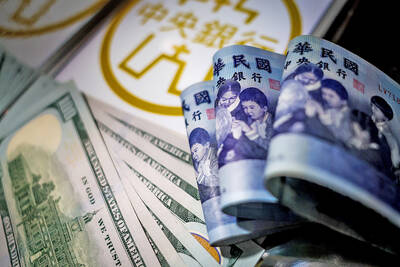
The New Taiwan dollar yesterday fell sharply against the US dollar to close at its lowest level since May 22 amid a massive outflow of funds from the country because of investors panicking over global equity markets. The NT dollar ended at NT$31.580 against the US dollar, slightly lower than its close of NT$31.568 on May 22, after moving between NT$31.5 and NT$31.648 on combined turnover of US$3.062 billion on the Taipei Foreign Exchange and the Cosmos Foreign Exchange. The NT dollar received a significant hit in the morning session, slumping as much as NT$0.173 at a time when other Asian currencies
Taiwan Semiconductor Manufacturing Co (TSMC, 台積電) is now ranked ninth among the world’s 100 most valuable companies after its market capitalization more than doubled over the past year, PricewaterhouseCoopers (PwC) Taiwan said in a report last month. TSMC’s market capitalization surged 101 percent year-on-year to US$1.427 trillion as of March 31, the accounting and consulting firm’s 2026 Global Top 100 Companies by Market Capitalization report said. The gain catapulted the world’s largest contract chipmaker from 12th place to ninth in the rankings, and it was the fastest-growing among the global top 10, it said. TSMC was the only Taiwanese company among the top
Taiwan Semiconductor Manufacturing Co (TSMC, 台積電) yesterday reported record revenue of NT$416.975 billion (US$13.17 billion) for last month, putting the world’s largest contract chipmaker on track to set a record for quarterly revenue. Last month’s figure surpassed March’s record NT$415.19 billion and represented increases of 1.5 percent from April and 30.1 percent from a year earlier. For the first five months of the year, TSMC generated NT$1.96 trillion in revenue, up 30 percent year-on-year, it said in a statement. TSMC has forecast second-quarter revenue of between US$39 billion and US$40.2 billion, representing sequential growth of about 10 percent and year-on-year growth of about


 RSS
RSS