


Fujitsu Ltd, Japan’s biggest provider of computer services, said the company will miss its annual shipment target for personal computers amid slow demand for Microsoft Corp’s Windows 8 operating system.
Initial demand for the software, introduced in October, is “weak,” Fujitsu president Masami Yamamoto told reporters in Tokyo on Thursday. A slump in demand in Europe resulting from the eurozone sovereign debt crisis will also erode sales he said. PC deliveries for the year ending March 31 next year could be more than 6 million units, compared with an October estimate of 7 million units, he said.
US retail sales of devices running Windows systems fell 21 percent from a year earlier in the four weeks after Microsoft released Windows 8 on Oct. 26, according to a Nov. 29 report by Port Washington, New York-based NPD Group Inc. The decrease has been fueled by a 24 percent drop in sales of notebook computers as customers opt for Apple Inc’s iPad or tablets powered by Google Inc’s Android software.
“We can’t be optimistic about the PC industry,” said Yoshihisa Toyosaki, a Tokyo-based analyst at Architect Grand Design, an electronics research and consulting company. “PC makers’ bet on Windows 8 has failed as cheaper tablet computers are taking away customers.”
Fujitsu is focusing on information technology services, helping it weather a slump in electronics sales that contributed to record losses at Sony Corp, Panasonic Corp and Sharp Corp. Yamamoto said the company does not plan to lower prices for its PCs, which along with mobile phones accounted for a combined 20 percent of Fujitsu’s revenue in the year that ended March 31, according to data compiled by Bloomberg.
“Fujitsu doesn’t plan to join its competitors in discounting [to sustain sales],” Yamamoto said. The company needs to strengthen its services in overseas markets, shifting from a product-focused approach, he said.
The company had said earlier it was counting on shipments in Europe and other overseas markets to account for more than half of total PC sales in the current fiscal year.
Shares in Fujitsu, a supplier to Samsung Electronics Co, fell 0.8 percent to ¥360 at the close of trading on the Tokyo Stock Exchange. The stock has declined 10 percent this year, compared with a 23 percent gain in the benchmark Nikkei 225 Stock Average.
Dell Inc, the world’s third-largest PC maker, said on Dec. 12 it is seeing strong demand for computers and tablets running Windows 8.
Interest in the operating system is “quite high,” Dell chief executive officer Michael Dell said at a conference in Austin, Texas.
Microsoft plans to overhaul how it develops its flagship Windows operating system in a strategic shift aimed at keeping pace with nimbler rivals Apple and Google, people familiar with the matter said last month.
Microsoft aims to upgrade the software more frequently, about once a year, rather than every two or three years as it has done in the past, the people said. The world’s largest software maker has floundered as personal computers, where it has long dominated, have lost ground to the smartphones and tablets championed by Apple and Google.
Fujitsu, the maker of the K supercomputer, will decide on a restructuring plan for its unprofitable chip business by March 31 next year, Yamamoto said, declining to provide details. The company is trying to rely more on other firms to make its chips instead of running its own chip-fabrication plants.
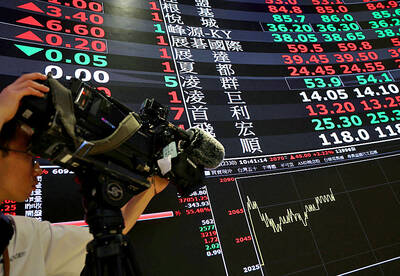
After several years flying high as Asia’s best Nvidia Corp proxy, Taiwan Semiconductor Manufacturing Co (TSMC, 台積電) is increasingly vying with other artificial intelligence (AI) stocks for investor attention. Stock traders are chasing a wider array of beneficiaries as mainstream usage of AI creates demand for hardware beyond the most-advanced chips TSMC makes for Nvidia. Subthemes from the deepening memory crunch to advances in robotics are also luring bids. At the same time, investment caps on single stocks are pushing funds to diversify, while retail investors long familiar with TSMC through its US depositary receipts are being offered a broader set of

Netherlands-based semiconductor equipment supplier ASML Holding NV yesterday said that it is planning to hire an additional 1,000 people in Taiwan this year in response to growing demand from clients. ASML had previously planned to recruit 600 people this year, but that the plan has been adjusted upward, ASML vice president and ASML Taiwan general manager Grace Wang (汪佳慧) told reporters. ASML has a workforce of more than 4,500 in Taiwan, accounting for about 10 percent of its global total, Wang said. This year’s recruitment campaign would focus on adding people in the customer support, manufacturing and supply chain domains to assist ASML

UNDER MICROSCOPE: Taiwan detained three people who allegedly conspired to buy servers in Taiwan and export them using fraudulent documentation, prosecutors said Nvidia Corp chief executive officer Jensen Huang (黃仁勳) on Saturday urged Super Micro Computer Inc to tighten up on compliance after Taiwan detained three people this week for allegedly making fraudulent declarations about artificial intelligence (AI) servers made by its US partner. The development marked the nation’s first crackdown on semiconductor smuggling, which grew after the US slapped restrictions on exports of high-end chips such as Nvidia AI accelerators to China. Nvidia is “rigorous” in explaining regulations to all of its partners, Huang told reporters after arriving in Taipei. “Ultimately Super Micro has to run their own company,” he said in response to

Nvidia Corp yesterday announced that CEO Jensen Huang (黃仁勳) would attend an employee meeting in Taipei tomorrow to celebrate the launch of the company’s Taiwan headquarters project. Huang would attend a gathering at the site of Nvidia’s planned headquarters in Beitou Shilin Technology Park (北投士林科技園區), the company said in a statement. After arriving in Taiwan on Saturday last week, Huang told reporters that he plans to meet with Quanta Computer Inc (廣達) chairman Barry Lam (林百里) and Taiwan Semiconductor Manufacturing Co (TSMC, 台積電) chairman C.C. Wei (魏哲家), and would attend the groundbreaking ceremony for Nvidia’s Taiwan headquarters tomorrow. Nvidia has not yet applied


 RSS
RSS