


Deep in the heart of the Gobi Desert in Mongolia amid a landscape of sand dunes and ice canyons, one of the world’s biggest copper mines is about to come on stream.
Anglo-Australian miner Rio Tinto and Canada’s Turquoise Hill Resources have jointly led construction of the US$6.2 billion Oyu Tolgoi mine, which is expected to produce 450,000 tonnes of copper concentrate a year at its peak.
Oyu Tolgoi LLC has estimated that by the time the mine is in full production in 2019, peak earnings could provide up to one-third of government revenue, averaging 800 billion tugriks (about US$575 million) per year over the life of the project.
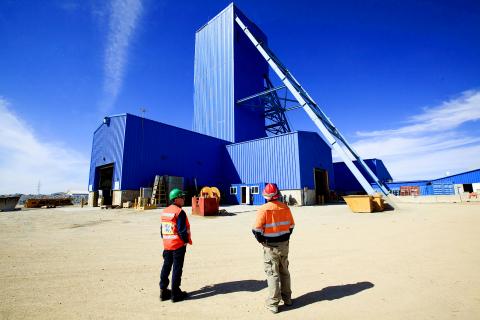
Photo: EPA
That holds out the promise of vast revenues for the government that can be spent on infrastructure and education if corruption can be kept in check.
“Most countries that have natural wealth have failed,” Mongolian President Elbegdorj Tsakhia said.
“Those that succeed are open countries, meaning they have open policy and democracy,” said the 49-year-old, who studied at Harvard’s Kennedy School of Government and was elected in 2009.
“I regard my country as an open country,” he added.
The state owns 34 percent of the joint venture, which is expected to be in operation for at least 50 years. However, according to a 2010 study by the IMF, the government will take 55 to 71 percent of revenues because of royalties and taxes.
The first trucks are envisioned rumbling towards the Chinese border within the first half of next year, where Chinese buyers will take the concentrate to copper smelters for further processing.
The metals are expected to be used in construction materials and consumer electronics, such as copper pipes, iPads and iPhones.
An estimated 9400kg of gold will also be extracted from the concentrate each year, worth about US$553 million at today’s market rate.
How Mongolia will manage its revenue from the project is a key question for Elbegdorj’s administration, says Oscar Mendoza, managing partner at Mongolia Asset Management, an investment advisor group based in Ulan Bator.
“Will it be Nigeria or Norway? Will it be the Philippines or Qatar?” he said.
Mongolian officials are aware of the so-called “resource curse” that often afflicts developing nations whose enormous natural riches fail to translate into better lives for citizens.
The Mongolian president cited Norway, Australia and Chile as models for his landlocked nation of 2.7 million people whose average per capita income was US$3,140 last year, according to the World Bank.
In order to fight possible corruption, the government has put in place what it claims will be a transparent treasury system across its ministries in order to track the flow of money.
“We have been working with them for several years and they have made great progress in many areas. They do have transparency of revenues,” World Bank resident representative Coralie Gevers said.
Mongolia is compliant with the Extractive Industries Transparency Initiative (EITI), a Norway-based organization which uses third-party auditors to inspect mining revenue data provided by governments and mining companies.
One of Mongolia’s great hopes for spreading wealth is a so-called Human Development Fund, established to boost social welfare projects. Rio Tinto has already contributed US$803 million to the government in taxes, pre-payments and other fees.
However, the mine — open pit initially and underground starting in 2016 — faces objections from some local residents concerned about the environmental impact.
Herders have complained about dust kicked up by trucks, which they say harms livestock. Last month, the campaign group OT Watch filed a claim against the mine on behalf of herders seeking compensation.
The mine has also run into political headwinds as vocal backbench legislators demand the government amend its 2009 investment agreement to increase its stake in the project to 50 percent.
Mongolian Prime Minister Altankhuyag Norov has not endorsed the calls, but says Mongolia “will revisit and reconsider some aspects of the agreement” because of higher development costs — to the angst of the private developers.
“When a few parliamentarians push government to renege on past deals its not just investors who are hurt, its Mongolians, Mongolian businesses, the entire supply chain,” Rio Tinto spokesman Houston Spencer told a recent conference.
Another pending issue is finalizing a power purchase agreement with China which remains incomplete amid ongoing negotiations between Rio Tinto and Beijing, the company said.
Until it is inked, Oyu Tolgoi cannot switch on key equipment that reduces raw ore to concentrate, a process which makes it economical to export.
The delay could hurt Mongolia’s economy, which has found itself on softer ground in recent months due to falling coal revenue in July and August.
Third-quarter GDP growth was 5.6 percent, compared with 16.5 percent in the first quarter, according to the National Statistics Office.
“Any delay in commercial production at the mine could also impact the near term growth outlook,” a World Bank report said last month.

Cairo’s new monorail slices across the city skyline, running above the familiar chaos of blaring horns and aging buses’ exhaust fumes that mark rush hour below. The US$4.5 billion monorail, opened this month, is among Egypt’s most prominent new transport projects, part of a debt-funded infrastructure drive criticized for sapping state finances while bringing limited benefits to most of the country’s 109 million people. “It feels like you’re in a different country,” said Ramy Sayed, a restaurant manager, aboard a driverless Innovia 300 train. “No noise, no traffic, we’re not used to this.” The eastern line runs 56km from the bustling middle-class

Taiwanese firms have increased investment in the Philippines in recent years as Manila’s ties with Washington deepen and global supply chains continue to shift away from China, an expert at the Chung-Hua Institution for Economic Research (CIER, 中華經濟研究院) said yesterday. The Philippines had not been among Taiwanese investors’ top choices in Southeast Asia, CIER Taiwan ASEAN Studies Center director Kristy Hsu (徐遵慈) said at a seminar in Taipei. However, Taiwan’s investment in the country has grown significantly since the COVID-19 pandemic, reaching US $257 million last year, a high in recent years, she said. Although Taiwan’s total investment in the Philippines still lags

Intel Corp regards Taiwan Semiconductor Manufacturing Co (TSMC, 台積電) as a longstanding partner, as the US chipmaker would continue outsourcing production of advanced chips to TSMC, Intel chief executive officer Lip-Bu Tan (陳立武) said yesterday. “I don’t look at people as competitors. I look at the collaboration... Nvidia is also, you know, a good friend,” Tan told a news conference following his keynote speech at the Computex trade show in Taipei. “It’s a very trusted partnership for us... We are a big, top customer for them, and we’re going to continue doing that,” he said, referring to TSMC, the world’s largest foundry

Artificial intelligence (AI) agents would supplant smartphones as the center of people’s digital lives, fundamentally reshaping personal devices and driving a major computing upgrade cycle, Qualcomm Inc CEO Cristiano Amon said yesterday. In his keynote speech for this year’s Computex trade show in Taipei, Amon said that the rise of "agentic AI" — AI systems capable of reasoning, planning and carrying out tasks autonomously — would transform how people interact with technology across phones, PCs, vehicles and wearable devices. Describing the technology as the next major evolution in computing, Amon said that "2026 is the year of agents.” For decades, smartphones have sat


 RSS
RSS