


More reports of falling earnings and slashed forecasts sent US stocks lower for another week, with uncertainty over the Nov. 6 US presidential election and what will follow, policy-wise, increasingly holding investors’ sway.
Company after company cited slow growth in China, the eurozone crisis and uncertainty over US policy — particularly the “fiscal cliff” — as they reported slowing sales and tighter margins.
While the news was not all bad — a mix of companies like Comcast Corp, Facebook Inc, Yahoo Inc and Boeing Co all did well — the general picture was glum.
Even companies like Caterpillar Inc, which beat analysts’ expectations on profits, fell short on revenues and warned of tougher conditions in the coming year.
“As we’ve moved through the year, we’ve seen continued economic weakening and uncertainty. It’s definitely impacting our business with dealers intending to lower inventories and mining customers delaying some projects and reducing orders,” Caterpillar chief executive Doug Oberhelman said.
That set the mood for trade for the week. Ending at 13,107.21 on Friday, the Dow Jones Industrial Average was off 1.77 percent for the period.
The S&P 500 gave up 1.48 percent to 1,411.94 and the NASDAQ Composite slipped 0.59 percent to 2,987.95.
Major companies that missed performance expectations in their quarterly reports included giants like Apple Inc (minus-1 percent for the week), Amazon.com Inc (minus-0.7 percent), Dow Chemical Co (minus-1 percent), DuPont Co (minus-8.4 percent), and Procter & Gamble Co (plus-1.3 percent).
Apple profits continued to soar and the company offset its target miss with the launch of the iPad Mini and updated its other products, but its slower growth and lowered guidance was taken as a sign of tightness in consumer pockets.
Apple “will not be immune to the undercurrent of economic sluggishness, especially in the consumer space, where higher gasoline prices are leaving consumers with little money for their next favorite gadget,” Global Equities Research’s Trip Chowdhry said.
The picture was not helped by Friday’s report that US economic growth had picked up pace to 2 percent at an annual rate in the third quarter, after the turgid 1.3 percent second quarter.
That confirmed the view of the US Federal Reserve’s policy board that the economy still faces hurdles.
IHS Global Insight US economists Nigel Gault and Paul Edelstein said the low gear economy would remain a drag on profits.
“The details confirm our view that the economy will further experience modest but sub-par growth,” they said in an analysis on Friday.
“From a corporate earnings perspective, this is unwelcome news. Profits had been growing at a double-digit pace as companies benefited from strong overseas demand and productivity enhancements that compensated for domestic weakness,” Gault and Edelstein said, adding “But the latest earnings reports indicate that those opportunities are harder to exploit, leading many companies to downgrade their profit outlook.”
The coming week will be dominated by elections talk, ahead of the vote on Tuesday, with US President Barack Obama and Republican challenger Mitt Romney neck-and-neck.
Also looming is a mega storm expected to hit the US East Coast on Tuesday which has the potential of causing widespread damage.
That aside, the earnings season that peaks out next week is likely to confirm that picture, with reports coming in from Pfizer, the three big US auto companies, ExxonMobil Corp, AIG Inc, Chevron Corp, News Corp, Walt Disney Co, Cisco, Dell Inc and Hewlett-Packard Inc.
Economic data releases include personal income and consumption last month (to be released tomorrow); the Case-Shiller home price index (Tuesday); consumer confidence (Tuesday); last month’s construction spending (Thursday) and this month’s jobs report (Friday).

HSBC Holdings PLC is deepening its commitment to Taiwan as the economy emerges as one of the bank’s fastest-growing markets globally, driven by an artificial intelligence (AI) investment boom, expanding cross-border trade, and rising wealth creation. “The advantage that Taiwan has is a growth story linked to the semiconductor and broader AI industries, strong underlying corporate performance, and wealth creation,” said Surendra Rosha, HSBC’s co-chief executive for Asia and the Middle East, in an exclusive interview with the Taipei Times on June 2, during this year’s HSBC Taiwan Conference. That combination has helped HSBC cement its position as the most profitable international
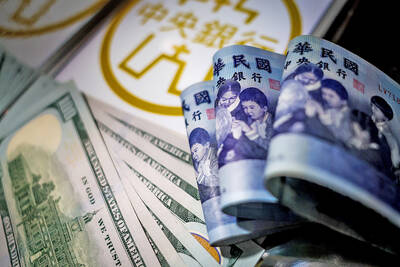
The New Taiwan dollar yesterday fell sharply against the US dollar to close at its lowest level since May 22 amid a massive outflow of funds from the country because of investors panicking over global equity markets. The NT dollar ended at NT$31.580 against the US dollar, slightly lower than its close of NT$31.568 on May 22, after moving between NT$31.5 and NT$31.648 on combined turnover of US$3.062 billion on the Taipei Foreign Exchange and the Cosmos Foreign Exchange. The NT dollar received a significant hit in the morning session, slumping as much as NT$0.173 at a time when other Asian currencies
Taiwan Semiconductor Manufacturing Co (TSMC, 台積電) is now ranked ninth among the world’s 100 most valuable companies after its market capitalization more than doubled over the past year, PricewaterhouseCoopers (PwC) Taiwan said in a report last month. TSMC’s market capitalization surged 101 percent year-on-year to US$1.427 trillion as of March 31, the accounting and consulting firm’s 2026 Global Top 100 Companies by Market Capitalization report said. The gain catapulted the world’s largest contract chipmaker from 12th place to ninth in the rankings, and it was the fastest-growing among the global top 10, it said. TSMC was the only Taiwanese company among the top
Taiwan Semiconductor Manufacturing Co (TSMC, 台積電) yesterday reported record revenue of NT$416.975 billion (US$13.17 billion) for last month, putting the world’s largest contract chipmaker on track to set a record for quarterly revenue. Last month’s figure surpassed March’s record NT$415.19 billion and represented increases of 1.5 percent from April and 30.1 percent from a year earlier. For the first five months of the year, TSMC generated NT$1.96 trillion in revenue, up 30 percent year-on-year, it said in a statement. TSMC has forecast second-quarter revenue of between US$39 billion and US$40.2 billion, representing sequential growth of about 10 percent and year-on-year growth of about


 RSS
RSS