


Facebook said on Friday it had hired renowned architect Frank Gehry to design the company’s campus expansion, which includes a new building with a rooftop garden.
“When it is completed, we hope it will provide a paradise workspace for the 3,400 engineers who will one day fill it,” a company statement said.
The expansion to the campus in Menlo Park, California, will be designed by the Canadian-born Gehry, known for the Guggenheim Museum in Bilbao, Spain, and the Walt Disney Concert Hall in Los Angeles, among others.
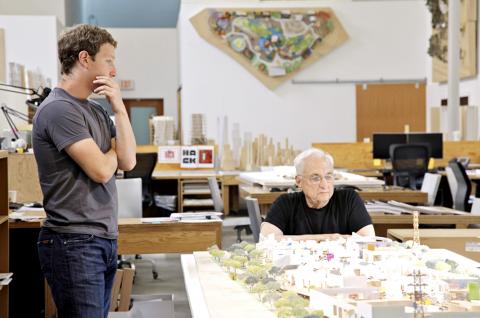
Photo: Reuters
Gehry, known for his deconstructive style and buildings that sometimes appear unfinished, also designed the Stata Center at the Massachusetts Institute of Technology and the Cinematheque Francaise in Paris.
“At every step of planning the new building, Frank has taken into account our engineering culture,” Facebook said. “It will be a large, one-room building that somewhat resembles a warehouse. Just like we do now, everyone will sit out in the open with desks that can be quickly shuffled around as teams form and break apart around projects.”
The new building will include “cafes and lots of micro-kitchens with snacks so that you never have to go hungry,” the statement said.
“And we’ll fill the building with break-away spaces with couches and whiteboards to make getting away from your desk easy,” it said.
Facebook last year took over the headquarters of Sun Microsystems in Menlo Park, moving from cramped headquarters in nearby Palo Alto.
The company seeks to break ground on the new building early next year, with hopes for “a quick construction.”
It said the exterior also “takes into account the local architecture” and that “a tonne” of trees would be planted on the grounds and on the rooftop garden.
“The raw, unfinished look of our buildings means we can construct them quickly and with a big emphasis on being eco-friendly,” Facebook said.
Facebook will maintain its current campus and use an underground tunnel to connect the two areas.

Cairo’s new monorail slices across the city skyline, running above the familiar chaos of blaring horns and aging buses’ exhaust fumes that mark rush hour below. The US$4.5 billion monorail, opened this month, is among Egypt’s most prominent new transport projects, part of a debt-funded infrastructure drive criticized for sapping state finances while bringing limited benefits to most of the country’s 109 million people. “It feels like you’re in a different country,” said Ramy Sayed, a restaurant manager, aboard a driverless Innovia 300 train. “No noise, no traffic, we’re not used to this.” The eastern line runs 56km from the bustling middle-class
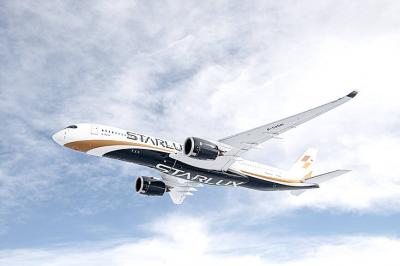
Starlux Airlines Co (星宇航空) today unveiled a long-haul network expansion plan at a shareholders’ meeting in Taipei, including direct flights to Barcelona, Spain, and Zurich, Switzerland, as well as a service connecting Taipei, Sydney and New Zealand. Starlux is to become the first Taiwanese carrier to offer non-stop services to the two European cities, while the inaugural oceanic route is expected to expand transit opportunities within the Australia-New Zealand market, Starlux said. Flight services to Chicago, Dallas, Washington and New York are under evaluation, the airline added. Prior to the shareholders’ meeting, the airline earlier this year announced that it would be

Taiwanese prosecutors suspect that three people successfully smuggled at least one shipment of Nvidia Corp artificial intelligence (AI) chips to China after first exporting them to Japan, people familiar with the matter said. The trio was detained last week by the Keelung District Prosecutors’ Office for allegedly falsifying documents related to exports of Super Micro Computer Inc servers containing advanced Nvidia chips, which the US has barred from sale to China without a license from Washington. The move marked Taiwan’s first public crackdown on AI chip diversion after years of pressure from the US to take a more active role in curtailing
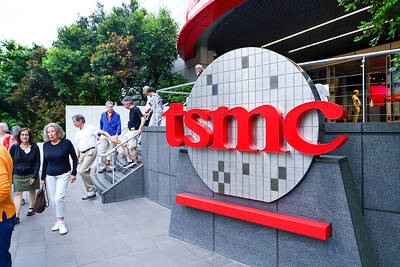
Taiwan Semiconductor Manufacturing Co (TSMC, 台積電) employee bonuses are likely to grow more than 30 percent this year, in line with the past few years as the company’s profits continue to set new records, an anonymous source cited TSMC chairman C.C. Wei (魏哲家) as saying yesterday. TSMC, the world’s largest contract chipmaker, is committed to taking care of its workers, the source said, citing Wei’s meeting with employees yesterday morning. Wei also expressed gratitude to employees for their contribution to the company’s improving bottom line, the source added. Since 2023, TSMC’s employee bonuses have grown at an annual rate of


 RSS
RSS