


Several major think tanks in Taiwan are expected to revise down their forecast for annual GDP growth this week, following Academia Sinica’s cut of its growth forecast for this year to 1.94 percent on Wednesday last week.
The weaker-than-expected economic momentum in the second quarter, caused by continuous global economic uncertainties, would be the major factor dragging down these institutes’ latest forecast, economists said.
“It is difficult for the nation’s economy to grow more than 3 percent this year,” director of the Chung-Hua Institution for Economic Research’s (CIER, 中華經濟研究院) center for economic forecasting Liu Meng-chun (劉孟俊) said by telephone.
Liu cited weak overseas and domestic demand as exports fell 4.7 percent from a year ago in the first six months of the year, with private consumption slower in the same period due to the government’s decision to raise energy prices.
Liu’s views confirmed that the CIER — which is scheduled to update its full-year economic growth forecast today — will cut the figure from the 3.55 percent growth it estimated in April.
The Taiwan Institute of Economic Research (TIER, 台灣經濟研究院), which is set to release its latest growth forecast tomorrow, may also follow the trend, as the think tank estimated in April that economic expansion would reach 3.48 percent this year.
“Taiwan’s economic growth in the second quarter may be lower than that in the first quarter as a result of the impact of slowing domestic demand,” director of TIER’s macroeconomic forecasting center Gordon Sun (孫明德) said.
Many economists had previously thought Taiwan’s economy would bottom out in the first quarter, but it turned out that GDP in the second quarter may show a contraction because of the deteriorating domestic demand, Sun said.
Renewed worries about the nation’s economic prospects have placed speculation and discussion about the central bank possibly cutting interest rates back on the table.
The central bank on June 21 decided to keep its key interest rates unchanged for the fourth consecutive quarter and left its discount rate at 1.875 percent. The bank is expected to review its monetary policy adjustment at a board meeting in late September.
“Taiwan’s policy rate outlook is less than clear at this juncture,” Grace Ng (吳向紅), a Hong Kong-based economist at JPMorgan Chase Bank, said in a report issued on Wednesday last week.
Three months ago, there was a lot of discussion about the need for the central bank to raise policy rates, given the impact electricity and fuel price hikes had on inflation and on driving up uncertainty over the policy rate outlook, Ng said.
JPMorgan said it now views Taiwan’s near-term policy rate outlook as a close call.
“[Only] in the event that the external environment worsens further, will the probability of moderate rate cuts by the central bank rise in the coming months,” Ng said.
On the exchange rate front, it seems that policymakers have been keen to maintain a competitive currency through the economic cycles in support of the export sector, she added.
Cheng Cheng-mount (鄭貞茂), chief economist at Citigroup in Taipei, shared Ng’s views.
“The central bank still has many other tools and open-market operations, such as cutting the overnight interbank call-loan rate, to deal with the current economic situation in Taiwan,” Cheng said by telephone.
Cheng said that he sees no need for the central bank to cut the nation’s policy rates further in the second half of this year given the current low level of rates.
Nonetheless, the central bank has been gradually driving down the overnight interbank call-loan rate since last week, with the rate falling 0.014 percentage points to 0.391 percent on Friday last week, marking the lowest level in nearly 11 months. In the past seven trading sessions, the rate has declined by 0.118 percentage points.
A lower overnight interbank call-loan rate will drag down short-term financing costs for banks, which may further lower domestic firms’ financing costs and raise the market’s liquidity.
Australia and New Zealand Banking Group Ltd said in a report on Friday that the central bank will continue to lower the interbank overnight rates in a bid to reduce banks’ borrowing costs.
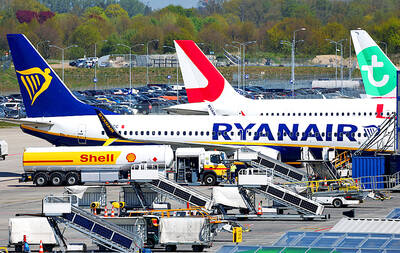
Ryanair, Transavia, Volotea and other low-cost airlines are feeling the financial pain from high jet fuel prices as a result of the Middle East war and are cutting flights. The closure of the Strait of Hormuz has taken a huge chunk of oil supplies off the market, sending the price of jet fuel soaring and triggering fears of shortages that could force airlines to cancel flights. Airlines are not waiting for a lack of supplies to react. “Travel alert: Airlines are cutting thousands of flights right now,” Travel Therapy host Karen Schaler said in an Instagram reel this past weekend.

MANAGING RISKS: Taiwan has secured LNG sufficient to cover 95 percent of electricity demand for next month, UBS said, describing the government’s approach as proactive UBS Group AG has raised its forecast for Taiwan’s economic growth this year to 8 percent, up from 6.9 percent previously, and said expansion could reach as high as 8.6 percent if external energy shocks are avoided. The upgrade reflects a stronger-than-expected first-quarter performance and sustained momentum in artificial intelligence (AI)-driven exports, which UBS said are providing a firm foundation for growth despite geopolitical and energy risks. Taiwan’s GDP expanded 13.69 percent year-on-year in the first quarter, the fastest growth since the second quarter of 1987, the Directorate-General of Budget, Accounting and Statistics (DGBAS) reported on Thursday. On a seasonally

The Fair Trade Commission’s (FTC) ongoing review of Grab Holdings Ltd’s US$600 million acquisition of Foodpanda Taiwan’s operations, announced on March 23, has taken on fresh urgency as industry experts warn that the transaction could embed significant Chinese cybersecurity vulnerabilities into Taiwan’s digital infrastructure through Grab’s deep ties to autonomous-driving firm WeRide (文遠知行). Less than 16 months after the FTC blocked Uber Eats’ direct attempt to acquire Foodpanda Taiwan — citing potential combined market shares of 80 to 90 percent — the emergence of Grab as the buyer has prompted questions about whether the same competitive harm is simply being rerouted

The list of Asian stocks that benefit from business partnership with Nvidia Corp is getting longer, as the region further integrates into the artificial intelligence (AI) chip giant’s business ecosystem. Just in the past week, South Korea’s LG Electronics Inc, Taiwan’s Nanya Technology Corp (南亞科技), as well as China’s Huizhou Desay SV Automotive Co (德賽西威) and Pateo Connect Technology Shanghai Corp (博泰車聯) have become the latest to rally on news of tie-ups, supply-chain participation or product collaboration with the US chip designer. Asian suppliers account for about 90 percent of Nvidia’s production costs, up from about 65 percent last year, data compiled


 RSS
RSS