


Company representatives from around the world will be able to put their hands on ultra-thin laptops running on Microsoft Corp’s highly anticipated new operating system at Computex Taipei next month, one of the organizers said.
This year at Computex, visitors will see a preview of Windows 8-based Ultrabooks, said Enoch Du (杜全昌), secretary-general of the Taipei Computer Association (TCA, 台北市電腦公會), which co-organizes the world’s second-largest tech trade fair.
“Although Microsoft is very cautious about the launch, vendors in fact are ready to offer the Windows 8 devices, including Ultrabooks, tablet computers and smart handheld devices,” he said in an interview recently.
“You can put your hands on the models and use them,” Du added. “With the release of the Windows 8, there will be a big jump in Ultrabook [sales] volumes.”
In the fourth quarter of last year, the world’s top five PC vendors all introduced Ultrabook-type products, but their price tags exceeded US$1,000, making them less attractive, according to DRAMexchange Technology Inc (集邦科技).
The average notebook price is about US$650 this year, so Ultrabook prices need to dip below US$700 to be acceptable to consumers, the research firm said.
Factoring in the expected price cut, Ultrabook shipments are forecast at 20 million units this year, accounting for 10 percent of total notebook shipments, compared with 2 percent last year, it predicted.
Meanwhile, the PC industry chain will see a big change in business models, such as the integration of mobile chipsets designed by ARM Holdings PLC, which are widely used in Android-based smartphones and tablet PCs to lower power consumption, Du said.
Intel Corp, which supplies processors for Ultrabooks, has forecast that the category might be priced as low as US$599 in the second half of this year, when manufacturers use new and cheaper casing materials, such as a mixture of plastics and aluminum.
The US chipmaker projected that the new models to be launched in the third and fourth quarter would support new functions, such as touch-enabled screens and gesture sensors, which would help drive overall demand.
For this year as a whole, Intel expected Ultrabooks to account for between 30 and 40 percent of global notebook shipments, thanks to the introduction of lower-priced models.
However, Du said that 20 percent would be a more reasonable penetration rate this year, because Intel’s forecast looks more like a long-term target.
“The pricing for Ultrabooks is related to the total volume,” he said. “When the volume increases, component costs drop and then lower the retail prices, driving a virtuous cycle.”
“I’m optimistic that Ultrabooks will become cheaper and cheaper, but it will be quite difficult to see US$599 models this year,” Du said.
Last month, Asustek Computer Inc (華碩) said Ultrabooks would gain more momentum in the second half of this year thanks to an increase in the supply of new chipsets and the expected launch of the new Windows system.
Asustek plans to roll out a number of new Ultrabooks priced from US$799 to US$1,999 starting in the current quarter, and the company expects the category to account for between 10 and 20 percent of its notebook shipments this year.
Separately, Acer Inc (宏碁) has reduced its Ultrabook prices to as low as US$799 in selected regions, but the price has remained too high for many consumers, compared with a price tag of between US$400 and US$500 for mainstream notebooks.
Acer projected that Ultrabooks will account for between 12 and 20 percent of its notebook shipments by the end of this year, which would be lower than the 25 to 35 percent that the company forecast earlier, because of less promotion by the industry.
Computex Taipei, to be held from June 5 to June 9, is expected to attract more than 36,000 international buyers and generate US$28 billion in business, up from US$25 billion last year, the organizers estimated.

HSBC Holdings PLC is deepening its commitment to Taiwan as the economy emerges as one of the bank’s fastest-growing markets globally, driven by an artificial intelligence (AI) investment boom, expanding cross-border trade, and rising wealth creation. “The advantage that Taiwan has is a growth story linked to the semiconductor and broader AI industries, strong underlying corporate performance, and wealth creation,” said Surendra Rosha, HSBC’s co-chief executive for Asia and the Middle East, in an exclusive interview with the Taipei Times on June 2, during this year’s HSBC Taiwan Conference. That combination has helped HSBC cement its position as the most profitable international
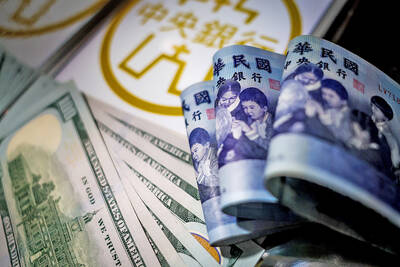
The New Taiwan dollar yesterday fell sharply against the US dollar to close at its lowest level since May 22 amid a massive outflow of funds from the country because of investors panicking over global equity markets. The NT dollar ended at NT$31.580 against the US dollar, slightly lower than its close of NT$31.568 on May 22, after moving between NT$31.5 and NT$31.648 on combined turnover of US$3.062 billion on the Taipei Foreign Exchange and the Cosmos Foreign Exchange. The NT dollar received a significant hit in the morning session, slumping as much as NT$0.173 at a time when other Asian currencies
Taiwan Semiconductor Manufacturing Co (TSMC, 台積電) is now ranked ninth among the world’s 100 most valuable companies after its market capitalization more than doubled over the past year, PricewaterhouseCoopers (PwC) Taiwan said in a report last month. TSMC’s market capitalization surged 101 percent year-on-year to US$1.427 trillion as of March 31, the accounting and consulting firm’s 2026 Global Top 100 Companies by Market Capitalization report said. The gain catapulted the world’s largest contract chipmaker from 12th place to ninth in the rankings, and it was the fastest-growing among the global top 10, it said. TSMC was the only Taiwanese company among the top
Taiwan Semiconductor Manufacturing Co (TSMC, 台積電) yesterday reported record revenue of NT$416.975 billion (US$13.17 billion) for last month, putting the world’s largest contract chipmaker on track to set a record for quarterly revenue. Last month’s figure surpassed March’s record NT$415.19 billion and represented increases of 1.5 percent from April and 30.1 percent from a year earlier. For the first five months of the year, TSMC generated NT$1.96 trillion in revenue, up 30 percent year-on-year, it said in a statement. TSMC has forecast second-quarter revenue of between US$39 billion and US$40.2 billion, representing sequential growth of about 10 percent and year-on-year growth of about


 RSS
RSS