


The scale of the market pressure on Spain is not justified given the reforms being undertaken by its government and the European Central Bank (ECB) bond-buying program, ECB executive board member Benoit Coeure said yesterday.
Markets are watching closely for any signs that a rise in Spanish bond yields back above 6 percent could prompt a change in the bank’s rhetoric after policymakers in recent weeks underlined it was now up to governments to deal with the crisis, not the bank.
Coeure, the board member in charge of market operations, said the central bank still had the Securities Market Programme (SMP) in place which allowed it to purchase the debt of eurozone nations, should the need arise.
“We are seeing today growing signs of normalization on a whole group of market segments ... but the situation in recent days shows that this normalization remains fragile,” Coeure told a conference in Paris.
Referring to Spain, where sovereign debt yields have spiked amid concerns over the government’s ability to cut its deficit, Coeure said: “The political will is there, which makes me think that what is happening at the moment in the market does not reflect the fundamentals.”
“There is no reason why the situation does not normalize in Spain as well,” he said. “We have an instrument for intervention, the SMP, which has not been used recently but which exists.”
His comments appeared to open the door to the ECB reactivating its bond-buying program — a policy option which would meet strong resistance from the Bundesbank and other ECB policy-makers from the eurozone’s healthier “core” economies.
The ECB left the program unused for the seventh time in eight weeks last week.
However, Coeure said that the ECB’s three-year liquidity operations (LTRO) in December last year and February had helped normalize market conditions, which banks and governments should take advantage of to press ahead with reform.
“Banks need to reach their capital adequacy targets, improve their funding profiles and restart lending,” he said.
On the basis of central bank definitions, there was about 800 billion euros (US$1.051 trillion) of excess liquidity in the euro system, but weak levels of aggregate demand meant this did not represent an inflationary risk in the short term, he said.
Should growth recover, banks would gradually exit the LTRO mechanism, decreasing excess liquidity, The ECB also has a number of tools at its disposal, including unused instruments such as certificates of deposit, to mop up excess money supply if required, he added.
Coeure said that the crisis had led to a fragmentation of capital markets, as savings went increasingly to domestic debt markets rather than crossing national borders, hampering the efficient working of the single market.
He called for a “financial compact,” similar to the fiscal compact signed recently by 25 EU leaders, to unfreeze the capital flows between member states.


Taiwan’s foreign exchange reserves fell below the US$600 billion mark at the end of last month, with the central bank reporting a total of US$596.89 billion — a decline of US$8.6 billion from February — ending a three-month streak of increases. The central bank attributed the drop to a combination of factors such as outflows by foreign institutional investors, currency fluctuations and its own market interventions. “The large-scale outflows disrupted the balance of supply and demand in the foreign exchange market, prompting the central bank to intervene repeatedly by selling US dollars to stabilize the local currency,” Department of Foreign

Intel Corp is joining Elon Musk’s long-shot effort to develop semiconductors for Tesla Inc, Space Exploration Technologies Corp and xAI, marking a surprising twist in the chipmaker’s comeback bid. Intel would help the Terafab project “refactor” the technology in a chip factory, the company said on Tuesday in a post on X, Musk’s social media platform. That is a stage in the development process that typically helps make chips more powerful or reliable. The chipmaker’s shares jumped 4.2 percent to US$52.91 in New York trading on Tuesday. The Terafab project is a grand plan by Musk to eventually manufacture his own chips for

Some robotaxi passengers were left stranded in the middle of fast-moving traffic in a major Chinese city after their driverless vehicles stopped running, according to police and media reports on Wednesday. A preliminary investigation indicates more than 100 robotaxis came to a halt because of a “system malfunction,” police in the city of Wuhan said in a statement, without elaborating. No injuries were reported. One passenger told Chinese media that their robotaxi stopped after turning a corner. An instruction on a screen read: “Driving system malfunction. Staff are expected to arrive in 5 minutes.” After no one showed up, the passenger pushed
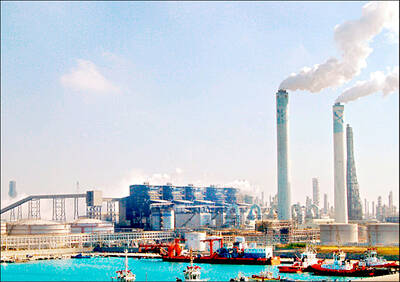
Taiwan Power Co (Taipower, 台電) yesterday said it plans to resume operations at two coal-fired power generators for three months to boost security of electricity supply as liquefied natural gas (LNG) supply risks are running high due to the Middle East conflict. The two coal-fired power generators are at Mailiao Power Plant in Yunlin County’s Mailiao Township (麥寮). The plant, operated by Formosa Plastics Group (台塑集團), supplied electricity to Taipower’s power grid until the end of last year. Taipower’s decision came about one month after Minister of Economic Affairs Kung Ming-hsin (龔明鑫) on March 10 said that the nation had no imminent


 RSS
RSS