


Academics yesterday warned the government to watch out for overinvestment in real estate after real estate-related financing approached 50 percent of GDP in January.
Real estate-linked financing — including loans for home purchases, repair and construction — totaled NT$7.15 trillion (US$242.09 billion) at the end of January, accounting for 48.15 percent of GDP, which was valued at NT$14.85 trillion in December last year, said Chuang Meng-han (莊孟翰), a professor of industrial economics at Tamkang University.
“The high ratio is worrying, as it may crowd out funds for investment in other sectors and sustain housing prices” that have remained unresponsive thus far to the government’s measures to facilitate a correction, Chuang told a property seminar in Taipei.
The liquidity-driven boom will continue now that life insurance firms are also showing interest in purchasing storefronts because of the scarcity of commercial buildings, Chuang said.
Construction financing more than doubled in the past decade, while home loans have increased by 90.52 percent and savings deposits have risen by 56.73 percent, Chuang said.
The figures suggest that land developers spearheaded the property boom, while simultaneously contributing to the large increase in unoccupied housing, the academic said.
More than 1.56 million housing units in Taiwan are unoccupied, with 44 percent of them concentrated in the north, Chuang said.
“There is no quick fix to increasingly unaffordable housing,” Chuang said. “The government has probably missed the best opportunity to address the situation, but continued delay may prove a dangerous mistake in the long run.”
Chang Chin-o (張金顎), a professor at National Chengchi University’s land economics department, also expressed concern over the heavy concentration of funds in the housing market.
“Overinvestment in a single sector is not positive for the nation’s overall competitiveness and may spell problems once the industry enters a correction,” Chang said. “A boom cycle cannot last forever.”
Chang said the government, like the general public, also relies on the private sector for information to guide its housing policy, lending support for market transparency and accountability.
A requirement introduced on July 1 for home buyers and brokers to register transaction data online should be the beginning, not the end, of the government’s efforts to put the -market on a healthy course, Chang said.
The academic questioned the truth in recent reports of a revival in purchasing interest on the part of home buyers, saying this might be another advertising tactic adopted by land developers to boost sales.
Construction firms and brokers have reported an increase in the number of people looking for houses over the spring season, beginning yesterday. Billy Yen (顏炳立), general manager at DTZ, an international real-estate services provider, said he did not believe in the existence of the so-called March 29 season.
“It is fair prices, not the timing of transactions, that top the list of concerns of home buyers,” Yen said.

Cairo’s new monorail slices across the city skyline, running above the familiar chaos of blaring horns and aging buses’ exhaust fumes that mark rush hour below. The US$4.5 billion monorail, opened this month, is among Egypt’s most prominent new transport projects, part of a debt-funded infrastructure drive criticized for sapping state finances while bringing limited benefits to most of the country’s 109 million people. “It feels like you’re in a different country,” said Ramy Sayed, a restaurant manager, aboard a driverless Innovia 300 train. “No noise, no traffic, we’re not used to this.” The eastern line runs 56km from the bustling middle-class

Taiwanese firms have increased investment in the Philippines in recent years as Manila’s ties with Washington deepen and global supply chains continue to shift away from China, an expert at the Chung-Hua Institution for Economic Research (CIER, 中華經濟研究院) said yesterday. The Philippines had not been among Taiwanese investors’ top choices in Southeast Asia, CIER Taiwan ASEAN Studies Center director Kristy Hsu (徐遵慈) said at a seminar in Taipei. However, Taiwan’s investment in the country has grown significantly since the COVID-19 pandemic, reaching US $257 million last year, a high in recent years, she said. Although Taiwan’s total investment in the Philippines still lags
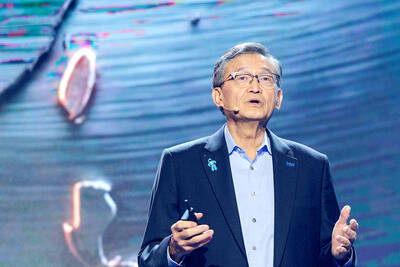
Intel Corp regards Taiwan Semiconductor Manufacturing Co (TSMC, 台積電) as a longstanding partner, as the US chipmaker would continue outsourcing production of advanced chips to TSMC, Intel chief executive officer Lip-Bu Tan (陳立武) said yesterday. “I don’t look at people as competitors. I look at the collaboration... Nvidia is also, you know, a good friend,” Tan told a news conference following his keynote speech at the Computex trade show in Taipei. “It’s a very trusted partnership for us... We are a big, top customer for them, and we’re going to continue doing that,” he said, referring to TSMC, the world’s largest foundry

Artificial intelligence (AI) agents would supplant smartphones as the center of people’s digital lives, fundamentally reshaping personal devices and driving a major computing upgrade cycle, Qualcomm Inc CEO Cristiano Amon said yesterday. In his keynote speech for this year’s Computex trade show in Taipei, Amon said that the rise of "agentic AI" — AI systems capable of reasoning, planning and carrying out tasks autonomously — would transform how people interact with technology across phones, PCs, vehicles and wearable devices. Describing the technology as the next major evolution in computing, Amon said that "2026 is the year of agents.” For decades, smartphones have sat


 RSS
RSS