


The Greek Cabinet approved a draft bill spelling out reforms required by the EU and the IMF on Friday, taking Athens closer to getting a new 130 billion euro (US$171.6 billion) bailout after the prime minister warned the alternative was “catastrophe.”
All eyes will now be on parliament, which is scheduled to vote on the bill today. Analysts expect the deeply unpopular package to be adopted, but Greek politics remain highly unstable.
Even after this is done, the EU also wants a further 325 million euros of spending cuts and clear commitments by main party leaders that the reforms will be implemented before it agrees to release the aid.
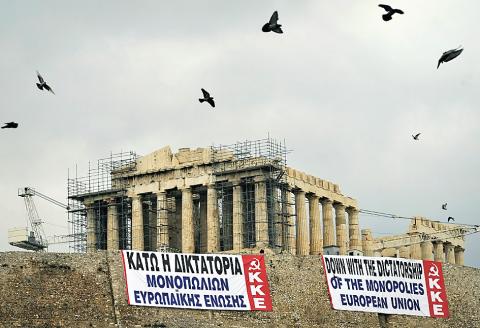
Photo: AFP
Greek Prime Minister Lucas Papademos told his turbulent coalition government earlier on Friday to accept the harsh international bailout deal or condemn the nation to disaster.
“We cannot allow Greece to go bankrupt,” he told a Cabinet meeting. “Our priority is to do whatever it takes to approve the new economic program and proceed with the new loan agreement.”
Papademos, the sole technocrat in a coalition of feuding politicians, tried to assert his authority after six Cabinet members resigned over EU and IMF demands for yet more pay, pension and job cuts in return for the financial rescue.
The austerity plan includes lowering the minimum wage by 22 percent, axing 150,000 public sector jobs and reducing pensions.
“It goes without saying that whoever disagrees and does not vote for the new program cannot remain in the government,” he said in televised remarks.
Greece faces bankruptcy unless it gets the funds from the IMF and EU by March 20, when it has to repay 14.5 billion euros in maturing bonds.
“It was approved,” a minister who took part in the Cabinet meeting said about the draft bill.
A former central banker, Papademos tried to raise Greeks’ spirits as the nation enters its fifth year of recession, saying economic growth would return in 2013 despite accusations that the austerity is merely driving Greece into a downward spiral.
Any alternative to the rescue would be much worse, he said in opening remarks using the word “catastrophe” four times.
Earlier, far-right leader George Karatzaferis said he could not back the tough terms attached to the bailout and all four Cabinet members of his LAOS party submitted their resignations, along with two from the socialist PASOK party.
Papademos was not expected to react immediately to the loss of his transport minister and five deputy ministers.
“There will be no reshuffle today [Friday],” a government official said.
Adding to the confusion, Greek media said that two of the LAOS Cabinet members had resigned only under orders from Karatzaferis and would support the deeply unpopular package when parliament votes, possibly today or tomorrow.
The socialist PASOK party, one of three in the “national unity” government, called on its lawmakers to vote for the bailout, and analysts said they still thought parliament would pass the deeply unpopular package.
Outside parliament, police fired tear gas at black-masked protesters who threw petrol bombs, stones and bottles at the start of a 48-hour general strike against the cuts ordered by the “troika” of international lenders. However, the street protests were relatively small compared with last year’s mass rallies.
A group of 35 lawmakers from PASOK, whose public support has collapsed, protested against pressure from eurozone ministers.
“Our lenders are once again presenting the dilemma: either you take the measures or you lead the country to a default,” they said in a protest letter.
The biggest police trade union said it would issue arrest warrants for Greece’s international lenders for subverting democracy, and refused to “fight against our brothers.”
Greek Finance Minister Evangelos Venizelos made clear Greece has little choice but to accept the harsh conditions attached to the bailout, and a plan to halve its huge debt to private bondholders, to avoid a chaotic default next month.
LAOS leader Karatzaferis begged to differ.
“Greeks cannot be hostages and serfs,” he said. “We were robbed of our dignity, we were humiliated. I can’t take this. I won’t allow it, no matter how hungry I am.”
His party has 15 deputies in the 300 seat parliament, dominated by the socialist PASOK and conservative New Democracy parties, which both support the Papademos government.
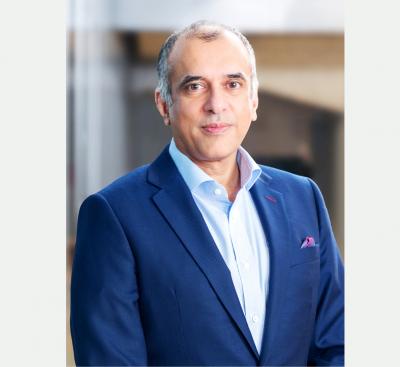
HSBC Holdings PLC is deepening its commitment to Taiwan as the economy emerges as one of the bank’s fastest-growing markets globally, driven by an artificial intelligence (AI) investment boom, expanding cross-border trade, and rising wealth creation. “The advantage that Taiwan has is a growth story linked to the semiconductor and broader AI industries, strong underlying corporate performance, and wealth creation,” said Surendra Rosha, HSBC’s co-chief executive for Asia and the Middle East, in an exclusive interview with the Taipei Times on June 2, during this year’s HSBC Taiwan Conference. That combination has helped HSBC cement its position as the most profitable international
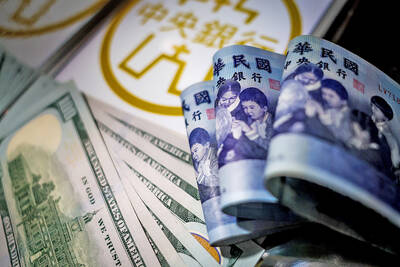
The New Taiwan dollar yesterday fell sharply against the US dollar to close at its lowest level since May 22 amid a massive outflow of funds from the country because of investors panicking over global equity markets. The NT dollar ended at NT$31.580 against the US dollar, slightly lower than its close of NT$31.568 on May 22, after moving between NT$31.5 and NT$31.648 on combined turnover of US$3.062 billion on the Taipei Foreign Exchange and the Cosmos Foreign Exchange. The NT dollar received a significant hit in the morning session, slumping as much as NT$0.173 at a time when other Asian currencies
Taiwan Semiconductor Manufacturing Co (TSMC, 台積電) is now ranked ninth among the world’s 100 most valuable companies after its market capitalization more than doubled over the past year, PricewaterhouseCoopers (PwC) Taiwan said in a report last month. TSMC’s market capitalization surged 101 percent year-on-year to US$1.427 trillion as of March 31, the accounting and consulting firm’s 2026 Global Top 100 Companies by Market Capitalization report said. The gain catapulted the world’s largest contract chipmaker from 12th place to ninth in the rankings, and it was the fastest-growing among the global top 10, it said. TSMC was the only Taiwanese company among the top
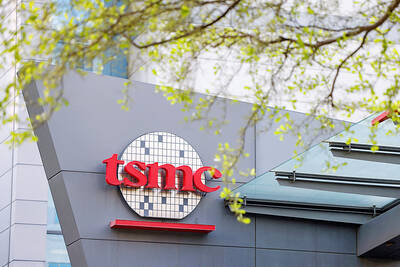
Taiwan Semiconductor Manufacturing Co (TSMC, 台積電) yesterday reported record revenue of NT$416.975 billion (US$13.17 billion) for last month, putting the world’s largest contract chipmaker on track to set a record for quarterly revenue. Last month’s figure surpassed March’s record NT$415.19 billion and represented increases of 1.5 percent from April and 30.1 percent from a year earlier. For the first five months of the year, TSMC generated NT$1.96 trillion in revenue, up 30 percent year-on-year, it said in a statement. TSMC has forecast second-quarter revenue of between US$39 billion and US$40.2 billion, representing sequential growth of about 10 percent and year-on-year growth of about


 RSS
RSS