


JPMorgan Chase, the largest US bank, posted a record profit for last year. However, that didn’t translate into a bigger bonus for CEO Jamie Dimon. Morgan Stanley’s latest quarterly results topped expectations as the bank trimmed costs and cleaned up problems dating from the financial crisis, but CEO James Gorman saw the value of his stock awards for the year fall by half.
Across their ranks, Wall Street banks are curbing bonus pay for last year’s performance, which was marked by big drops in stock prices and still-hefty costs for mortgage-related problems. In the last three months of the year, fear about the European debt crisis made the stock and bond markets volatile, and clients of all the major banks shied away from mergers and acquisitions and public offerings of stock. That sharply reduced investment banking and underwriting fees. The banks also faced a surge in populist anger, as the Occupy Wall Street movement went national.
Financial stocks were some of the worst performing last year. While the S&P 500 Index finished the year flat, Morgan Stanley shares plunged 44 percent, JPMorgan dropped nearly 22 percent and Goldman Sachs Group Inc tanked 46 percent.
Compensation followed the downward trend. In a closely watched and politically charged gauge, JPMorgan Chase & Co revealed earlier this month that it set aside 36 percent less than the year before to pay its investment bankers. Morgan Stanley shed 700 workers last year and capped the amount that workers can get in their bonuses immediately, deferring anything over US$125,000. Rival Goldman eliminated 7 percent of its employees and cut pay by 21 percent last year.
It appears the banks’ CEOs are not immune. On Friday, Morgan Stanley’s regulatory filing showed that the value of Gorman’s stock award for the year dropped to US$5.1 million, from US$10.2 million in 2010.
Gorman, who became CEO two years ago, has been slimming down the bank, selling off units like a mortgage servicing division and an asset management business. He has been emphasizing divisions like wealth management, which provide smaller returns than some investment banking operations, but also carry much less risk because they’re based on fees rather than markets. Unlike JPMorgan and some other big banks, Morgan Stanley doesn’t have a large consumer deposit base to rely on when its investment bank stumbles.
JPMorgan’s Dimon received restricted stock worth US$12.6 million and stock appreciation rights reportedly valued at roughly US$5 million for last year, according to a filing with the US Securities and Exchange Commission on Friday. That compares with about US$17.1 million in stock and stock appreciation rights that he was granted for 2010.
For the full year, JPMorgan posted a record profit of US$19 billion, up from US$17.4 billion in 2010, but the bank struggled amid the choppy financial markets, which hurt investment banking fees in the fourth quarter. The bank also disclosed that it spent US$3.2 billion last year to fight lawsuits, almost all of them over poorly written mortgages. That is down from US$5.7 billion in 2010, but Dimon acknowledged there is still a “huge drag” on earnings five years after the bubble burst.
Complete compensation details, including the value of the executives’ cash compensation, perks and benefits for last year weren’t disclosed. None of the banks have filed annual proxy statements, which include those financial details.
Dimon received a total pay package for 2010 valued at US$20.8 million, including a salary of US$1 million and a cash bonus of US$5 million. Gorman received compensation valued at US$15.2 million, including a salary of US$800,000 and a cash bonus of US$3.9 million.
The Associated Press formula calculates an executive’s total compensation during the last fiscal year by adding salary, bonuses, perks, above-market interest the company pays on deferred compensation and the estimated value of stock and stock options awarded during the year. The AP formula does not count changes in the present value of pension benefits. That makes the AP total slightly different in most cases from the total reported by companies to the Securities and Exchange Commission.
The value that a company assigned to an executive’s stock and option awards for 2010 was the present value that the company expected the awards to be worth to the executive over time. Companies use one of several formulas to calculate that value. However, the number is just an estimate, and what an executive ultimately receives depends on the performance of the company’s stock in the years after the awards are granted. Most stock compensation programs require an executive to wait a specified length of time to receive shares or exercise options.

HSBC Holdings PLC is deepening its commitment to Taiwan as the economy emerges as one of the bank’s fastest-growing markets globally, driven by an artificial intelligence (AI) investment boom, expanding cross-border trade, and rising wealth creation. “The advantage that Taiwan has is a growth story linked to the semiconductor and broader AI industries, strong underlying corporate performance, and wealth creation,” said Surendra Rosha, HSBC’s co-chief executive for Asia and the Middle East, in an exclusive interview with the Taipei Times on June 2, during this year’s HSBC Taiwan Conference. That combination has helped HSBC cement its position as the most profitable international
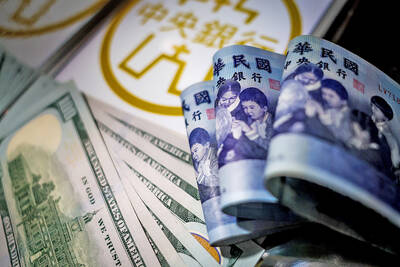
The New Taiwan dollar yesterday fell sharply against the US dollar to close at its lowest level since May 22 amid a massive outflow of funds from the country because of investors panicking over global equity markets. The NT dollar ended at NT$31.580 against the US dollar, slightly lower than its close of NT$31.568 on May 22, after moving between NT$31.5 and NT$31.648 on combined turnover of US$3.062 billion on the Taipei Foreign Exchange and the Cosmos Foreign Exchange. The NT dollar received a significant hit in the morning session, slumping as much as NT$0.173 at a time when other Asian currencies
Taiwan Semiconductor Manufacturing Co (TSMC, 台積電) is now ranked ninth among the world’s 100 most valuable companies after its market capitalization more than doubled over the past year, PricewaterhouseCoopers (PwC) Taiwan said in a report last month. TSMC’s market capitalization surged 101 percent year-on-year to US$1.427 trillion as of March 31, the accounting and consulting firm’s 2026 Global Top 100 Companies by Market Capitalization report said. The gain catapulted the world’s largest contract chipmaker from 12th place to ninth in the rankings, and it was the fastest-growing among the global top 10, it said. TSMC was the only Taiwanese company among the top
Taiwan Semiconductor Manufacturing Co (TSMC, 台積電) yesterday reported record revenue of NT$416.975 billion (US$13.17 billion) for last month, putting the world’s largest contract chipmaker on track to set a record for quarterly revenue. Last month’s figure surpassed March’s record NT$415.19 billion and represented increases of 1.5 percent from April and 30.1 percent from a year earlier. For the first five months of the year, TSMC generated NT$1.96 trillion in revenue, up 30 percent year-on-year, it said in a statement. TSMC has forecast second-quarter revenue of between US$39 billion and US$40.2 billion, representing sequential growth of about 10 percent and year-on-year growth of about


 RSS
RSS