


Standing in the glare of a 250 watt light bulb in the yard of his uncle’s house, Hilary Turyamugumya peers hopefully into the night sky in search of grasshoppers.
“Every evening I first pray for there to be power — and then I pray that the grasshoppers will come,” Turyamugumya said.
Stripped of their wings and fried with onions, grasshoppers are a delicacy in Uganda’s central region — gobbled up by the handful and washed down with beer in bars around Kampala.
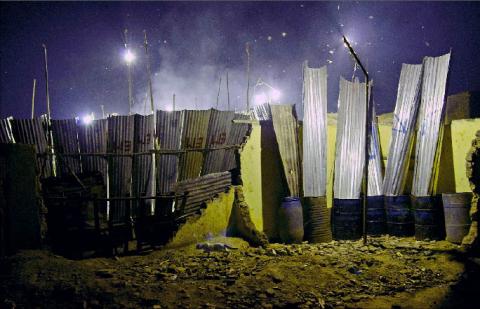
Photo: AFP
This time of year should be peak season for the insect catchers, but Turyamugumya — who uses bright lights to attract the flying insects before disorientating them with smoke and trapping them in disused oil drums — says that business is tough.
“The problem has been power. It is on and off. Like last night, the whole night it was off,” the 33-year-old said.
From bakeries to beauticians to building firms, small businesses across Uganda have been struggling to cope with worsening power cuts in recent months.

Photo: AFP
Growing demand and a government failure to pay its bills saw power to some parts of the country cut for days at a time.
For Turyamugumya, and many others who work catching grasshoppers, no power means no light and no light means no grasshoppers.
Turyamugumya estimates his income this season will be half what it was in the previous grasshopper season.
“There is a shortage of grasshoppers and it is creating a problem for those who are catching and selling them,” Turyamugumya said.
Wandering up and down a strip of bars in the bustling Kabalagala suburb of the capital with his plastic bucket of grasshoppers, vendor Andrew Tumulamye agrees.
Power problems mean that the price he pays for grasshoppers at the market has gone up — and that means insect-loving bar-goers are having to pay more for the snacks. The price for the smallest bag has doubled to about US$0.45.
“When power is not good the prices go up and our customers cannot buy,” said Tumulamye, who is 18.
However, despite the price rises, the lure of a freshly fried grasshopper is too strong to resist for many Ugandans.
“They have a lot of proteins and a special taste like shrimps, they are like seafood. Look at this head, it is what I like most,” said bar owner Asha Cartier, after washing down a crunchy mouthful of insects with a glass of vodka.
As for the broader issue of power, the government admits that years of under-investment in the sector have left the country facing major shortfalls and forced the authorities to rely on expensive diesel generators.
In recent months, rising fuel prices and a weakening local currency have meant the government has struggled to cover bills for diesel generators and left the country facing a shortfall, Ugandan State Minister for Energy Simon D’ujanga said.
However, D’ujanga said, things are improving. Early this year a new hydroelectric power plant is set to come online.
“The future is bright, but for the time being we have to put up with this inconvenience,” D’ujanga said.
Those improvements will take time, however, and with the end of the current grasshopper season approaching fast, Turyamugumya says he cannot wait that long for the power supply to get better.
“We are looking for other ways to make sure we have power,” he said. “Me, I am already thinking of buying a big generator.”

Cairo’s new monorail slices across the city skyline, running above the familiar chaos of blaring horns and aging buses’ exhaust fumes that mark rush hour below. The US$4.5 billion monorail, opened this month, is among Egypt’s most prominent new transport projects, part of a debt-funded infrastructure drive criticized for sapping state finances while bringing limited benefits to most of the country’s 109 million people. “It feels like you’re in a different country,” said Ramy Sayed, a restaurant manager, aboard a driverless Innovia 300 train. “No noise, no traffic, we’re not used to this.” The eastern line runs 56km from the bustling middle-class

Starlux Airlines Co (星宇航空) today unveiled a long-haul network expansion plan at a shareholders’ meeting in Taipei, including direct flights to Barcelona, Spain, and Zurich, Switzerland, as well as a service connecting Taipei, Sydney and New Zealand. Starlux is to become the first Taiwanese carrier to offer non-stop services to the two European cities, while the inaugural oceanic route is expected to expand transit opportunities within the Australia-New Zealand market, Starlux said. Flight services to Chicago, Dallas, Washington and New York are under evaluation, the airline added. Prior to the shareholders’ meeting, the airline earlier this year announced that it would be

Taiwanese prosecutors suspect that three people successfully smuggled at least one shipment of Nvidia Corp artificial intelligence (AI) chips to China after first exporting them to Japan, people familiar with the matter said. The trio was detained last week by the Keelung District Prosecutors’ Office for allegedly falsifying documents related to exports of Super Micro Computer Inc servers containing advanced Nvidia chips, which the US has barred from sale to China without a license from Washington. The move marked Taiwan’s first public crackdown on AI chip diversion after years of pressure from the US to take a more active role in curtailing

Taiwan Semiconductor Manufacturing Co (TSMC, 台積電) employee bonuses are likely to grow more than 30 percent this year, in line with the past few years as the company’s profits continue to set new records, an anonymous source cited TSMC chairman C.C. Wei (魏哲家) as saying yesterday. TSMC, the world’s largest contract chipmaker, is committed to taking care of its workers, the source said, citing Wei’s meeting with employees yesterday morning. Wei also expressed gratitude to employees for their contribution to the company’s improving bottom line, the source added. Since 2023, TSMC’s employee bonuses have grown at an annual rate of


 RSS
RSS