


Belgian politicians reached a deal on next year’s budget yesterday, ending a 19-month deadlock that had prevented the formation of a stable government and led to a debt downgrade, a negotiator said.
“There is an agreement,” a spokesman for the French-speaking socialists, one of six parties in the linguistically divided country that had been struggling to reconcile spending cuts with tax rises.
The accord, reached after 17 hours of negotiations, opens the way to forming a new government after more than a year-and-a-half in caretaker management.
Friday night’s downgrade by ratings giant Standard and Poor’s (S&P), which saw Belgium drop by one notch to “AA,” piled pressure on the parties to reconcile spending cuts with tax rises to avoid EU penalties next month.
S&P said bank guarantees, lack of policy consensus and slowing growth will make it difficult to reduce the euro region’s fifth-highest debt load.
The rating was lowered from “AA+,” with a negative outlook, London-based S&P said on Friday in a statement. The action by S&P is the first downgrade for Belgium in almost 13 years and puts its credit ranking on a par with the S&P local-currency ratings of the Czech Republic, Kuwait and Chile.
Belgium’s borrowing costs have surged to the highest level in 11 years in the past two months after the nation’s government agreed to buy Dexia SA’s Belgian bank unit and guarantee part of the crisis-hit lender’s liabilities for 10 years. Investors continued a sell-off in Belgian bonds after six-party coalition talks ran aground this week as Liberals and Socialists clashed over how to cut the budget deficit.
Belgium follows Slovenia, Spain, Italy, Ireland, Portugal, Cyprus and Greece as euro-area countries having their credit rating cut this year.
The yield on Belgium’s 4.25 percent bond due in September 2021 rose 13 basis points to 5.86 percent at 6pm in Brussels on Friday, after reaching 5.88 percent, the highest since February 2000. The extra yield investors demand to hold the Belgian government securities instead of German bonds of similar maturity widened to a record 360 basis points.
Several days ago, Belgium’s King Albert II turned down French-speaking Socialist Party leader Elio Di Rupo’s request to stand down from leading the negotiations and urged the six parties to complete budget discussions and form a government. Di Rupo sought to quit after the Liberals from both sides of Belgium’s linguistic divide refused to accept his latest proposals for the budget.
Those proposals included 6.6 billion euros (US$8.7 billion) of additional taxes even as the European Commission told Belgium to focus on spending cuts to narrow its budget deficit, Alexander De Croo, leader of the Flemish Liberal party, told public broadcaster VRT after the talks broke down on Monday.
Belgium’s budget deficit will narrow to about 3.6 percent of GDP this year from 4.1 percent last year, S&P said. It also forecast government debt will increase to about 97 percent of GDP from 96.1 percent last year after the administration paid 4 billion euros to nationalize Dexia Bank Belgium NV.
Public debt could potentially exceed one year of economic output should government backstops given to banks “crystallize” on the sovereign’s balance sheet, S&P said. Belgium agreed to guarantee as much as 54.5 billion euros of Dexia’s liabilities as part of the joint rescue with France and Luxembourg, both of which are rated “AAA” by S&P.
The French-Belgian lender, which is being broken up after running out of short-term funding, still had 23.9 billion euros of government-backed borrowings outstanding on Thursday, according to data published by the National Bank of Belgium. Some of that debt doesn’t mature before May 2014.
Belgium has also conditionally pledged to buy shares of the nation’s biggest bank and insurer KBC Groep NV, covering 90 percent of potential losses exceeding 3.2 billion euros on collateralized debt obligations and protection bought from MBIA Insurance Corp.

HSBC Holdings PLC is deepening its commitment to Taiwan as the economy emerges as one of the bank’s fastest-growing markets globally, driven by an artificial intelligence (AI) investment boom, expanding cross-border trade, and rising wealth creation. “The advantage that Taiwan has is a growth story linked to the semiconductor and broader AI industries, strong underlying corporate performance, and wealth creation,” said Surendra Rosha, HSBC’s co-chief executive for Asia and the Middle East, in an exclusive interview with the Taipei Times on June 2, during this year’s HSBC Taiwan Conference. That combination has helped HSBC cement its position as the most profitable international
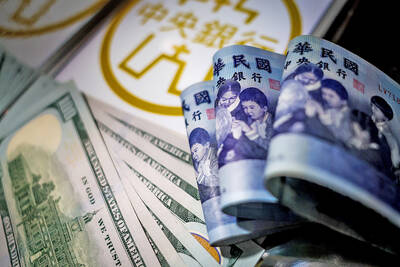
The New Taiwan dollar yesterday fell sharply against the US dollar to close at its lowest level since May 22 amid a massive outflow of funds from the country because of investors panicking over global equity markets. The NT dollar ended at NT$31.580 against the US dollar, slightly lower than its close of NT$31.568 on May 22, after moving between NT$31.5 and NT$31.648 on combined turnover of US$3.062 billion on the Taipei Foreign Exchange and the Cosmos Foreign Exchange. The NT dollar received a significant hit in the morning session, slumping as much as NT$0.173 at a time when other Asian currencies
Taiwan Semiconductor Manufacturing Co (TSMC, 台積電) is now ranked ninth among the world’s 100 most valuable companies after its market capitalization more than doubled over the past year, PricewaterhouseCoopers (PwC) Taiwan said in a report last month. TSMC’s market capitalization surged 101 percent year-on-year to US$1.427 trillion as of March 31, the accounting and consulting firm’s 2026 Global Top 100 Companies by Market Capitalization report said. The gain catapulted the world’s largest contract chipmaker from 12th place to ninth in the rankings, and it was the fastest-growing among the global top 10, it said. TSMC was the only Taiwanese company among the top
Taiwan Semiconductor Manufacturing Co (TSMC, 台積電) yesterday reported record revenue of NT$416.975 billion (US$13.17 billion) for last month, putting the world’s largest contract chipmaker on track to set a record for quarterly revenue. Last month’s figure surpassed March’s record NT$415.19 billion and represented increases of 1.5 percent from April and 30.1 percent from a year earlier. For the first five months of the year, TSMC generated NT$1.96 trillion in revenue, up 30 percent year-on-year, it said in a statement. TSMC has forecast second-quarter revenue of between US$39 billion and US$40.2 billion, representing sequential growth of about 10 percent and year-on-year growth of about


 RSS
RSS