


Samsung Electronics Co unveiled its newest Galaxy Nexus smartphone yesterday, the first to use the latest version of Google Inc’s Android operating system.
The new phone is seen as the Samsung-Google partnership’s answer to Apple Inc’s iPhone 4S, which in less than a week on the market has already sold more than 4 million units.
At a glitzy unveiling in Hong Kong, Google executive Andy Rubin said Android’s latest “Ice Cream Sandwich” operating system demonstrates innovation “that works on phones and tablets and everything in between.”
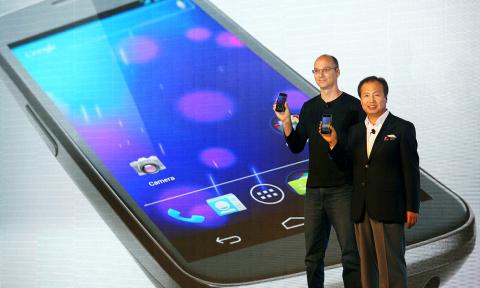
Photo: Reuters
Rubin said features like Android Beam and Face Unlock showcased Ice Cream Sandwich’s capabilities.
Android Beam allows transfer of data between two smartphones by holding them together, while Face Unlock uses facial recognition technology to activate smartphones, rather than conventional passwords.
However, during a demonstration at the Hong Kong unveiling, the Face Unlock feature failed to activate the Galaxy Nexus.
Executives of South Korea’s Samsung said the Galaxy Nexus will go on sale next month in the US, Europe and Asia, including China and Japan. They did not reveal the new smartphone’s price or its sales volume targets.
Samsung and Taiwan’s HTC Corp (宏達電) are the biggest users of the Android platform, which is engaged in a furious competition with Apple’s own operating system for market share in the rapidly expanding smartphone sector.
The US International Trade Commission issued an initial ruling on Tuesday that Apple’s iPhone does not violate four patents owned by HTC, a blow to the Taiwanese company.
On Monday, Samsung asked Japanese and Australian courts to block sales of Apple’s new iPhone 4S in those countries over alleged patent violations. The actions are part of an intensifying patent battle between the smartphone giants.
Samsung is also appealing an Australian court’s decision last week to temporarily ban sales of Samsung’s new Galaxy tablet computer. Apple accused Samsung of copying the iPad and iPhone and violating Apple’s patents.

Netherlands-based semiconductor equipment supplier ASML Holding NV yesterday said that it is planning to hire an additional 1,000 people in Taiwan this year in response to growing demand from clients. ASML had previously planned to recruit 600 people this year, but that the plan has been adjusted upward, ASML vice president and ASML Taiwan general manager Grace Wang (汪佳慧) told reporters. ASML has a workforce of more than 4,500 in Taiwan, accounting for about 10 percent of its global total, Wang said. This year’s recruitment campaign would focus on adding people in the customer support, manufacturing and supply chain domains to assist ASML

UNDER MICROSCOPE: Taiwan detained three people who allegedly conspired to buy servers in Taiwan and export them using fraudulent documentation, prosecutors said Nvidia Corp chief executive officer Jensen Huang (黃仁勳) on Saturday urged Super Micro Computer Inc to tighten up on compliance after Taiwan detained three people this week for allegedly making fraudulent declarations about artificial intelligence (AI) servers made by its US partner. The development marked the nation’s first crackdown on semiconductor smuggling, which grew after the US slapped restrictions on exports of high-end chips such as Nvidia AI accelerators to China. Nvidia is “rigorous” in explaining regulations to all of its partners, Huang told reporters after arriving in Taipei. “Ultimately Super Micro has to run their own company,” he said in response to

Nvidia Corp yesterday announced that CEO Jensen Huang (黃仁勳) would attend an employee meeting in Taipei tomorrow to celebrate the launch of the company’s Taiwan headquarters project. Huang would attend a gathering at the site of Nvidia’s planned headquarters in Beitou Shilin Technology Park (北投士林科技園區), the company said in a statement. After arriving in Taiwan on Saturday last week, Huang told reporters that he plans to meet with Quanta Computer Inc (廣達) chairman Barry Lam (林百里) and Taiwan Semiconductor Manufacturing Co (TSMC, 台積電) chairman C.C. Wei (魏哲家), and would attend the groundbreaking ceremony for Nvidia’s Taiwan headquarters tomorrow. Nvidia has not yet applied

Huawei Technologies Co (華為) said it has come up with a new pathway to shorten its gap with industry leader Taiwan Semiconductor Manufacturing Co (TSMC, 台積電), potentially achieving a breakthrough in making advanced semiconductors without cutting-edge equipment. Right now there is about a five-year gap between what TSMC is capable of and what Huawei, together with its manufacturing partner Semiconductor Manufacturing International Corp (中芯), can produce. Huawei is to start making 1.4-nanometer chips by 2031 with its own “LogicFolding” technology, Huawei semiconductor chief He Tingbo (何庭波) said in a rare public appearance during a chip conference yesterday, while TSMC has


 RSS
RSS