


European stocks fell for the first week in three amid concern policymakers would not be able to stop the region’s sovereign-debt crisis from growing and damaging the economic recovery.
The STOXX 600 dropped 3.7 percent to 224.59 this week as 18 of 19 industry groups declined. The gauge has plunged 23 percent since this year’s peak on Feb. 17 as economic data from the US and Europe trailed forecasts and Standard & Poor’s downgraded the US’ triple-A sovereign-debt rating, citing political failure to reduce record deficits.
The index is trading at 9.4 times the estimated earnings of its constituent companies, near the lowest valuation since March 2009, according to data compiled by Bloomberg.
There has been “a whirlwind of sovereign downgrades, collapsing economic data and stumbling politics across developed markets” in recent weeks, said Tim Price, chief investment director at PFP Group in London. “Unsurprisingly, markets have suffered. We have gone from a consensus of muted recovery to one of possible double dip.”
National benchmark indexes fell in all of the 18 western European markets except Switzerland, where the Swiss National Bank intervened to weaken the franc. France’s CAC 40 declined 5.5 percent, the UK’s FTSE 100 slid 1.5 percent and Germany’s DAX plunged 6.3 percent. The Swiss Market Index gained 1.3 percent, a third straight weekly advance.
The VStoxx Index, which measures the cost of protecting against a decline in shares on the Euro STOXX 50 Index, climbed 24 percent, the biggest gain in a month.
The STOXX 600 tumbled 4.1 percent on Monday after German Chancellor Angela Merkel’s party suffered its fifth election loss this year as she faced criticism over the handling of the debt crisis.
European Central Bank (ECB) President Jean-Claude Trichet on Thursday said threats to the euro region had worsened and inflation risks had eased. Planned rescue loans to Greece have been put in doubt as countries, including Finland, demand the country provide collateral in exchange for the funds.
The cost of insuring against default on European financial companies rose to a record this week as the ECB comments added to concern lenders are finding it harder to access funding markets.
Credit-default swaps on Greek government debt surged to an all-time high, signaling a 91 percent chance the country will fail to meet debt commitments, after its economy shrank more than previously reported.
The rate at which London-based banks say they can borrow for three months in US dollars climbed to the highest level in more than a year on Friday. The London interbank offered rate, or Libor, for US dollar loans rose to the highest since August last year, according to the British Bankers’ Association.
The STOXX 600 Banks Index dropped 8.4 percent. Societe Generale, France’s second-largest lender, and BCP, Portugal’s second-biggest publicly traded bank by market value, fell 21 percent and 17 percent, respectively.
RBS, Britain’s biggest government-owned lender, and Barclays each fell 13 percent. The banks were among European, Asian and US lenders sued by the US Federal Housing Finance Agency on Sept. 2 to recoup US$196 billion spent on mortgage-backed securities bought by Fannie Mae and Freddie Mac.

HSBC Holdings PLC is deepening its commitment to Taiwan as the economy emerges as one of the bank’s fastest-growing markets globally, driven by an artificial intelligence (AI) investment boom, expanding cross-border trade, and rising wealth creation. “The advantage that Taiwan has is a growth story linked to the semiconductor and broader AI industries, strong underlying corporate performance, and wealth creation,” said Surendra Rosha, HSBC’s co-chief executive for Asia and the Middle East, in an exclusive interview with the Taipei Times on June 2, during this year’s HSBC Taiwan Conference. That combination has helped HSBC cement its position as the most profitable international
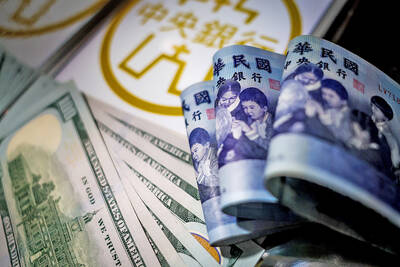
The New Taiwan dollar yesterday fell sharply against the US dollar to close at its lowest level since May 22 amid a massive outflow of funds from the country because of investors panicking over global equity markets. The NT dollar ended at NT$31.580 against the US dollar, slightly lower than its close of NT$31.568 on May 22, after moving between NT$31.5 and NT$31.648 on combined turnover of US$3.062 billion on the Taipei Foreign Exchange and the Cosmos Foreign Exchange. The NT dollar received a significant hit in the morning session, slumping as much as NT$0.173 at a time when other Asian currencies
Taiwan Semiconductor Manufacturing Co (TSMC, 台積電) is now ranked ninth among the world’s 100 most valuable companies after its market capitalization more than doubled over the past year, PricewaterhouseCoopers (PwC) Taiwan said in a report last month. TSMC’s market capitalization surged 101 percent year-on-year to US$1.427 trillion as of March 31, the accounting and consulting firm’s 2026 Global Top 100 Companies by Market Capitalization report said. The gain catapulted the world’s largest contract chipmaker from 12th place to ninth in the rankings, and it was the fastest-growing among the global top 10, it said. TSMC was the only Taiwanese company among the top
Taiwan Semiconductor Manufacturing Co (TSMC, 台積電) yesterday reported record revenue of NT$416.975 billion (US$13.17 billion) for last month, putting the world’s largest contract chipmaker on track to set a record for quarterly revenue. Last month’s figure surpassed March’s record NT$415.19 billion and represented increases of 1.5 percent from April and 30.1 percent from a year earlier. For the first five months of the year, TSMC generated NT$1.96 trillion in revenue, up 30 percent year-on-year, it said in a statement. TSMC has forecast second-quarter revenue of between US$39 billion and US$40.2 billion, representing sequential growth of about 10 percent and year-on-year growth of about


 RSS
RSS