


Tax revenues rose more than expected in the first half of the year, providing more evidence that full-year revenues could achieve the government’s goal of NT$1.695 trillion (US$56.76 billion), the Ministry of Finance said yesterday.
Last month’s tax revenues increased 33.5 percent from a year earlier to NT$282.2 billion, bringing revenues for the first six months to NT$997.4 billion, up 11 percent year-on-year, the ministry’s data showed.
“The ministry feels optimistic that full-year tax revenues may reach the target figures, as revenues from all types of taxes showed steady growth in the first half,” Hsu Ray-lin (許瑞琳), deputy director of the ministry’s statistics department, told a media briefing.
Hsu attributed the growth in tax revenues in the first half of this year to a pickup in business sales tax, corporate income tax, personal income tax and commodity tax.
Business sales tax revenue hit NT$134.4 billion in the first half, up 8 percent from a year earlier, amid strong imports and private consumption, the ministry said in a statement.
Revenues from the selective goods and services sales tax, also known as the luxury tax, were not included in last month’s tax data. Hsu said the ministry viewed the luxury tax as a kind of temporary levy, and so calculated it separately.
“The luxury tax will be put on the list after the ministry clarifies measures to manage and utilize these revenues, and its budget allotment method,” he added.

HSBC Holdings PLC is deepening its commitment to Taiwan as the economy emerges as one of the bank’s fastest-growing markets globally, driven by an artificial intelligence (AI) investment boom, expanding cross-border trade, and rising wealth creation. “The advantage that Taiwan has is a growth story linked to the semiconductor and broader AI industries, strong underlying corporate performance, and wealth creation,” said Surendra Rosha, HSBC’s co-chief executive for Asia and the Middle East, in an exclusive interview with the Taipei Times on June 2, during this year’s HSBC Taiwan Conference. That combination has helped HSBC cement its position as the most profitable international
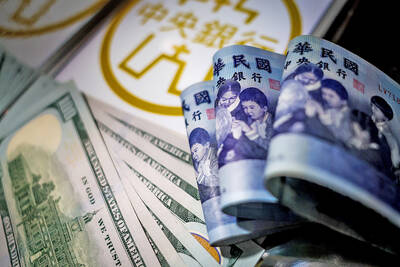
The New Taiwan dollar yesterday fell sharply against the US dollar to close at its lowest level since May 22 amid a massive outflow of funds from the country because of investors panicking over global equity markets. The NT dollar ended at NT$31.580 against the US dollar, slightly lower than its close of NT$31.568 on May 22, after moving between NT$31.5 and NT$31.648 on combined turnover of US$3.062 billion on the Taipei Foreign Exchange and the Cosmos Foreign Exchange. The NT dollar received a significant hit in the morning session, slumping as much as NT$0.173 at a time when other Asian currencies
Taiwan Semiconductor Manufacturing Co (TSMC, 台積電) is now ranked ninth among the world’s 100 most valuable companies after its market capitalization more than doubled over the past year, PricewaterhouseCoopers (PwC) Taiwan said in a report last month. TSMC’s market capitalization surged 101 percent year-on-year to US$1.427 trillion as of March 31, the accounting and consulting firm’s 2026 Global Top 100 Companies by Market Capitalization report said. The gain catapulted the world’s largest contract chipmaker from 12th place to ninth in the rankings, and it was the fastest-growing among the global top 10, it said. TSMC was the only Taiwanese company among the top
Taiwan Semiconductor Manufacturing Co (TSMC, 台積電) yesterday reported record revenue of NT$416.975 billion (US$13.17 billion) for last month, putting the world’s largest contract chipmaker on track to set a record for quarterly revenue. Last month’s figure surpassed March’s record NT$415.19 billion and represented increases of 1.5 percent from April and 30.1 percent from a year earlier. For the first five months of the year, TSMC generated NT$1.96 trillion in revenue, up 30 percent year-on-year, it said in a statement. TSMC has forecast second-quarter revenue of between US$39 billion and US$40.2 billion, representing sequential growth of about 10 percent and year-on-year growth of about


 RSS
RSS