


Oil tumbled this week after the International Energy Agency (IEA) agreed to draw on emergency reserves to make up for lost Libyan supplies and as global economic recovery fears prompted demand concerns.
“The big thing this week was really IEA’s decision to release 60 million barrels of crude oil over the next month — taking the teeth out of any possible price spikes in crude oil as we move into higher demand in the third quarter of 2011,” SEB commodities analyst Bjarne Schieldrop said. “So, pre-emptive action from IEA and US politicians to safe-guard the fragile economy as we move into higher oil demand.”
However, he cautioned that the impact would be somewhat limited because the move did not solve medium term supply issues.
“On a week-on-week basis, the changes in commodity prices are fairly small since last Friday’s close — except for crude and energy,” Schieldrop added.
Agricultural commodities, meanwhile, were subdued after G20 farming ministers from the world’s top economies agreed on action to curb speculative trading blamed for recent food price spikes, at a key meeting in Paris.
The agreement supports establishing an international agricultural market information system, or AMIS, to remedy a chronic lack of output and stocks data that is seen as a major source of price volatility.
OIL: Prices slumped as the IEA, the energy arm of the OECD, -announced it would tap emergency crude reserves of its 28 member nations.
Brent North Sea crude for delivery in August nosedived by a hefty US$6.95, or 6.0 percent, in value on Thursday.
The IEA sparked a steep sell-off when it announced its decision to release 60 million barrels of crude. Prior to the announcement, the market was already buckling under the weight of a stronger US dollar, spreading global economic gloom and contagion fears arising from the Greek-eurozone debt crisis.
The shock IEA move is intended to replace output from Libya, where a revolt has practically halted production.
However, some analysts said Thursday’s heavy price falls were overdone in light of the outlook.
By late Friday on London’s Intercontinental Exchange, Brent North Sea crude for delivery in August tumbled to US$105.95 a barrel from US$112.84.
On the New York Mercantile Exchange, West Texas Intermediate or light sweet crude for August dived to US$90.92 a barrel from US$92.70 the previous week for the July contract.
PRECIOUS METALS: Gold, silver, platinum and palladium finished the week in negative territory.
“Gold is caught up in the downward pull on commodity markets caused by oil,” Commerzbank analysts said.
The stronger US currency made commodities priced in US dollars more expensive for buyers using weaker currencies, denting -demand and prices.
By late Friday on the London Bullion Market, gold dipped to US$1,514.75 an ounce from US$1,537.50 the previous week.
Silver slid to US$34.73 an ounce from US$35.39.
On the London Platinum and Palladium Market, platinum dived to US$1,696 an ounce from US$1,751.
Palladium fell to US$739 an ounce from US$754.
BASE METALS: Prices traded mixed as downbeat Chinese manufacturing data sparked fears over demand from the Asian powerhouse economy.
Chinese manufacturing eased to a 10-month low in May, preliminary HSBC data showed on Monday, fueling fears of a slowdown in the world’s No. 2 economy and sending Shanghai and Hong Kong shares down.
By late Friday on the London Metal Exchange, copper for delivery in three months eased to US$9,110 a tonne from US$9,147 the previous week.
GRAINS AND SOYA: Corn or maize declined further, after striking a record peak near US$8 earlier this month, while prices were also hit by global economic jitters.
“Grains prices have come under marked pressure on macro-economic concerns, sovereign debt risk fears, a firmer dollar and widespread risk reduction,” Barclays Capital analysts said.
By Friday on the Chicago Board of Trade, maize for delivery in September fell to US$6.68 a bushel from US$6.87 a week earlier.
November-dated soyabean meal — used in animal feed — slid to US$13.13 a bushel from US$13.33.
Wheat for September sank to US$6.73 from US$7.08.

Cairo’s new monorail slices across the city skyline, running above the familiar chaos of blaring horns and aging buses’ exhaust fumes that mark rush hour below. The US$4.5 billion monorail, opened this month, is among Egypt’s most prominent new transport projects, part of a debt-funded infrastructure drive criticized for sapping state finances while bringing limited benefits to most of the country’s 109 million people. “It feels like you’re in a different country,” said Ramy Sayed, a restaurant manager, aboard a driverless Innovia 300 train. “No noise, no traffic, we’re not used to this.” The eastern line runs 56km from the bustling middle-class

Taiwanese firms have increased investment in the Philippines in recent years as Manila’s ties with Washington deepen and global supply chains continue to shift away from China, an expert at the Chung-Hua Institution for Economic Research (CIER, 中華經濟研究院) said yesterday. The Philippines had not been among Taiwanese investors’ top choices in Southeast Asia, CIER Taiwan ASEAN Studies Center director Kristy Hsu (徐遵慈) said at a seminar in Taipei. However, Taiwan’s investment in the country has grown significantly since the COVID-19 pandemic, reaching US $257 million last year, a high in recent years, she said. Although Taiwan’s total investment in the Philippines still lags
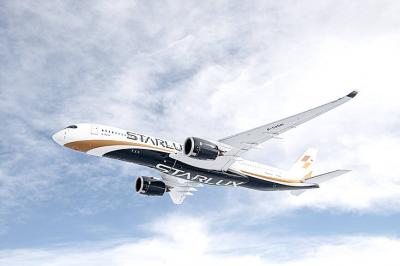
Starlux Airlines Co (星宇航空) today unveiled a long-haul network expansion plan at a shareholders’ meeting in Taipei, including direct flights to Barcelona, Spain, and Zurich, Switzerland, as well as a service connecting Taipei, Sydney and New Zealand. Starlux is to become the first Taiwanese carrier to offer non-stop services to the two European cities, while the inaugural oceanic route is expected to expand transit opportunities within the Australia-New Zealand market, Starlux said. Flight services to Chicago, Dallas, Washington and New York are under evaluation, the airline added. Prior to the shareholders’ meeting, the airline earlier this year announced that it would be

Intel Corp regards Taiwan Semiconductor Manufacturing Co (TSMC, 台積電) as a longstanding partner, as the US chipmaker would continue outsourcing production of advanced chips to TSMC, Intel chief executive officer Lip-Bu Tan (陳立武) said yesterday. “I don’t look at people as competitors. I look at the collaboration... Nvidia is also, you know, a good friend,” Tan told a news conference following his keynote speech at the Computex trade show in Taipei. “It’s a very trusted partnership for us... We are a big, top customer for them, and we’re going to continue doing that,” he said, referring to TSMC, the world’s largest foundry


 RSS
RSS