


Asian currencies gained for a third week on speculation regional central banks will keep raising interest rates to stem inflation, boosting the yield advantage on local assets.
The Bloomberg-JPMorgan Asia Dollar Index, which tracks the 10 most-active currencies, climbed 0.2 percent for the week as demand for the US dollar waned after Moody’s Investors Service said the US risks losing its top credit rating.
The baht had the best week in more than a month after the Thai central bank lifted benchmark borrowing costs on Wednesday to 3 percent, the fourth increase this year. That compares with 1.25 percent in the EU and a maximum 0.25 percent in the US.
The New Taiwan dollar advanced 0.5 percent to NT$28.750, the ringgit climbed 0.7 percent to 3.0120 per US dollar in Kuala Lumpur and the baht rose 0.2 percent to 30.33.
“The Moody’s report changes the ballgame and shifts investors’ focus from Europe to the US,” said Suresh Kumar Ramanathan, a foreign-exchange strategist at CIMB Investment Bank BHD in Kuala Lumpur. “The ringgit is holding firm because of the knock-on effect from the dollar weakness.”
Moody’s said on Thursday the US’ “Aaa” rating may be cut should there be “no progress” on lifting the US$14.3 trillion debt limit along with efforts to cut the budget deficit.
The Bank of Thailand lifted its one-day bond repurchase rate by a quarter of a percentage point this week after inflation accelerated to a 32-month high of 4.19 percent last month. Rates remain “low” and the pace of tightening is “still appropriate,” Assistant Governor Paiboon Kittisrikangwan said after the policy meeting.
“People in the market now predict more rate hikes than previously expected, providing support to the baht,” said Kozo Hasegawa, a currency trader at Sumitomo Mitsui Banking Corp in Bangkok.
The NT dollar climbed the most in the five days in more than a month as exporters repatriated earnings. Overseas investors bought US$879 million more local stocks than they sold this week, after net sales of US$996 million last week, according to exchange data.
“Many exporters kept selling the US dollar in the past two weeks before potential further appreciation of the [New] Taiwan dollar,” said Henry Lin, a Taipei-based foreign-exchange trader at Shin Kong Commercial Bank (新光銀行).
Elsewhere, the South Korean won rose for a third week, climbing 0.2 percent to 1,080.08 per US dollar. The yuan advanced 0.19 percent to 6.4794, the Philippine peso climbed 0.4 percent to 43.213 and Indonesia’s rupiah strengthened 0.5 percent to 8,531. India’s rupee added 0.7 percent to 44.87.
EURO RISES
The euro gained the most against the US dollar in four months this week after Greece was given more assistance to address its debt crisis, boosting confidence the region’s nations will be able to meet their obligations.
Europe’s shared currency reached a four-week high on Friday after Luxembourg Prime Minister Jean-Claude Juncker, who leads the group of eurozone finance ministers, said they agreed to pay the next installment to Greece under last year’s 110 billion euro ($161 billion) bailout.
The US currency dropped to a record against the Swiss franc after the US jobless rate unexpectedly rose to 9.1 percent. European Central Bank policymakers may consider increasing interest rates when they meet next week.
“People are taking the package as a positive factor,” said David Mann, regional head of research for the Americas at Standard Chartered PLC in New York.
The euro rose 2.2 percent to US$1.4635, from US$1.4319 on May 27, and touched US$1.4643, the highest level since May 5. It was the currency’s biggest weekly gain since Jan. 14. It added 1.6 percent to ¥117.48, from ¥115.67 last week. The US dollar dropped 0.6 percent to ¥80.34 from ¥80.80.
The euro was the biggest weekly winner against nine other currencies of developed nations. It rose 1.6 percent, followed by a 1.2 percent gain in the Swiss franc and a 1.1 percent advance in the Norwegian krone.
EU and IMF officials agreed to pay the next installment to Greece under last year’s bailout, paving the way for an upgraded aid package that includes a “voluntary” role for investors. Greece’s government said a review of the country’s economic progress concluded “positively.”
“There’s a little bit of optimism on the sovereign debt stuff,” said Carl Forcheski, a director on the corporate currency sales desk at Societe Generale SA in New York. “You’ve seen [US] Treasury yields coming down very steadily since the peak in early April. They have continued sliding through the second half of May and that’s helped contribute to the euro’s rise.”
Yields on the Treasury 10-year notes fell to less than 3 percent on Wednesday for the first time this year.
The US dollar has dropped 6.5 percent this year against its nine developed-nation counterparts, the biggest decline in the group. The euro has gained 3.2 percent this year and the yen has dropped 5.5 percent.
The Swiss franc reached a record SF0.8331 against the US dollar on Friday and SF1.20543 against the euro on Thursday.
“It’s a pretty nasty witch’s brew for risky assets,” said Richard Franulovich, a senior currency strategist at Westpac Banking Corp in New York. The franc and the yen “will strengthen in times of stress.”
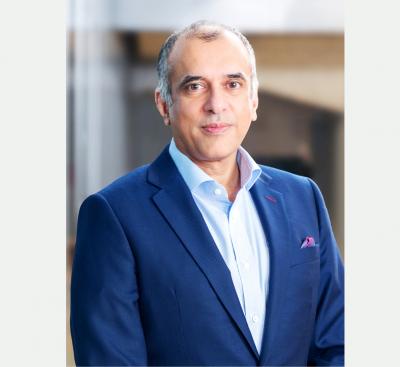
HSBC Holdings PLC is deepening its commitment to Taiwan as the economy emerges as one of the bank’s fastest-growing markets globally, driven by an artificial intelligence (AI) investment boom, expanding cross-border trade, and rising wealth creation. “The advantage that Taiwan has is a growth story linked to the semiconductor and broader AI industries, strong underlying corporate performance, and wealth creation,” said Surendra Rosha, HSBC’s co-chief executive for Asia and the Middle East, in an exclusive interview with the Taipei Times on June 2, during this year’s HSBC Taiwan Conference. That combination has helped HSBC cement its position as the most profitable international
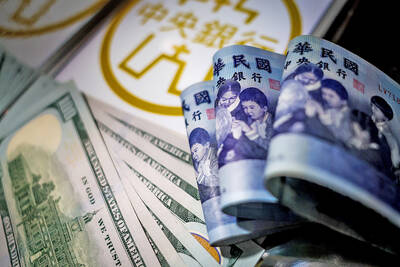
The New Taiwan dollar yesterday fell sharply against the US dollar to close at its lowest level since May 22 amid a massive outflow of funds from the country because of investors panicking over global equity markets. The NT dollar ended at NT$31.580 against the US dollar, slightly lower than its close of NT$31.568 on May 22, after moving between NT$31.5 and NT$31.648 on combined turnover of US$3.062 billion on the Taipei Foreign Exchange and the Cosmos Foreign Exchange. The NT dollar received a significant hit in the morning session, slumping as much as NT$0.173 at a time when other Asian currencies
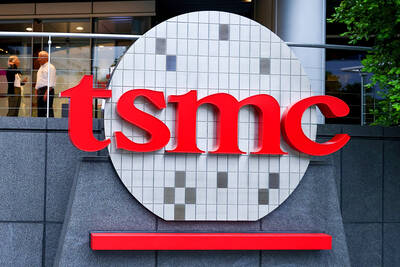
Taiwan Semiconductor Manufacturing Co (TSMC, 台積電) is now ranked ninth among the world’s 100 most valuable companies after its market capitalization more than doubled over the past year, PricewaterhouseCoopers (PwC) Taiwan said in a report last month. TSMC’s market capitalization surged 101 percent year-on-year to US$1.427 trillion as of March 31, the accounting and consulting firm’s 2026 Global Top 100 Companies by Market Capitalization report said. The gain catapulted the world’s largest contract chipmaker from 12th place to ninth in the rankings, and it was the fastest-growing among the global top 10, it said. TSMC was the only Taiwanese company among the top
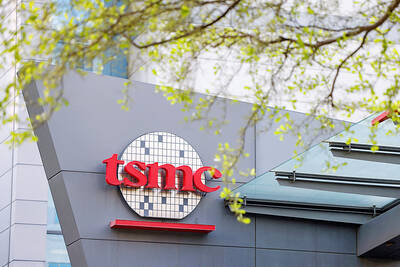
Taiwan Semiconductor Manufacturing Co (TSMC, 台積電) yesterday reported record revenue of NT$416.975 billion (US$13.17 billion) for last month, putting the world’s largest contract chipmaker on track to set a record for quarterly revenue. Last month’s figure surpassed March’s record NT$415.19 billion and represented increases of 1.5 percent from April and 30.1 percent from a year earlier. For the first five months of the year, TSMC generated NT$1.96 trillion in revenue, up 30 percent year-on-year, it said in a statement. TSMC has forecast second-quarter revenue of between US$39 billion and US$40.2 billion, representing sequential growth of about 10 percent and year-on-year growth of about


 RSS
RSS