


Taiwan’s move to allow offshore banking units (OBU) of local banks to handle yuan-denominated operations was praised yesterday by an analyst who expects the new facility’s growth potential will boost bottom lines in the sector.
“The opening will allow local banks to extend yuan loans to Taiwanese investors operating in China without the need to set up a branch on the mainland first,” Grand Cathay Securities (大華證券) analyst Mars Hsu (徐振家) said.
The Financial Supervisory Commission announced on Thursday that it had agreed to a proposal to allow local banks’ OBUs to handle yuan transactions, with the measure to take effect pending approval from the Executive Yuan.
Taiwanese banks have long urged the government to relax restrictions to allow their offshore arms to conduct yuan transactions.
Currently, only six local banks operate branches in major Chinese cities, such as Shanghai and Shenzhen, where Taiwanese investors are clustered.
The six, which opened branches in China late last year or early this year, are First Commercial Bank (第一銀行), Cathay United Bank (國泰世華銀行), Chang Hwa Commercial Bank (彰化銀行), Land Bank of Taiwan (土地銀行), Taiwan Cooperative Bank (合作金庫銀行) and Hua Nan Commercial Bank (華南銀行).
POSITIVE
None of these six banks, however, are allowed by Chinese authorities to extend loans to their Taiwanese clients until their branches in China can show a profit over a full year of operations.
“The new rule opens a gate for local banks and saves them plenty of time as they gear up to generate profits by targeting Taiwanese firms there,” Hsu said. “That is no doubt positive.”
Hsu said large banks with strong corporate banking operations are expected to be the largest beneficiaries of the new business.
“The market has high hopes that the new rule will lift Chinatrust Commercial Bank’s (中國信託商銀)and Mega International Commercial Bank’s (兆豐國際商銀) profitability,” Hsu said.
According to Hsu, corporate lending accounts for about 40 percent of Chinatrust’s total lending balance and more than 50 percent of Mega Bank’s lending balance.

HSBC Holdings PLC is deepening its commitment to Taiwan as the economy emerges as one of the bank’s fastest-growing markets globally, driven by an artificial intelligence (AI) investment boom, expanding cross-border trade, and rising wealth creation. “The advantage that Taiwan has is a growth story linked to the semiconductor and broader AI industries, strong underlying corporate performance, and wealth creation,” said Surendra Rosha, HSBC’s co-chief executive for Asia and the Middle East, in an exclusive interview with the Taipei Times on June 2, during this year’s HSBC Taiwan Conference. That combination has helped HSBC cement its position as the most profitable international

The New Taiwan dollar yesterday fell sharply against the US dollar to close at its lowest level since May 22 amid a massive outflow of funds from the country because of investors panicking over global equity markets. The NT dollar ended at NT$31.580 against the US dollar, slightly lower than its close of NT$31.568 on May 22, after moving between NT$31.5 and NT$31.648 on combined turnover of US$3.062 billion on the Taipei Foreign Exchange and the Cosmos Foreign Exchange. The NT dollar received a significant hit in the morning session, slumping as much as NT$0.173 at a time when other Asian currencies

Taiwan Semiconductor Manufacturing Co (TSMC, 台積電) is now ranked ninth among the world’s 100 most valuable companies after its market capitalization more than doubled over the past year, PricewaterhouseCoopers (PwC) Taiwan said in a report last month. TSMC’s market capitalization surged 101 percent year-on-year to US$1.427 trillion as of March 31, the accounting and consulting firm’s 2026 Global Top 100 Companies by Market Capitalization report said. The gain catapulted the world’s largest contract chipmaker from 12th place to ninth in the rankings, and it was the fastest-growing among the global top 10, it said. TSMC was the only Taiwanese company among the top
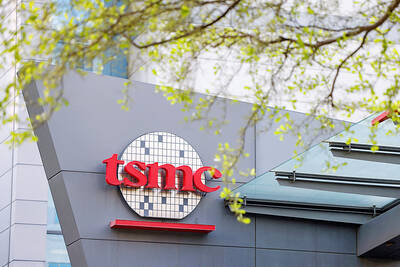
Taiwan Semiconductor Manufacturing Co (TSMC, 台積電) yesterday reported record revenue of NT$416.975 billion (US$13.17 billion) for last month, putting the world’s largest contract chipmaker on track to set a record for quarterly revenue. Last month’s figure surpassed March’s record NT$415.19 billion and represented increases of 1.5 percent from April and 30.1 percent from a year earlier. For the first five months of the year, TSMC generated NT$1.96 trillion in revenue, up 30 percent year-on-year, it said in a statement. TSMC has forecast second-quarter revenue of between US$39 billion and US$40.2 billion, representing sequential growth of about 10 percent and year-on-year growth of about


 RSS
RSS