


Irish central bank Governor Patrick Honohan said the country would avoid economic “doomsday,” as a government minister and prominent professor suggested the nation should reschedule debts from its as much as 85 billion euros (US$121 billion) bailout.
Honohan was responding to Morgan Kelly, an economics professor dubbed Ireland’s Doctor Doom, who wrote in the Irish Times newspaper that Ireland faces a “prolonged and chaotic national bankruptcy.”
“What we are working on is a plan, that if things go well in terms of economic growth, is clearly something that will bring debt on a sustainable path,” Honohan said in an interview with Dublin-based RTE radio on Sunday.
“If things don’t go well, it will be much more difficult. In that case, there will be a problem,” he said.
Kelly said the country faces “economic ruin” unless it walks away from last year’s bailout, withdraws support for banks and cuts its fiscal deficit to zero.
Ireland’s debt will peak at 116 percent of GDP in 2014, according to government forecasts published on April 29. The figure was 25 percent at the end of 2007.
Irish Energy Minister Pat Rabbitte said on Sunday “in my own view” the debt stemming from Ireland’s bailout “must be rescheduled.”
Ireland last year sought the bailout as investors shunned government and bank debt after the economy shrank about 15 percent since 2007. Talks on the terms of the aid are continuing, with the government seeking a cut on the average 5.8 percent interest rate it are paying on the loans.
The debt “is a serious problem and needs to be managed in discussion with our European partners,” Honohan said, adding Ireland is on “a very low growth scenario.”
“We are keeping our options open,” he said.
“We have a number of cards, we don’t have many cards, in these negotiations. There is a right time to play your most important cards,” he said.
In an interview with RTE, Rabbitte said he hopes that the “punitive” rate on Ireland’s bailout may be reduced at a meeting of European finance ministers this month after European Commissioners gave a “notice of approval” for a reduction.
The country’s loans will be repaid in line with their terms and conditions, Eoin Dorgan, an Irish Finance Ministry spokesman, said on Sunday in a telephone interview after Rabbitte’s remarks. He said a report in the Irish Mail on Sunday that the country may restructure its debts is “completely outlandish.”
The Mail reported that the government might restructure debts to the European Union and the IMF, citing an unidentified “senior minister.”
The cost of insuring Irish sovereign debt against default for five years rose 10 basis points to 669, according to CMA prices. The credit default swaps cost 644 basis points for Portugal and 1,360 for Greece.
The extra yield investors demand to hold Irish 10-year bonds rather than German securities of similar maturity narrowed 4 basis points to 714 as of 9:37am in London. A basis point is 0.01 percentage point. The spread was 646 on Nov. 6, just before Ireland’s bailout was agreed.
Kelly wrote the bailout might be considered an “abject failure.” A University College Dublin economist, Kelly was given the “Doom” nickname by newspapers after he forecast in 2006 that Irish property prices may decline as much as 80 percent.
Kelly said ownership of Ireland’s banks should be handed over to the European Central Bank and the government should immediately reduce the fiscal deficit to zero from about 10 percent of GDP. That would allow the country wean itself from reliance on outside aid and slash its debt.
“I always take him seriously,” said Honohan, adding that a lot of his analysis is “absolutely spot on.”
Also, “there are some serious errors in it. The story he spins is somewhat incomplete,” Honohan said.

SECOND-RATE: Models distilled from US products do not perform the same as the original and undo measures that ensure the systems are neutral, the US’ cable said The US Department of State has ordered a global push to bring attention to what it said are widespread efforts by Chinese companies, including artificial intelligence (AI) start-up DeepSeek (深度求索), to steal intellectual property from US AI labs, according to a diplomatic cable. The cable, dated Friday and sent to diplomatic and consular posts around the world, instructs diplomatic staff to speak to their foreign counterparts about “concerns over adversaries’ extraction and distillation of US AI models.” Distillation is the process of training smaller AI models using output from larger, more expensive ones to lower the costs of training a powerful new

Singapore-based ride-hailing and delivery giant Grab Holdings’ planned acquisition of Foodpanda’s Taiwan operations has yet to enter the formal review stage, as regulators await supplementary documents, the Fair Trade Commission (FTC) said yesterday. Acting FTC Chairman Chen Chih-min (陳志民) told the legislature’s Economics Committee that although Grab submitted its application on March 27, the case has not been officially accepted because required materials remain incomplete. Once the filing is finalized, the FTC would launch a formal probe into the deal, focusing on issues such as cross-shareholding and potential restrictions on market competition, Chen told lawmakers. Grab last month announced that it would acquire
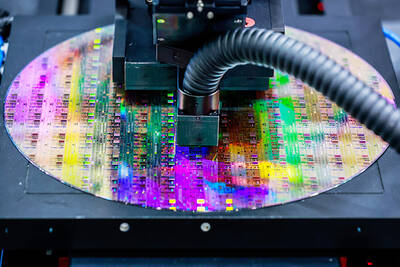
The artificial intelligence (AI) boom has triggered a seismic reshuffling of global equity markets, with Taiwan and South Korea muscling past European nations one by one. With its stock market now valued at nearly US$4.3 trillion, Taiwan surpassed the UK, Europe’s biggest market, earlier this month, data compiled by Bloomberg showed. South Korea is about US$140 billion away from doing the same. The tech-heavy Asian markets have shot past Germany and France in the past seven months. The shift is largely down to massive gains in shares of three companies that provide essential hardware for AI: Taiwan Semiconductor Manufacturing Co (TSMC, 台積電),

Shares of Taiwan Semiconductor Manufacturing Co (TSMC, 台積電) have repeatedly hit new highs, but an equity analyst said the stock’s valuation remains within a reasonable range and any pullback would likely be technical. The contract chipmaker’s historical price-to-earnings (P/E) ratio has ranged between 20 and 30, Cathay Futures Consultant Co (國泰證期) analyst Tsai Ming-han (蔡明翰) told Central News Agency. With market consensus projecting that TSMC would post earnings per share of about NT$100 (US$3.17) this year, supported by strong global demand for artificial intelligence (AI) applications, and the stock currently trading at a P/E ratio of below 25, Tsai said the valuation


 RSS
RSS