


Oil prices rose to near US$113 a barrel yesterday in Asia after Libyan rebels said they would not produce crude for at least a month as they repair fields damaged by fighting.
Benchmark crude for June delivery was up US$0.52 at US$112.81 a barrel at late afternoon in Singapore in electronic trading on the New York Mercantile Exchange.
Oil markets were closed on Friday for the Easter holiday. The June contract last settled up US$0.84 at US$112.29 on Thursday.
In London, Brent crude for June delivery was up US$0.37 to US$124.36 a barrel on the ICE Futures exchange.
Fighting between forces loyal to Libyan leader Muammar Qaddafi and rebels has shutdown almost all of the OPEC nation’s 1.6 million barrels a day of oil output and contributed to a 34 percent gain in crude prices since mid-February.
Rebels said on Sunday that they will need at least four weeks to fix equipment at the key Messla and Sarir oil fields in the rebel-controlled east.
Rising crude prices have pushed gasoline above US$4 a gallon in some US states. On Saturday, US President Barack Obama said the US must develop alternatives to fossil fuel and renewed calls to end US$4 billion in subsidies for oil and gas companies.
Traders are also closely watching this week for comments by the US Federal Reserve at its meeting tomorrow and the latest US GDP figures scheduled to be released on Thursday.
Last week, signs of growing oil consumption in China and an unexpected drop in US crude supplies helped lift prices to near two-and-a-half-year highs.
“We continue to note demand strength out of the emerging economies and a gradual tightening in US petroleum balances,” Ritterbusch and Associates said in a report. “We expect a run at the US$114 level [this week] with the market ultimately pushing up to around the US$119 area within about one month.”
In other Nymex trading in contracts for next month, heating oil rose US$0.02 to US$3.23 a gallon and gasoline was flat at US$3.31 a gallon. Natural gas futures were up US$0.01 at US$4.43 per 28.3m3.
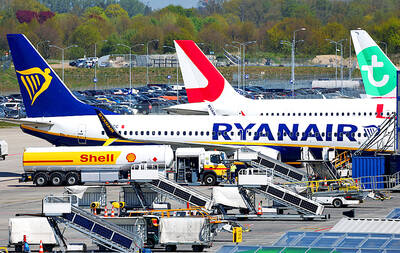
Ryanair, Transavia, Volotea and other low-cost airlines are feeling the financial pain from high jet fuel prices as a result of the Middle East war and are cutting flights. The closure of the Strait of Hormuz has taken a huge chunk of oil supplies off the market, sending the price of jet fuel soaring and triggering fears of shortages that could force airlines to cancel flights. Airlines are not waiting for a lack of supplies to react. “Travel alert: Airlines are cutting thousands of flights right now,” Travel Therapy host Karen Schaler said in an Instagram reel this past weekend.

MANAGING RISKS: Taiwan has secured LNG sufficient to cover 95 percent of electricity demand for next month, UBS said, describing the government’s approach as proactive UBS Group AG has raised its forecast for Taiwan’s economic growth this year to 8 percent, up from 6.9 percent previously, and said expansion could reach as high as 8.6 percent if external energy shocks are avoided. The upgrade reflects a stronger-than-expected first-quarter performance and sustained momentum in artificial intelligence (AI)-driven exports, which UBS said are providing a firm foundation for growth despite geopolitical and energy risks. Taiwan’s GDP expanded 13.69 percent year-on-year in the first quarter, the fastest growth since the second quarter of 1987, the Directorate-General of Budget, Accounting and Statistics (DGBAS) reported on Thursday. On a seasonally

The list of Asian stocks that benefit from business partnership with Nvidia Corp is getting longer, as the region further integrates into the artificial intelligence (AI) chip giant’s business ecosystem. Just in the past week, South Korea’s LG Electronics Inc, Taiwan’s Nanya Technology Corp (南亞科技), as well as China’s Huizhou Desay SV Automotive Co (德賽西威) and Pateo Connect Technology Shanghai Corp (博泰車聯) have become the latest to rally on news of tie-ups, supply-chain participation or product collaboration with the US chip designer. Asian suppliers account for about 90 percent of Nvidia’s production costs, up from about 65 percent last year, data compiled

UPBEAT: The chip designer expects its first AI ASIC project for a US hyperscaler to contribute US$2 billion in the fourth quarter, double its previous estimate MediaTek Inc (聯發科), the world’s largest mobile phone chip supplier, yesterday projected that revenue this year would grow by a mid-to-high-single-digit percentage, as robust demand for artificial intelligence (AI) accelerators would compensate for weakness in smartphone chips. The Hsinchu-based chip designer said the mobile chip segment is facing strong headwinds this year, with global smartphone shipments forecast to fall about 15 percent annually due to a memorychip supply crunch and rising prices. On the data center front, MediaTek said that with demand surging, it has significantly raised its revenue forecast for the global AI accelerator market to between US$70 billion and US$80


 RSS
RSS