


US stocks rose for a second week, sending benchmark indexes to 32-month highs, as takeovers, a rebound in retail sales and Egyptian President Hosni Mubarak’s resignation bolstered investors’ optimism.
American Express Co advanced 6.7 percent to lead gains in the Dow Jones Industrial Average. Walt Disney Co surged 6.6 percent as the world’s biggest theme-park operator posted higher-than-estimated quarterly profit. Standard & Poor’s 500 Index consumer companies reliant on Americans’ discretionary spending climbed 3.5 percent as confidence rose. NYSE Euronext soared 17 percent after saying it was in talks to be purchased by Germany’s Deutsche Boerse AG.
The tech-rich NASDAQ Composite hit a November 2007 high after rising 1.45 percent over the week to 2,809.44 points.
The S&P 500 rose 1.4 percent to 1,329.15. The Dow added 181.11 points, or 1.5 percent, to 12,273.26. Both have advanced to the highest levels since June 2008.
“While the economy is -doing well and CEOs are becoming more optimistic, the highlight of the week for us was the geopolitical events in Egypt, which couldn’t have worked out much better,” said Philip Orlando, New York-based chief equity market strategist at Federated Investors Inc, which manages US$358.2 billion. “M&A continues to be a positive for the market.”
The S&P 500 has advanced 5.7 percent this year as better-than-forecast economic data and company earnings boosted confidence in the economic recovery, while the US Federal Reserve continued its program of buying US$600 billion in Treasuries. There have been 2,707 takeovers announced globally this year, totaling US$226.2 billion, a 21 percent increase from the US$186.9 billion in the same period last year, according to data compiled by Bloomberg.
Federal Reserve Chairman Ben Bernanke said this week the economic recovery has strengthened while unemployment will remain high “for some time.” His comments back speculation the central bank is waiting for further proof of a durable pickup in the job market as it presses ahead with its quantitative easing plan.
Initial claims for unemployment insurance fell to the lowest since July 2008. First-time applications for jobless benefits dropped by 36,000 to 383,000, less than the 410,000 projected by economists in a Bloomberg survey.
Stocks erased their losses on Friday as Mubarak said he would step down as president of Egypt and handed power to the military, bowing to the demands of protesters that have occupied central Cairo for the past three weeks demanding an end to his 30-year rule. The Market Vectors Egypt Index ETF, an exchange-traded fund that holds Egyptian shares, rallied following the announcement and posted a weekly gain of 4.2 percent.
“The noise coming out of Egypt as of this moment anyway has not disrupted global trade production, the US economy or credit markets to unseat what’s been a fairly -decent market for risk assets,” said Kevin Caron, a market strategist in Florham Park, New Jersey, at Stifel Nicolaus & Co, which has about US$90 billion in client assets.
US retail sales increased 2.2 percent in the week ended Feb. 5 after four straight declines, the International Council of Shopping Centers said. The numbers are based on the ICSC-Goldman Sachs Weekly Chain Store Sales Index. The Thomson Reuters/-University of Michigan preliminary index of consumer sentiment for the month climbed to 75.1 from 74.2 in January, the highest level in eight months as decreasing unemployment lifted Americans’ spirits.
More than 73 percent of the 348 companies in the S&P 500 that reported results since Jan. 10 have topped analysts’ per-share profit predictions, according to data compiled by Bloomberg. Confidence among US small companies rose last month to the highest level in three years, as the outlook for sales and profits improved, a survey from the National
Whole Foods Market Inc soared 13 percent to US$59.67. The largest US natural-goods grocer raised its annual forecasts, buoyed by freer-spending consumers prepared to pay for healthy food. Whole Foods projected as much as US$1.80 a share in earnings this year, compared with a previous estimate of up to US$1.71.
Cisco Systems Inc tumbled 15 percent, the most for a week since November, to US$18.70. The company’s gross margin, the percentage of profit left after subtracting production costs, slid to 62.4 -percent in the period that ended Jan. 29. That missed the 63.3 percent average estimate of analysts surveyed by Bloomberg.
Traders face a lively calendar of economic news that kicks off tomorrow with US President Barack Obama’s the next fiscal year’s budget plan, giving investors fodder to chew on the potential direction of the economy.
Data on retail sales last month follows on Tuesday. Analysts forecast sales rose despite severe winter weather in broad swaths of the country.
The minutes of the Federal Reserve’s last policy-setting meeting, to be published on Wednesday, were expected to confirm the central bank’s cautious outlook on the nascent economic recovery.

HSBC Holdings PLC is deepening its commitment to Taiwan as the economy emerges as one of the bank’s fastest-growing markets globally, driven by an artificial intelligence (AI) investment boom, expanding cross-border trade, and rising wealth creation. “The advantage that Taiwan has is a growth story linked to the semiconductor and broader AI industries, strong underlying corporate performance, and wealth creation,” said Surendra Rosha, HSBC’s co-chief executive for Asia and the Middle East, in an exclusive interview with the Taipei Times on June 2, during this year’s HSBC Taiwan Conference. That combination has helped HSBC cement its position as the most profitable international
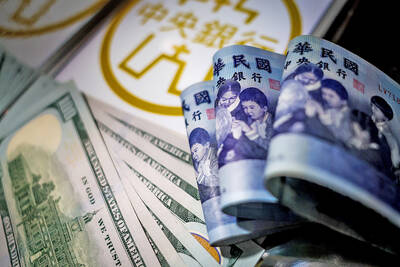
The New Taiwan dollar yesterday fell sharply against the US dollar to close at its lowest level since May 22 amid a massive outflow of funds from the country because of investors panicking over global equity markets. The NT dollar ended at NT$31.580 against the US dollar, slightly lower than its close of NT$31.568 on May 22, after moving between NT$31.5 and NT$31.648 on combined turnover of US$3.062 billion on the Taipei Foreign Exchange and the Cosmos Foreign Exchange. The NT dollar received a significant hit in the morning session, slumping as much as NT$0.173 at a time when other Asian currencies
Taiwan Semiconductor Manufacturing Co (TSMC, 台積電) is now ranked ninth among the world’s 100 most valuable companies after its market capitalization more than doubled over the past year, PricewaterhouseCoopers (PwC) Taiwan said in a report last month. TSMC’s market capitalization surged 101 percent year-on-year to US$1.427 trillion as of March 31, the accounting and consulting firm’s 2026 Global Top 100 Companies by Market Capitalization report said. The gain catapulted the world’s largest contract chipmaker from 12th place to ninth in the rankings, and it was the fastest-growing among the global top 10, it said. TSMC was the only Taiwanese company among the top
Taiwan Semiconductor Manufacturing Co (TSMC, 台積電) yesterday reported record revenue of NT$416.975 billion (US$13.17 billion) for last month, putting the world’s largest contract chipmaker on track to set a record for quarterly revenue. Last month’s figure surpassed March’s record NT$415.19 billion and represented increases of 1.5 percent from April and 30.1 percent from a year earlier. For the first five months of the year, TSMC generated NT$1.96 trillion in revenue, up 30 percent year-on-year, it said in a statement. TSMC has forecast second-quarter revenue of between US$39 billion and US$40.2 billion, representing sequential growth of about 10 percent and year-on-year growth of about


 RSS
RSS