


Since the early-harvest list for the Economic Cooperation Framework Agreement (ECFA) took effect on Jan. 1, about 1,500 product origin certificates have been issued, mostly in the petrochemical sector, the Bureau of Foreign Trade (BOFT) said.
To enjoy reduced tariffs before exporting goods to China, Taiwanese companies are required to file applications via the bureau to obtain the certificates needed to prove that their goods originate in Taiwan.
Likewise, Chinese firms must apply for the certificates with Chinese authorities before exporting to Taiwan.
The process is similar to the product origin certificates that Taiwanese enterprises are currently required to obtain if they want to export to Guatemala, Panama, Nicaragua, Honduras and El Salvador, all of which have free-trade agreements with Taiwan.
The bureau issued nearly 1,500 product origin certificates last month, the Central News Agency (CNA) reported yesterday, citing bureau officials.
The majority of applicants are from the petrochemical and machinery sectors, while some are from the agriculture and textile sectors, the bureau said.
Bureau of Foreign Trade -Director-General Bill Cho (卓士昭) said last month the certificate applications would normally take one day to process.
However, he said quite a number of applications had been rejected for technical reasons, such as a failure to submit supplementary documents or forms that were filled out incorrectly — which he said was a common problem because the ECFA certificate process is new to applicants.
Cho also said that bureau is holding multiple road shows across northern, central and southern parts of the nation to boost awareness of ECFA’s product origin certificates.
There is also a service section available on the ECFA’s Web site (www.ecfa.org.tw) for companies to seek help with the certificate application process, he said.
CNA also reported that the bureau has received feedback from some enterprises that hoped the certification would be extended to Taiwanese firms registered in the Cayman Islands.
However, the bureau said this request could not be fulfilled because the ECFA only covers companies registered in Taiwan or in China.
Under early-harvest provisions, China has agreed to gradually lower tariffs on 539 categories of imports from Taiwan, with an -estimated value of US$13.8 billion a year. Beijing also agreed to open 11 service categories and 18 farming and fishery categories to tariff reductions.
Chinese exporters will get a reciprocal deal on 267 items, with an estimated value of US$2.9 billion annually.
The government said the ECFA would help create 260,000 jobs in Taiwan and boost economic growth by as much as 1.7 percent, adding that the ECFA was crucial to ensure Taiwan was not marginalized following the creation of ASEAN Plus Three (ASEAN plus China, Japan and South Korea).

HSBC Holdings PLC is deepening its commitment to Taiwan as the economy emerges as one of the bank’s fastest-growing markets globally, driven by an artificial intelligence (AI) investment boom, expanding cross-border trade, and rising wealth creation. “The advantage that Taiwan has is a growth story linked to the semiconductor and broader AI industries, strong underlying corporate performance, and wealth creation,” said Surendra Rosha, HSBC’s co-chief executive for Asia and the Middle East, in an exclusive interview with the Taipei Times on June 2, during this year’s HSBC Taiwan Conference. That combination has helped HSBC cement its position as the most profitable international
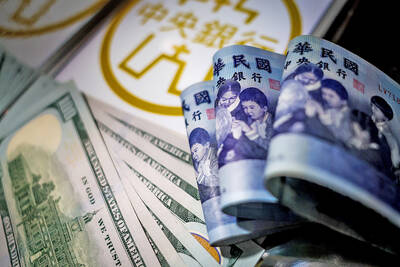
The New Taiwan dollar yesterday fell sharply against the US dollar to close at its lowest level since May 22 amid a massive outflow of funds from the country because of investors panicking over global equity markets. The NT dollar ended at NT$31.580 against the US dollar, slightly lower than its close of NT$31.568 on May 22, after moving between NT$31.5 and NT$31.648 on combined turnover of US$3.062 billion on the Taipei Foreign Exchange and the Cosmos Foreign Exchange. The NT dollar received a significant hit in the morning session, slumping as much as NT$0.173 at a time when other Asian currencies
Taiwan Semiconductor Manufacturing Co (TSMC, 台積電) is now ranked ninth among the world’s 100 most valuable companies after its market capitalization more than doubled over the past year, PricewaterhouseCoopers (PwC) Taiwan said in a report last month. TSMC’s market capitalization surged 101 percent year-on-year to US$1.427 trillion as of March 31, the accounting and consulting firm’s 2026 Global Top 100 Companies by Market Capitalization report said. The gain catapulted the world’s largest contract chipmaker from 12th place to ninth in the rankings, and it was the fastest-growing among the global top 10, it said. TSMC was the only Taiwanese company among the top
Taiwan Semiconductor Manufacturing Co (TSMC, 台積電) yesterday reported record revenue of NT$416.975 billion (US$13.17 billion) for last month, putting the world’s largest contract chipmaker on track to set a record for quarterly revenue. Last month’s figure surpassed March’s record NT$415.19 billion and represented increases of 1.5 percent from April and 30.1 percent from a year earlier. For the first five months of the year, TSMC generated NT$1.96 trillion in revenue, up 30 percent year-on-year, it said in a statement. TSMC has forecast second-quarter revenue of between US$39 billion and US$40.2 billion, representing sequential growth of about 10 percent and year-on-year growth of about


 RSS
RSS