


When computer engineer Wan Jon Yew left Malaysia in 2005 for a job in Singapore, all he wanted was to work in the city state for a few years before going home. Now, he says, he will never return.
With a family, a home and a car, he now plans to settle in Singapore for good — one of many Malaysians stampeding abroad every year in a worrying “brain drain” the government is trying to reverse.
“I wouldn’t consider going back to Malaysia, I won’t look back. If I were ever going to leave Singapore, I would migrate to Australia,” said the 28-year-old, who now has permanent resident status.
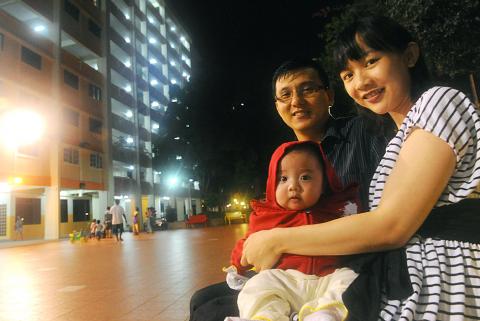
PHOTO: AFP
“It’s not about the money. I could have a better quality of life in Malaysia with my pay. I could have a semi-detached bungalow and have a maid there, but I would rather live in a government flat in Singapore,” he said.
Wan, who is ethnically Chinese, is one of some 700,000 Malaysians — most of them highly educated — who are currently working abroad in an exodus that Malaysian Prime Minister Najib Razak’s government is struggling to reverse.
The “brain drain” has a number of causes. Some have been lured by higher salaries, but others blame political and social gripes including preferential policies for Muslim Malays, who form the majority.
Many feel constrained by life in a country where the ruling coalition has been in power for half a century, and where progress on freedom of expression, the right to assembly, and tackling corruption has been slow.
A decades-old affirmative action policy which hands Malays and the indigenous groups privileges in housing, education and business, has been criticized as uncompetitive and improperly benefiting the elite.
As a consequence, many of those who have left are members of Malaysia’s ethnic Chinese and Indian minorities, who make up some 25 percent and 10 percent of the population respectively.
Last month Najib launched a “Talent Corporation” with incentives to woo back highly skilled workers and foreign professionals.
Malaysia has ambitions to transform itself into a developed nation by 2020, but a lack of human capital is a barrier to reaching that goal.
World Bank data cited by the Malaysian press shows that while globally the number of migrants rose 2.4 times between 1960 and 2005, Malaysia’s diaspora registered a staggering 155-fold increase over the 45-year period.
“I don’t want my children to go through the unfair treatment,” said Wan, who believes Singapore offers “fair competition.”
“I’m not proud of being a Malaysian because I think the government doesn’t treat me as a Malaysian,” he said. “I would rather be a PR [permanent resident], a second-class citizen in a foreign country, than to be a citizen in my own country.”
Wan said his wife, an IT analyst, renounced her citizenship in July, joining a queue of about 30 Malaysians lining up to do so on that day alone at the Malaysian embassy in Singapore.
Commentators are skeptical over whether the government’s latest effort to reverse the “brain drain” will be successful.
“Money does have a significant role but the most important factor, I think, is opportunity. Malaysia is too politicized and opportunities are not evenly available to everyone,” political analyst Wan Saiful Wan Jan said.
In one example, he said academics are reluctant to work in local universities as they must sign a “loyalty pledge” barring them from, among other things, criticizing government policies.
Wan Saiful said the Talent Corporation will be “another expensive failure” if it does not tackle these structural problems.
“When I apply for a job, buy a house, register my children for school etc, why does it matter what my race or religion is? This should stop,” the analyst said.

CHIP RACE: Three years of overbroad export controls drove foreign competitors to pursue their own AI chips, and ‘cost US taxpayers billions of dollars,’ Nvidia said China has figured out the US strategy for allowing it to buy Nvidia Corp’s H200s and is rejecting the artificial intelligence (AI) chip in favor of domestically developed semiconductors, White House AI adviser David Sacks said, citing news reports. US President Donald Trump on Monday said that he would allow shipments of Nvidia’s H200 chips to China, part of an administration effort backed by Sacks to challenge Chinese tech champions such as Huawei Technologies Co (華為) by bringing US competition to their home market. On Friday, Sacks signaled that he was uncertain about whether that approach would work. “They’re rejecting our chips,” Sacks

NATIONAL SECURITY: Intel’s testing of ACM tools despite US government control ‘highlights egregious gaps in US technology protection policies,’ a former official said Chipmaker Intel Corp has tested chipmaking tools this year from a toolmaker with deep roots in China and two overseas units that were targeted by US sanctions, according to two sources with direct knowledge of the matter. Intel, which fended off calls for its CEO’s resignation from US President Donald Trump in August over his alleged ties to China, got the tools from ACM Research Inc, a Fremont, California-based producer of chipmaking equipment. Two of ACM’s units, based in Shanghai and South Korea, were among a number of firms barred last year from receiving US technology over claims they have

It is challenging to build infrastructure in much of Europe. Constrained budgets and polarized politics tend to undermine long-term projects, forcing officials to react to emergencies rather than plan for the future. Not in Austria. Today, the country is to officially open its Koralmbahn tunnel, the 5.9 billion euro (US$6.9 billion) centerpiece of a groundbreaking new railway that will eventually run from Poland’s Baltic coast to the Adriatic Sea, transforming travel within Austria and positioning the Alpine nation at the forefront of logistics in Europe. “It is Austria’s biggest socio-economic experiment in over a century,” said Eric Kirschner, an economist at Graz-based Joanneum

OPTION: Uber said it could provide higher pay for batch trips, if incentives for batching is not removed entirely, as the latter would force it to pass on the costs to consumers Uber Technologies Inc yesterday warned that proposed restrictions on batching orders and minimum wages could prompt a NT$20 delivery fee increase in Taiwan, as lower efficiency would drive up costs. Uber CEO Dara Khosrowshahi made the remarks yesterday during his visit to Taiwan. He is on a multileg trip to the region, which includes stops in South Korea and Japan. His visit coincided the release last month of the Ministry of Labor’s draft bill on the delivery sector, which aims to safeguard delivery workers’ rights and improve their welfare. The ministry set the minimum pay for local food delivery drivers at


 RSS
RSS