


Ford Lio Ho Motor Co (福特六和), a Taiwanese subsidiary of the US-based Ford Motor Co, said yesterday it will roll out its 2 millionth car in the local market next week after 38 years in the country.
Ford Motor Group vice president and president for Asia-Pacific and Africa Joe Hinrichs, Minister of Economic Affairs Shih Yen--shiang (施顏祥) and Industrial Development Bureau Director-General Woody Duh (杜紫軍), will attend the ceremony to unveil the new car.
Ford Lio Ho, a 70 percent-owned subsidiary of the US car maker, is a joint venture with the Lio Ho Group. It was set up in 1972, and has become one of Ford Motor’s important overseas production bases, according to the local company.
The company said this year has special meaning for Ford Motor, as the number of cars it has produced in Taiwan will reach the 2 million mark, symbolizing the strong sales the automaker has generated locally.
In the first 10 months of this year, sales posted by Ford Lio Ho, which owns the Ford and Mazda brands in Taiwan, rose 29 percent from a year earlier, while sales of the Ford brand alone grew 20.1 percent year-on-year.
Last month, Ford Lio Ho accounted for 11 percent of the Taiwanese auto market, compared with 11.1 percent recorded a year earlier.
The Taiwanese unit said its 2 millionth car is a new Mondeo passenger model equipped with Ford Motor’s energy-efficient EcoBoost engine, which is being introduced into the Taiwanese market for the first time.
According to the company, the EcoBoost engine technology, which Ford Motor unveiled at the North American International Auto Show in 2008, delivers up to 20 percent better fuel economy and cuts carbon dioxide emissions by 15 percent.
Ford Lio Ho said more than 80 percent of its cars will be equipped with EcoBoost engines by 2013.
Meanwhile, Ford Motor is opening dozens of new dealerships in China as it expands its reach into provincial cities, courting new car buyers.
The automaker yesterday inaugurated 40 new dealerships out of 66 it will open before the end of the year in China. This year it plans to open a total of 100 dealerships there, raising the total number of outlets to 340.
China’s car market is the world’s biggest and sales are growing fastest in provincial cities where millions of new and potential car buyers live.
Ford is forecasting record sales for this year, though it got a later start and has a smaller presence in China than rival General Motors Co.

Netherlands-based semiconductor equipment supplier ASML Holding NV yesterday said that it is planning to hire an additional 1,000 people in Taiwan this year in response to growing demand from clients. ASML had previously planned to recruit 600 people this year, but that the plan has been adjusted upward, ASML vice president and ASML Taiwan general manager Grace Wang (汪佳慧) told reporters. ASML has a workforce of more than 4,500 in Taiwan, accounting for about 10 percent of its global total, Wang said. This year’s recruitment campaign would focus on adding people in the customer support, manufacturing and supply chain domains to assist ASML
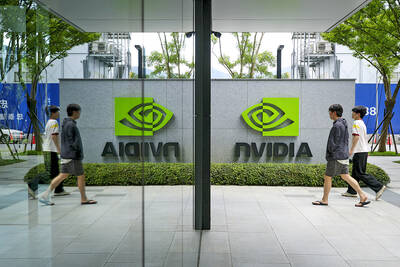
UNDER MICROSCOPE: Taiwan detained three people who allegedly conspired to buy servers in Taiwan and export them using fraudulent documentation, prosecutors said Nvidia Corp chief executive officer Jensen Huang (黃仁勳) on Saturday urged Super Micro Computer Inc to tighten up on compliance after Taiwan detained three people this week for allegedly making fraudulent declarations about artificial intelligence (AI) servers made by its US partner. The development marked the nation’s first crackdown on semiconductor smuggling, which grew after the US slapped restrictions on exports of high-end chips such as Nvidia AI accelerators to China. Nvidia is “rigorous” in explaining regulations to all of its partners, Huang told reporters after arriving in Taipei. “Ultimately Super Micro has to run their own company,” he said in response to
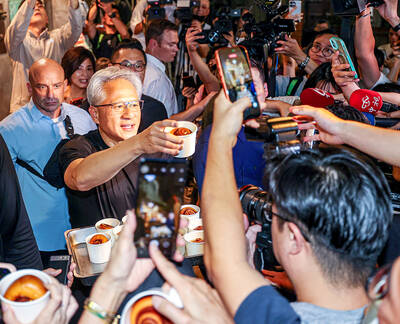
Nvidia Corp yesterday announced that CEO Jensen Huang (黃仁勳) would attend an employee meeting in Taipei tomorrow to celebrate the launch of the company’s Taiwan headquarters project. Huang would attend a gathering at the site of Nvidia’s planned headquarters in Beitou Shilin Technology Park (北投士林科技園區), the company said in a statement. After arriving in Taiwan on Saturday last week, Huang told reporters that he plans to meet with Quanta Computer Inc (廣達) chairman Barry Lam (林百里) and Taiwan Semiconductor Manufacturing Co (TSMC, 台積電) chairman C.C. Wei (魏哲家), and would attend the groundbreaking ceremony for Nvidia’s Taiwan headquarters tomorrow. Nvidia has not yet applied

Huawei Technologies Co (華為) said it has come up with a new pathway to shorten its gap with industry leader Taiwan Semiconductor Manufacturing Co (TSMC, 台積電), potentially achieving a breakthrough in making advanced semiconductors without cutting-edge equipment. Right now there is about a five-year gap between what TSMC is capable of and what Huawei, together with its manufacturing partner Semiconductor Manufacturing International Corp (中芯), can produce. Huawei is to start making 1.4-nanometer chips by 2031 with its own “LogicFolding” technology, Huawei semiconductor chief He Tingbo (何庭波) said in a rare public appearance during a chip conference yesterday, while TSMC has


 RSS
RSS