


German economic growth slowed in the third quarter, after record expansion in the second, as the cooling global recovery crimped export demand.
GDP adjusted for seasonal effects rose 0.7 percent from the second quarter, when it surged an upwardly revised 2.3 percent, the Federal Statistics Office in Wiesbaden said yesterday.
Economists predicted the economy would expand 0.8 percent, the median of 37 estimates in a Bloomberg News survey shows.
Separately, France said GDP rose 0.4 percent in the third quarter after a 0.7 percent gain in the second.
Germany is driving growth in the 16-nation euro area as debt-strapped countries such as Ireland, Portugal and Greece grapple with a loss of investor confidence in their ability to finance themselves. Germany’s economy, Europe’s largest, will expand 3.7 percent this year, the government’s council of economic advisers forecast this week. That would be the fastest growth rate since 1991.
“This is an incredible number for Germany,” Andreas Scheuerle, an economist at Dekabank in Frankfurt, said of the third-quarter report. “Consumption has picked up, investment is strong. What else do you want? We’re expanding at high speed and twice our potential.”
The statistics office said trade and investment as well as household and government spending all contributed to growth in the third quarter. GDP rose 3.9 percent from a year earlier.
In France, economic expansion also slowed in the third quarter as a surge in imports and a decline in manufacturing overshadowed increasing household spending.
GDP rose 0.4 percent in the three months through September, down from the 0.7 percent gain in the previous quarter, Paris-based statistics office Insee said yesterday.
The growth was less than the median 0.5 percent forecast in a survey of 20 analysts by Bloomberg News. France’s GDP rose 1.8 percent from its level one year earlier.
So far, French consumer spending has supported the economy, limiting the drop in output during the recession relative to other countries.
“One of the consistent surprises for me has been the resilience of consumer spending,” said Joost Beaumont, an economist at ABN Amro in Amsterdam, adding that growth could moderate in the months ahead “as fiscal retrenchment as well as weak labor market conditions leave their mark.”
Meanwhile, Italy’s economy, the eurozone’s third largest, expanded less than economists expected in the three months through September, a sign that its export-led recovery from last year’s recession is losing momentum.
GDP rose 0.2 percent from the second quarter when it climbed 0.4 percent, Rome-based statistics institute Istat said in a preliminary report yesterday.
That was lower than the 0.4 percent economists forecast, according to the median of 21 estimates in a Bloomberg News survey. The economy expanded 1 percent from a year earlier.
The Dutch economy contracted 0.1 percent in the third quarter from the previous three months, the national statistics bureau in The Hague said on its Web site.
Taiwan Semiconductor Manufacturing Co (TSMC, 台積電) yesterday reported record revenue of NT$416.975 billion (US$13.17 billion) for last month, putting the world’s largest contract chipmaker on track to set a record for quarterly revenue. Last month’s figure surpassed March’s record NT$415.19 billion and represented increases of 1.5 percent from April and 30.1 percent from a year earlier. For the first five months of the year, TSMC generated NT$1.96 trillion in revenue, up 30 percent year-on-year, it said in a statement. TSMC has forecast second-quarter revenue of between US$39 billion and US$40.2 billion, representing sequential growth of about 10 percent and year-on-year growth of about
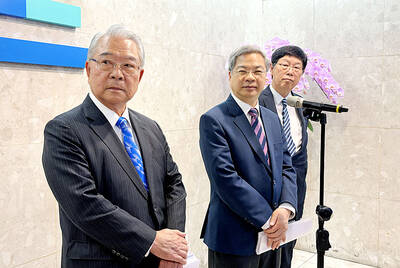
PATENT PROBE: US lawmakers called for a ban on imports of chips made by TSMC if they are found to infringe on US patents, with a preliminary ruling expected soon Minister of Economic Affairs Kung Ming-hsin (龔明鑫) yesterday expressed confidence in Taiwan Semiconductor Manufacturing Co’s (TSMC, 台積電) compliance with patent regulations after reports linked the company to a patent infringement lawsuit in the US. US Representative Ryan Zinke, and US senators Tim Sheehy, Roger Marshall and Bernie Moreno urged the US International Trade Commission in a May 22 letter to ban imports of chips made by TSMC if they are found to infringe on US patents, Axios reported on Wednesday. An administrative law judge is expected to issue a preliminary ruling this month, with the commission potentially making a final decision in

Infineon Technologies AG is preparing to open its largest single investment, a 5 billion euro (US$5.8 billion) semiconductor factory built with the help of EU subsidies, as the bloc seeks to boost chip production. The power chip fab, which is an extension of the German company’s Dresden campus, is scheduled to open on July 2, Infineon chief operating officer Alexander Gorski said this week at the site. The project is a major recipient of EU Chips Act funds, receiving about 1 billion euros in subsidies. The new plant represents a rare success for the bloc’s flagship semiconductor law, which was drawn up during

Taiwanese authorities are considering much stricter export controls on artificial intelligence (AI) chip sales to China to further align with US measures, according to people familiar with the matter, an effort to address semiconductor smuggling that risks drawing a rebuke from Beijing. The idea is to give authorities more legal tools to address diversion of advanced hardware, like AI servers with Nvidia Corp chips, from Taiwan to China. Such sales are already banned under US regulations unless companies get Washington’s permission, per curbs the US first imposed in 2022 to prevent Beijing from using advanced Nvidia processors to gain a military


 RSS
RSS