


The US claimed victory on Friday in a trade dispute with China, after a WTO panel largely upheld tariffs that were imposed on an array of Chinese-made steel pipes, tires and other products during former US president George W. Bush’s administration.
China had used a number of technical arguments in a September 2008 challenge to anti-dumping duties, which are supposed to compensate for unfair pricing and countervailing duties that are used to offset improper government subsidies. However, a WTO dispute settlement panel rejected most of those arguments.
The Bush administration announced levies on US$200 million worth of steel pipe shipments from China, South Korea and Mexico in July 2008, a month after imposing similar countervailing duties involving a different kind of steel pipe.
US President Barack Obama’s administration has defended those decisions.
“This is a significant win for American workers and businesses affected by unfairly traded imports,” US Trade Representative Ron Kirk said. “This case makes clear that the Obama -administration, -including USTR [Office of the US Trade Representative] and our colleagues at the Department of Commerce, will vigorously defend the application of our trade remedy laws.”
The duties that were upheld on Friday had been imposed on a variety of specialized goods: circular welded pipe, certain pneumatic off-road tires, light-walled rectangular pipe and tube and laminated woven sacks.
The ruling comes at a time of increasing tensions over currency and trade between China and the US. The Obama administration has agreed to investigate a complaint brought by the United -Steelworkers over China’s support for its clean energy industries, and it is concerned about Chinese efforts to block exports shipments of valuable minerals known as rare earths.
“These findings are especially important at a time when the United States is vigorously implementing WTO-consistent tools to address China’s unfair trade practices and to address global imbalances,” said Representative Sander Levin, one of the most outspoken House members on China’s decision to hold down the value of the yuan. “We should not let the possibility of meritless allegations of WTO inconsistency prevent us from standing up for US workers and businesses.”
The WTO panel was established in January last year and held hearings in July and November of that year. Both China and the US have up to 60 days to appeal the panel’s ruling, which ran to 283 pages and was published on the Web site of the WTO.
In a separate case, the US International Trade Commission, an independent federal agency that assesses whether imports unfairly damage US industry, on Friday authorized the Commerce Department to impose both antidumping and countervailing duties on coated paper that is used in sheet-fed presses from China and Indonesia.
The commission found that the presses, which are used to produce high-quality graphics, had been -unfairly subsidized and sold in the US at less than market value. Senator Sherrod Brown, who had submitted testimony to the trade commission in the coated-paper case, applauded the ruling.
“American producers face an inexcusable flood of dumped Chinese paper — subsidized from 10 to 15 percent of product cost,” he said after meeting with workers at Smart Papers, a coated-paper manufacturer in Hamilton, Ohio.
Brown said the decision “shows why rigorous trade law enforcement is critical to the economic security of our workers and viability of domestic manufacturing,” but he also argued that China’s currency policies should be considered in future trade remedy cases.
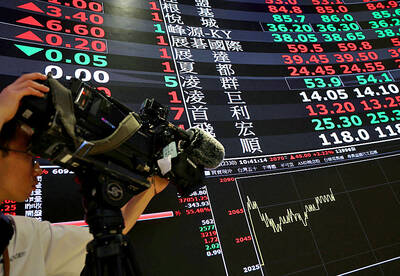
After several years flying high as Asia’s best Nvidia Corp proxy, Taiwan Semiconductor Manufacturing Co (TSMC, 台積電) is increasingly vying with other artificial intelligence (AI) stocks for investor attention. Stock traders are chasing a wider array of beneficiaries as mainstream usage of AI creates demand for hardware beyond the most-advanced chips TSMC makes for Nvidia. Subthemes from the deepening memory crunch to advances in robotics are also luring bids. At the same time, investment caps on single stocks are pushing funds to diversify, while retail investors long familiar with TSMC through its US depositary receipts are being offered a broader set of
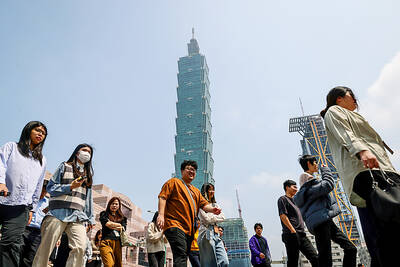
TECH RELIANCE: Growth is increasingly reflecting an unequal K-shaped distribution, where technology sectors outperform and other industries struggle, an expert said Standard Chartered Bank has significantly raised its forecast for Taiwan’s economic growth to 9.5 percent this year, up from 7.6 percent previously, citing surging artificial intelligence (AI) demand driving exports, semiconductor production and investment. The upgrade reflects a sustained AI supercycle that continues to fuel demand for advanced chips and technology infrastructure, which form the backbone of Taiwan’s exports, the bank said in a report this week. “We raise our 2026 growth forecast to reflect a much stronger-than-expected first-quarter GDP figure,” Standard Chartered senior economist for greater China and Asia Tommy Wu (胡東安) said in the report. Driven largely by a 35.3 percent
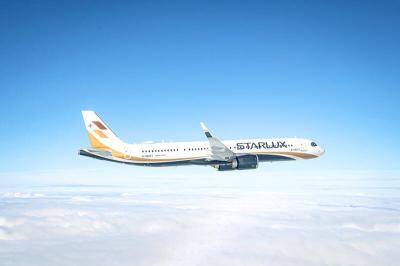
Two of Taiwan’s international carriers, Starlux Airlines Co (星宇航空) and EVA Airways Corp (長榮航空), have retained the five-star airline rating awarded by international airline review organization Skytrax. Starlux was awarded the distinction for a second consecutive year, while EVA Air received it for the 11th straight year, Skytrax said in statements released yesterday and on Thursday last week, respectively. The five-star rating is considered one of the airline industry's highest honors and is awarded following professional audits of airline product and frontline service standards, Skytrax said. The ratings are based on in-depth assessments using unified global quality standards rather than customer review scores
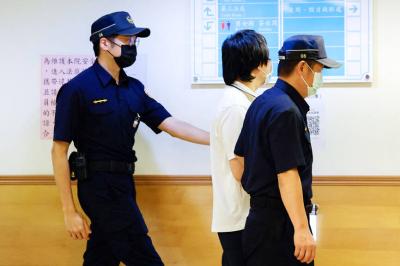
Tokyo Electron's Taiwan unit today said in a written response that it respects the judicial process, takes the court ruling seriously and would not appeal in the Taiwan Semiconductor Manufacturing Co (TSMC, 台積電) trade secrets case. Last month, a court fined the Taiwan unit of Japan's Tokyo Electron NT$150 million (US$4.74 million) in a case involving trade secrets related to TSMC's sensitive chip technology.


 RSS
RSS