


An official with Taiwan’s top financial regulator on Saturday dismissed market speculation that more foreign life insurance companies will pull out of Taiwan, after some of their branches said publicly they were not for sale.
“According to our initial understanding, there will be no walkout as speculated,” said Wu Chung-chuan (吳崇權), deputy director-general of the Financial Supervisory Commission’s Insurance Bureau.
“Some Taiwanese branches of foreign insurance companies in Taiwan told us voluntarily that there are no plans for their sale,” he told reporters in a telephone interview, but he declined to identify the companies’ names.
Wu also dismissed a media report that the bureau would arrange a number of meetings with executives of these Taiwanese branches next week to ask the companies to stay in the country.
The most recent round of speculation has focused on New York Life Insurance Taiwan Corp as the next branch of a foreign life insurer to be sold, but New York Life Insurance Taiwan dismissed the speculation in a statement released on Friday.
“Since its establishment 17 years ago, New York Life Insurance Taiwan has been receiving the support of its parent company, New York Life Insurance Co,” Danny Lam (林順財), the chief executive officer of the life insurer, said in the statement.
Lam said New York Life Insurance Taiwan is financially stable and will intensify its efforts to expand its market share in Taiwan.
Prudential Life Insurance Company of Taiwan, a unit of US-based Prudential Financial Inc, also denied that it would be sold, reports said on Saturday.
A number of foreign insurers, including ING Antai Life Insurance Co, have withdrawn from Taiwan’s market in the past two years.
Many were saddled with guaranteed-return policies sold when interest rates were higher and have struggled in Taiwan’s low interest rate spread environment. New accounting rules requiring insurers to increase their reserve funds have also been blamed for the exodus.
Other foreign life insurers that have left Taiwan over the past 18 months include UK-based Prudential PLC, Aegon NV of the Netherlands and US-based MetLife Inc, which announced the sale of its Taiwan business to Waterland Financial Holdings Co (國票金控) on April 19.
American International Group Inc sold Nan Shan Life Insurance Co (南山人壽) late last year to Hong Kong-based investment companies Primus Financial Holdings Ltd (博智金控) and China Strategic Holdings Ltd (中策集團), but the sale has yet to receive regulatory approval.
SECOND-RATE: Models distilled from US products do not perform the same as the original and undo measures that ensure the systems are neutral, the US’ cable said The US Department of State has ordered a global push to bring attention to what it said are widespread efforts by Chinese companies, including artificial intelligence (AI) start-up DeepSeek (深度求索), to steal intellectual property from US AI labs, according to a diplomatic cable. The cable, dated Friday and sent to diplomatic and consular posts around the world, instructs diplomatic staff to speak to their foreign counterparts about “concerns over adversaries’ extraction and distillation of US AI models.” Distillation is the process of training smaller AI models using output from larger, more expensive ones to lower the costs of training a powerful new
Shares of Taiwan Semiconductor Manufacturing Co (TSMC, 台積電) have repeatedly hit new highs, but an equity analyst said the stock’s valuation remains within a reasonable range and any pullback would likely be technical. The contract chipmaker’s historical price-to-earnings (P/E) ratio has ranged between 20 and 30, Cathay Futures Consultant Co (國泰證期) analyst Tsai Ming-han (蔡明翰) told Central News Agency. With market consensus projecting that TSMC would post earnings per share of about NT$100 (US$3.17) this year, supported by strong global demand for artificial intelligence (AI) applications, and the stock currently trading at a P/E ratio of below 25, Tsai said the valuation
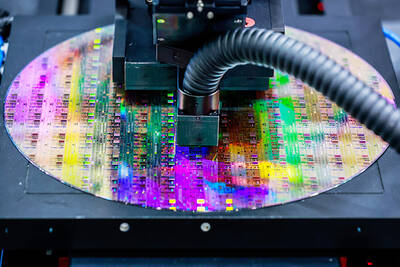
The artificial intelligence (AI) boom has triggered a seismic reshuffling of global equity markets, with Taiwan and South Korea muscling past European nations one by one. With its stock market now valued at nearly US$4.3 trillion, Taiwan surpassed the UK, Europe’s biggest market, earlier this month, data compiled by Bloomberg showed. South Korea is about US$140 billion away from doing the same. The tech-heavy Asian markets have shot past Germany and France in the past seven months. The shift is largely down to massive gains in shares of three companies that provide essential hardware for AI: Taiwan Semiconductor Manufacturing Co (TSMC, 台積電),
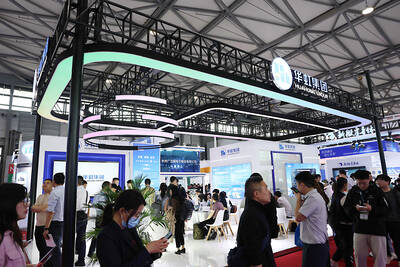
The US Department of Commerce last week ordered multiple chip equipment companies to halt shipments of certain tools to China’s second-largest chipmaker, Hua Hong Semiconductor Ltd (華虹半導體), its latest action to slow the country’s development of advanced chips, two people familiar with the matter said. The department sent letters to at least a handful of companies informing them of restrictions on tools and other materials destined for two Hua Hong facilities US officials believe make China’s most sophisticated chips, the people said. Top US chip equipment companies Lam Research Corp, Applied Materials Inc and KLA Corp, each of which has significant


 RSS
RSS